Feeling unfulfilled at work is a common experience among ambitious professionals, especially when success feels disconnected from personal meaning. Exploring career purpose brings clarity to this dilemma, grounding professional life in personal values, passions, and continuous growth. Recent research confirms that purpose evolves over time and delivers substantial psychological benefits, including improved resilience and motivation. By understanding how Japanese philosophical concepts foster this alignment, you can begin to chart a work path that resonates deeply with your identity and aspirations.
Table of Contents
- Defining Career Purpose And Common Myths
- Core Benefits Of Finding Career Purpose
- How Personality And Values Shape Purpose
- Japanese Philosophy’s Role In Career Fulfillment
- Practical Steps And Common Pitfalls To Avoid
Key Takeaways
| Point | Details |
|---|---|
| Understanding Career Purpose | It represents a dynamic journey that integrates personal values, skills, and meaningful work, not a fixed endpoint. |
| Common Myths | Misconceptions such as equating purpose with job title hinder personal growth and career exploration. |
| Benefits of Purpose | A clear career purpose enhances resilience, motivation, and overall well-being beyond traditional metrics. |
| Practical Steps | Regular self-assessments and flexible career planning are essential to align evolving personal values with professional goals. |
Defining Career Purpose and Common Myths
Career purpose represents more than just professional trajectory - it’s a profound connection between personal values, skills, and meaningful work. Recent research on purpose-based career coaching demonstrates that purpose is not a static concept, but a dynamic journey of self-discovery and alignment.
Many professionals misunderstand the fundamental nature of career purpose, leading to several prevalent misconceptions:
- Purpose is a fixed destination, not an evolving path
- Career purpose equals financial success or job title
- Only certain professions can have meaningful work
- Purpose emerges automatically without intentional exploration
Career purpose actually involves integrating personal values, passions, and professional capabilities into a holistic approach to work. Research from Harvard Business Review highlights that true purpose transcends traditional career metrics, focusing instead on authentic personal alignment.
Here’s how common myths about career purpose compare to the actual reality:
| Myth | Misconception Impact | Reality |
|---|---|---|
| Purpose is fixed | Limits personal growth | Purpose evolves with experience |
| Purpose equals title | Promotes narrow success view | True purpose involves alignment |
| Only some jobs matter | Reduces opportunities | All professions offer meaning |
| Purpose is automatic | Hinders reflection | Requires active exploration |
Understanding career purpose requires recognizing it as a multifaceted concept involving:
- Personal values and intrinsic motivations
- Professional skills and competencies
- Potential for meaningful contribution
- Continuous personal growth and adaptation
Career purpose is not about finding the perfect job, but creating meaningful work that resonates with your core identity.
Professional development becomes most effective when individuals approach their careers as dynamic journeys of self-discovery, rather than rigid, predetermined paths. This perspective allows for flexibility, continuous learning, and genuine engagement with one’s professional life.
Pro tip: Conduct a quarterly self-assessment to realign your career purpose with your evolving personal and professional goals.
Core Benefits of Finding Career Purpose
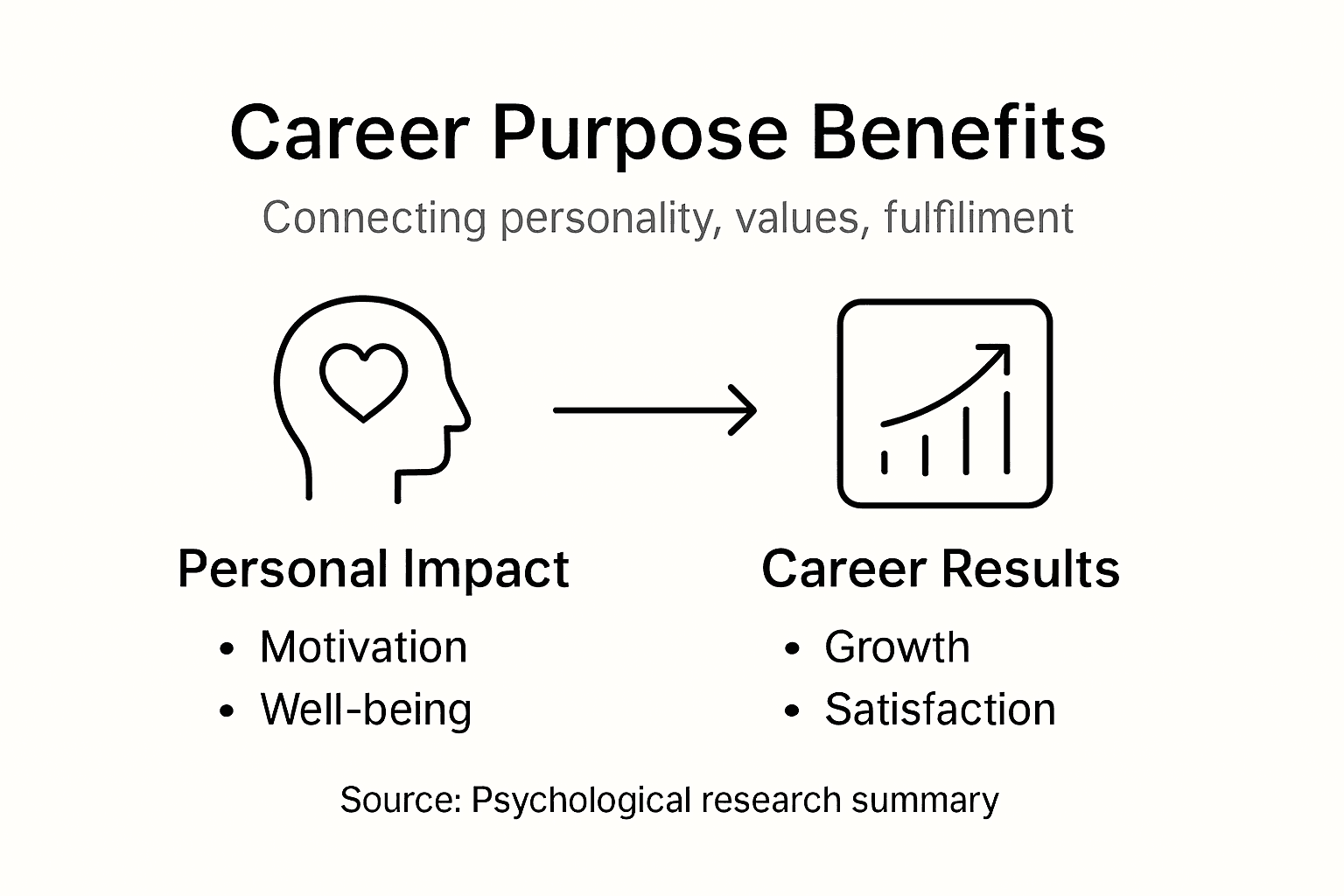
Career purpose is more than a professional goal - it’s a transformative approach to personal and professional development. Research demonstrates substantial benefits that extend far beyond traditional career expectations, impacting multiple dimensions of an individual’s life.
The core benefits of discovering and pursuing a meaningful career purpose include:
- Increased personal resilience and emotional strength
- Enhanced motivation and intrinsic job satisfaction
- Better stress management and psychological well-being
- Improved goal-setting and achievement capabilities
- Greater sense of personal and professional alignment
Academic research on purpose-driven motivation reveals that individuals with a clear career purpose exhibit remarkable psychological advantages. These professionals demonstrate higher levels of confidence, more effective decision-making skills, and a stronger capacity to navigate professional challenges.
Psychological resilience emerges as a critical benefit of understanding one’s career purpose. When professionals connect their work to deeper personal meanings, they develop:
- Enhanced emotional intelligence
- More adaptive problem-solving approaches
- Greater capacity for handling workplace uncertainties
- Sustained motivation during difficult professional periods
Purpose transforms work from a mere job into a meaningful life journey.
Beyond individual psychological benefits, career purpose also contributes to broader life satisfaction. Professionals who understand their core motivations tend to experience more fulfilling relationships, improved mental health, and a sense of continuous personal growth.
Pro tip: Create a personal mission statement that articulates your core professional values and desired impact, revisiting and refining it annually.
How Personality and Values Shape Purpose
Personal values are the fundamental building blocks of career purpose, serving as an internal compass that guides professional decision-making. Research on young adults’ career preferences reveals that these values are deeply intertwined with individual identity and professional aspirations.
People’s personality traits significantly influence their career purpose through several key mechanisms:
- Determining personal motivation levels
- Shaping approach to professional challenges
- Influencing decision-making capabilities
- Defining comfort with risk and innovation
- Establishing interpersonal work dynamics
Psychological research on personality traits demonstrates that different personality characteristics profoundly impact career trajectory. Specific traits like openness, conscientiousness, and emotional stability play crucial roles in how individuals perceive and pursue their professional purpose.

Key personality dimensions that shape career purpose include:
Below is a summary of how key personality traits influence your approach to purpose-driven careers:
| Personality Trait | Influence on Career Purpose | Typical Outcome |
|---|---|---|
| Openness | Embraces new opportunities | Greater adaptability |
| Emotional Stability | Handles stress effectively | Consistent motivation |
| Conscientiousness | Sets and achieves clear goals | Higher job satisfaction |
| Interpersonal Adaptability | Builds strong relationships | Collaborative work success |
- Openness to experience
- Emotional stability
- Conscientiousness
- Interpersonal adaptability
- Intrinsic motivation levels
Your personality is not a limitation, but a unique lens through which you can craft a meaningful career.
Psychological alignment occurs when personal values harmonize with professional goals, creating a powerful synergy that drives intrinsic motivation and career satisfaction. Understanding this connection allows professionals to design career paths that feel authentically meaningful and personally resonant.
Pro tip: Conduct a comprehensive self-assessment annually to understand how your evolving personality traits and values might reshape your career purpose.
Japanese Philosophy’s Role in Career Fulfillment
Japanese philosophical approaches to work transcend traditional Western career models, offering a holistic perspective on professional fulfillment. Ikigai research reveals profound insights into how cultural principles can transform our understanding of career purpose.
Key philosophical concepts that shape Japanese approach to career fulfillment include:
- Harmony between personal passion and professional contribution
- Emphasis on continuous personal development
- Integration of work with broader life meaning
- Respect for craftsmanship and skill mastery
- Balance between individual goals and community needs
Japanese work philosophy explores deep connections between professional identity and personal growth. The concept of Shigoto goes beyond mere employment, representing a holistic approach where work becomes a form of personal and societal expression.
Critical elements of Japanese career philosophy include:
- Viewing work as a form of personal artistry
- Prioritizing collective well-being over individual achievement
- Embracing lifelong learning and skill refinement
- Finding meaning through service and contribution
- Maintaining spiritual and professional alignment
Career fulfillment emerges not from external success, but from internal harmony and purposeful contribution.
Philosophical integration transforms career from a transactional experience to a meaningful journey of self-discovery and societal contribution. By adopting these principles, professionals can create more intentional, fulfilling career paths that extend beyond traditional performance metrics.
Pro tip: Practice ‘Kaizen’ by implementing small, continuous improvements in your professional skills and personal approach to work.
Practical Steps and Common Pitfalls to Avoid
Career purpose discovery requires strategic approaches and awareness of potential obstacles. Career development research offers structured guidance for professionals seeking meaningful career alignment and avoiding common missteps.
Key practical steps for identifying and pursuing career purpose include:
- Conducting comprehensive self-reflection exercises
- Mapping personal values to professional opportunities
- Creating flexible, adaptable career development plans
- Regularly reassessing career goals and motivations
- Seeking mentorship and external perspectives
Strategic career planning requires understanding the critical distinctions between passion, values, and purpose. Professionals often struggle by misinterpreting these interconnected yet distinct concepts.
Common pitfalls professionals should actively avoid:
- Confusing temporary passion with long-term purpose
- Neglecting personal values in career decisions
- Failing to adapt career strategies over time
- Avoiding necessary skill development
- Resisting periodic career reassessment
Purpose is not discovered overnight, but cultivated through intentional reflection and action.
Strategic navigation demands continuous learning and self-awareness. By understanding potential barriers and implementing deliberate career exploration techniques, professionals can create more meaningful and fulfilling career trajectories.
Pro tip: Develop a quarterly personal career review process to maintain alignment between your evolving values and professional goals.
Discover Your True Career Purpose with Ikigain.org
Many professionals feel stuck because they have not yet aligned their career with their core values and unique personality traits—a challenge highlighted in the article “Career Purpose Unlocking Fulfillment at Work.” If you struggle with finding meaningful work or worry about confusing passion with purpose this personalized journey can transform your professional life. Ikigain.org offers a scientifically-backed personality test deeply rooted in Japanese philosophy to help you identify your strengths passions and values so you can craft a career path that truly resonates with you.

Take control of your career and emotional well-being today by exploring the insightful tools and resources at Ikigain.org. Uncover your personal Ikigai and turn your work into a fulfilling life journey. Begin your transformation now at https://www.ikigain.org and experience the profound benefits of purpose-driven living.
Frequently Asked Questions
What is career purpose and why is it important?
Career purpose connects personal values and skills to meaningful work. It is vital because it drives motivation, enhances job satisfaction, and fosters personal and professional growth.
How can I identify my career purpose?
Identifying your career purpose involves self-reflection on your values, passions, and skills, as well as actively exploring different career options and seeking external perspectives through mentorship.
What are some common misconceptions about career purpose?
Common misconceptions include believing that purpose is a fixed destination, that it equates to a job title, that only certain professions can have meaning, and that purpose emerges automatically without exploration.
How can personality traits influence my career purpose?
Personality traits like openness, emotional stability, and conscientiousness shape how individuals approach their careers, impact motivation levels, and influence decision-making, ultimately guiding them toward their unique purpose.