Bold career moves and life transitions often spark questions about what truly guides your choices. For many, uncovering core values becomes a path to meaningful growth inspired by Japanese philosophies of self-reflection and harmony. Understanding that core values are not static or universal constructs empowers you to break free from limiting beliefs, tune into your personal journey, and gain practical tools for evolving your identity and professional fulfillment.
Table of Contents
- Core Values Defined And Common Myths
- Types Of Core Values And Examples
- Key Characteristics And Why They Matter
- How Core Values Shape Decisions And Fulfillment
- Steps To Discover Your Own Core Values
- Common Challenges And How To Stay Aligned
Key Takeaways
| Point | Details |
|---|---|
| Core values are dynamic | Core values evolve with personal growth and experiences, requiring ongoing reflection and realignment. |
| Types of core values | Understanding different categories of core values helps individuals navigate personal and professional identity effectively. |
| Decision-making influence | Core values serve as a guiding framework, enhancing satisfaction and fulfillment in decision-making processes. |
| Challenges in alignment | External pressures and unconscious habits can disrupt alignment; regular self-assessment is crucial for maintaining authenticity. |
Core values defined and common myths
Core values are deeply personal guiding principles that shape our decisions, behaviors, and sense of self. Unlike fleeting preferences, these fundamental beliefs form the ethical compass that directs our lives. Academic research on core values reveals they operate at multiple levels - from individual perspectives to broader societal contexts.
Contrary to popular misconception, core values are not static or universal constructs. They represent dynamic, evolving principles that transform with personal growth, experiences, and increased self-awareness. People often mistakenly believe core values are permanently fixed, when in reality they can shift and develop throughout different life stages.
Several common myths surrounding core values persist in personal development circles:
- Values are identical for everyone
- Core values never change
- Values can be easily adopted from external sources
- Personal values always align perfectly with professional expectations
Institutional research emphasizes that authentic core values require ongoing reflection and intentional alignment between individual beliefs and actions. This process demands continuous introspection and willingness to challenge existing assumptions about what truly matters to us.
Core values are not a destination but a continuous journey of self-discovery and personal growth.
Pro tip: Conduct a personal values audit every six months to track how your core principles are evolving and ensure they genuinely reflect your current life philosophy.
Types of core values and examples
Core values are not a one-size-fits-all concept but a rich tapestry of interconnected principles that guide human behavior across different domains. Psychological research on value categories reveals fifteen distinct families of values that encompass the complexity of human experience and motivation.
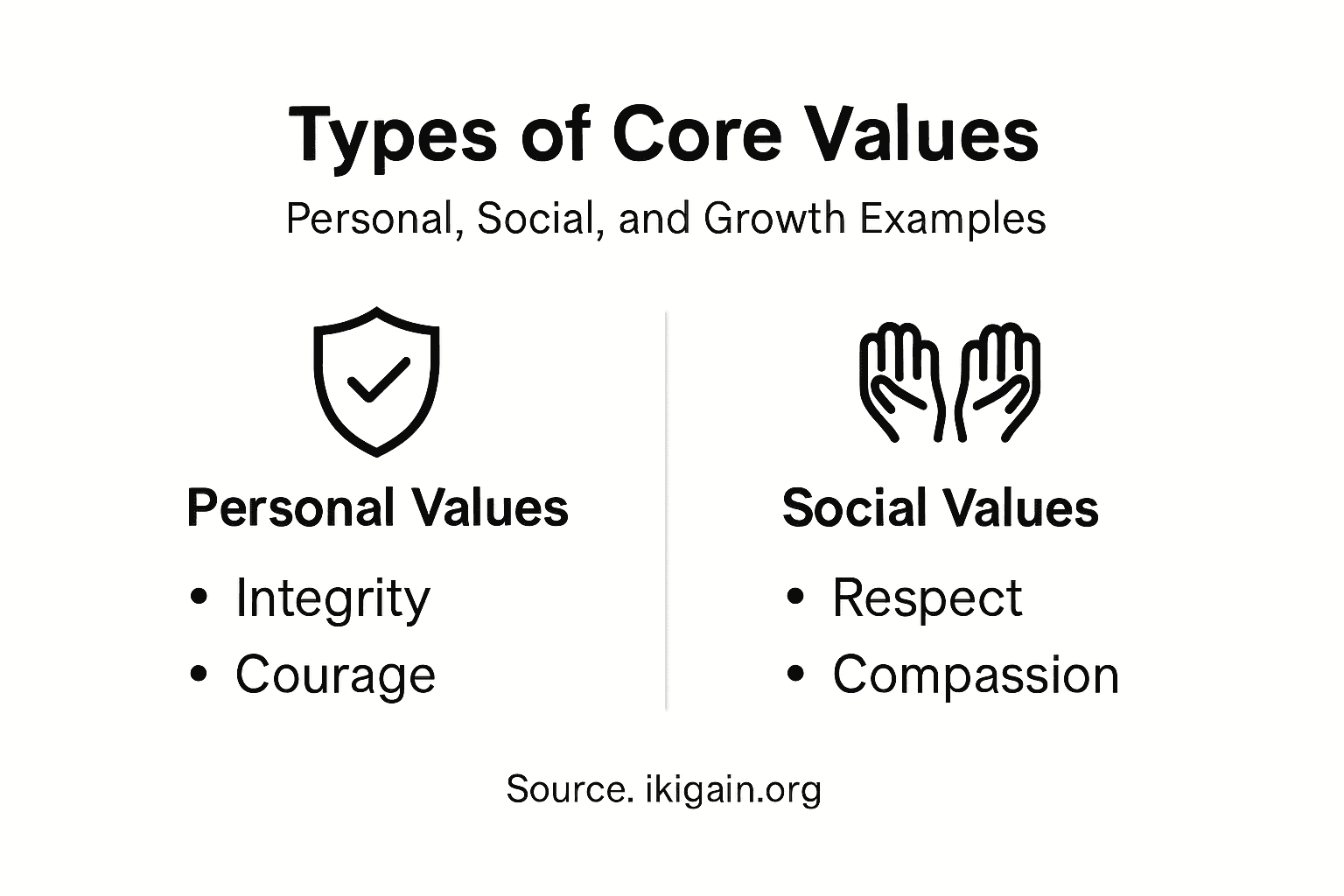
These value categories provide a comprehensive framework for understanding how individuals construct their personal and professional identities. The primary types of core values include:
- Personal Values: Individual beliefs about self-worth and personal development
- Social Values: Principles governing interactions and community relationships
- Professional Values: Ethical standards and behaviors in workplace contexts
- Moral Values: Fundamental principles of right and wrong
- Spiritual Values: Beliefs connecting individuals to deeper existential meanings
Behavioral science research highlights specific examples of core values that demonstrate how these principles manifest in everyday life. Concrete examples include accountability, authenticity, ambition, adaptability, and appreciation - each representing a unique approach to navigating personal and professional challenges.
Core values are the invisible architecture that shapes human potential and decision-making.
Understanding these value types allows individuals to develop a more nuanced approach to personal growth, recognizing that values are dynamic tools for self-improvement rather than rigid, unchangeable mandates.
Pro tip: Create a personal value map by identifying three core values in each category to gain deeper insights into your holistic belief system.
Here is a reference table summarizing core value categories and typical examples:
| Core Value Category | Defining Focus | Common Examples |
|---|---|---|
| Personal Values | Self-growth and identity | Integrity, ambition, resilience |
| Social Values | Relationships and community | Empathy, respect, cooperation |
| Professional Values | Workplace ethics and standards | Accountability, teamwork, transparency |
| Moral Values | Principles of right and wrong | Honesty, fairness, justice |
| Spiritual Values | Meaning and life purpose | Harmony, gratitude, connection |
Key characteristics and why they matter
Psychological research on personal values reveals that core values are far more than abstract concepts - they are powerful drivers of human behavior and decision-making. These fundamental beliefs serve as an internal compass, guiding individuals through complex personal and professional landscapes by providing clarity, direction, and meaningful context to our choices.
The key characteristics of core values demonstrate their profound impact on individual experiences and outcomes:
- Intrinsic Motivation: Values generate internal drive and passion
- Decision-Making Framework: Provide clear guidelines for navigating challenges
- Identity Shaping: Influence how we perceive ourselves and interact with others
- Behavioral Consistency: Create predictable patterns of action and response
- Adaptability: Allow for personal growth while maintaining fundamental principles
Institutional research on ethical principles emphasizes that core values play a critical role in fostering integrity, trust, and personal accountability. They function as internal navigational tools that help individuals maintain authenticity across different life contexts, whether in professional environments, personal relationships, or individual pursuits.
Core values are not static rules, but living principles that evolve with our understanding and experiences.
Understanding these characteristics enables individuals to consciously develop and refine their value system, transforming them from passive beliefs into active strategies for personal growth and meaningful engagement with the world around them.

Pro tip: Conduct a quarterly self-assessment to evaluate how your core values are actively manifesting in your daily decisions and behaviors.
How core values shape decisions and fulfillment
Academic research on value-driven choices reveals that core values are the invisible architects of our life trajectory, silently guiding our most significant decisions and ultimately determining our sense of personal fulfillment. These fundamental principles act as an internal navigation system, helping individuals align their actions with their deepest beliefs and aspirations.
The profound impact of core values on decision-making manifests through several critical mechanisms:
- Motivation Alignment: Connecting personal goals with intrinsic beliefs
- Authenticity Filter: Screening choices against personal integrity
- Emotional Resonance: Ensuring decisions feel meaningful and genuine
- Long-Term Perspective: Prioritizing sustainable life choices
- Self-Awareness Catalyst: Deepening understanding of personal drivers
Personal development research demonstrates that when individuals consciously integrate their core values into decision-making processes, they experience significantly higher levels of satisfaction and engagement. This alignment creates a powerful feedback loop where authentic choices reinforce personal growth and emotional well-being.
Fulfillment is not about perfect choices, but about choices that perfectly reflect who you are.
Understanding this dynamic helps individuals transform decision-making from a reactive process to a proactive strategy of personal development, where each choice becomes an opportunity to honor one’s deepest principles and cultivate a more intentional, meaningful life journey.
Pro tip: Create a personal decision-making matrix that cross-references potential choices with your core values to ensure authentic, fulfilling outcomes.
Steps to discover your own core values
Self-reflection techniques reveal that discovering core values is an intentional journey of deep personal exploration. This process requires honest introspection, patience, and a willingness to examine the fundamental beliefs that genuinely drive your decisions and shape your life experiences.
To effectively uncover your core values, consider these strategic approaches:
- Memory Mapping: Recall pivotal life moments that generated strong emotional responses
- Role Model Analysis: Identify traits you admire in people you respect
- Decision Retrospective: Examine patterns in past significant choices
- Emotional Resonance Test: Identify activities that make you feel most authentic
- Future Vision Alignment: Connect current values with long-term aspirations
Personal growth research emphasizes that core values are not static constructs but dynamic principles that evolve with personal understanding. The discovery process involves continuous reflection, testing your values against real-world experiences, and remaining open to refinement and growth.
Your truest values are not what you say, but what you consistently choose.
Successful value discovery requires vulnerability, self-compassion, and a commitment to understanding yourself beyond surface-level expectations. By approaching this journey with curiosity and openness, you create space for profound personal insights.
Pro tip: Create a personal values journal where you document moments that feel deeply meaningful, using these entries as a compass for understanding your core principles.
The following table compares popular methods for discovering core values:
| Discovery Method | Key Benefit | Potential Limitation |
|---|---|---|
| Memory Mapping | Reveals emotional drivers | May overlook current beliefs |
| Role Model Analysis | Highlights aspirational traits | Can be influenced by bias |
| Decision Retrospective | Shows patterns in choices | Requires honest reflection |
| Emotional Resonance Test | Identifies authentic feelings | May be subjective |
| Future Vision Alignment | Connects values to goals | Hard to predict change over time |
Common challenges and how to stay aligned
Alignment research on personal values reveals that maintaining consistency between core beliefs and daily actions is a dynamic, ongoing process fraught with complex challenges. External pressures, competing priorities, and unconscious patterns can easily derail our commitment to living authentically.
Common obstacles to value alignment include:
- External Expectations: Societal and professional pressures that conflict with personal principles
- Decision Fatigue: Compromising values when mentally exhausted
- Fear of Conflict: Avoiding difficult conversations to maintain harmony
- Unconscious Habits: Automatic behaviors that contradict core beliefs
- Limited Self-Awareness: Insufficient understanding of personal motivations
Psychological insights on value congruence emphasize the importance of developing robust self-reflection practices. These strategies help individuals recognize misalignments early, cultivate self-compassion, and create intentional mechanisms for realigning actions with fundamental beliefs.
Alignment is not a destination, but a continuous journey of intentional recalibration.
Navigating these challenges requires developing a flexible yet committed approach to personal integrity, where periodic reassessment and gentle course correction become standard practice in maintaining authentic living.
Pro tip: Schedule a monthly personal values audit, comparing your recent decisions against your core principles to identify and address potential misalignments.
Discover Your Core Values and Unlock True Fulfillment Today
The challenge of identifying and staying aligned with your core values can feel overwhelming. This article highlights common obstacles such as external pressures, decision fatigue, and fear of conflict that make living authentically difficult. Understanding your personal, social, and professional values is essential for making decisions that resonate deeply with who you are and what truly matters. If you have ever struggled with clarity around your values or feel disconnected from your life choices this is the moment to take control of your personal growth journey.

At Ikigain.org we are dedicated to helping you find your unique Ikigai by guiding you through a comprehensive personality test that reveals your core passions, strengths, and values. By using proven self-discovery techniques combined with Japanese philosophy, our platform empowers you to create an authentic roadmap for your career and life. Don’t wait to bridge the gap between your current challenges and the fulfilling life you deserve. Start your transformative journey now by visiting Ikigain.org and take the first step toward aligning your daily decisions with your deepest values and true purpose.
Frequently Asked Questions
What are core values?
Core values are deeply personal guiding principles that shape our decisions, behaviors, and sense of self. They act as an ethical compass, directing our lives based on fundamental beliefs.
How do core values change over time?
Core values are not static; they evolve with personal growth, experiences, and increased self-awareness. They can shift throughout different life stages as individuals reflect on what truly matters to them.
Why is it important to identify my core values?
Identifying your core values is essential because they guide your decisions and behaviors, providing clarity and direction in life. Aligning actions with personal values enhances motivation and overall fulfillment.
What are some methods for discovering my core values?
Some effective methods for discovering your core values include memory mapping (recalling pivotal moments), role model analysis (identifying admired traits), and conducting decision retrospectives (examining past choices).