Feeling disconnected or drained at work is a common struggle among creative professionals aiming for deeper purpose and fulfillment. Understanding your core values and strengths forms the backbone for genuine career satisfaction, helping you thrive in environments that align with your authentic motivations. By focusing on self-reflection and values-driven decisions, you set the stage for greater engagement, strong relationships, and lasting professional growth across global creative industries.
Table of Contents
- Step 1: Identify Your Core Values And Strengths
- Step 2: Align Your Daily Tasks With Personal Passions
- Step 3: Integrate Purpose Into Workplace Projects
- Step 4: Communicate Your Ikigai Vision With Colleagues
- Step 5: Evaluate Your Progress And Adjust For Growth
Quick Summary
| Key Point | Explanation |
|---|---|
| 1. Identify Core Values | Understanding your core values is crucial for career alignment and personal growth, shaping your professional journey. |
| 2. Align Tasks with Passions | Connect daily tasks to your true passions to enhance engagement and create a more fulfilling work experience. |
| 3. Integrate Purpose into Projects | Infuse your personal values into workplace projects to make work more meaningful and increase job satisfaction. |
| 4. Communicate Your Vision | Sharing your personal vision fosters collaboration and builds stronger relationships with colleagues around shared goals. |
| 5. Evaluate Progress Regularly | Conduct regular evaluations of your growth to ensure alignment with your purpose and adjust your career path as needed. |
Step 1: Identify your core values and strengths
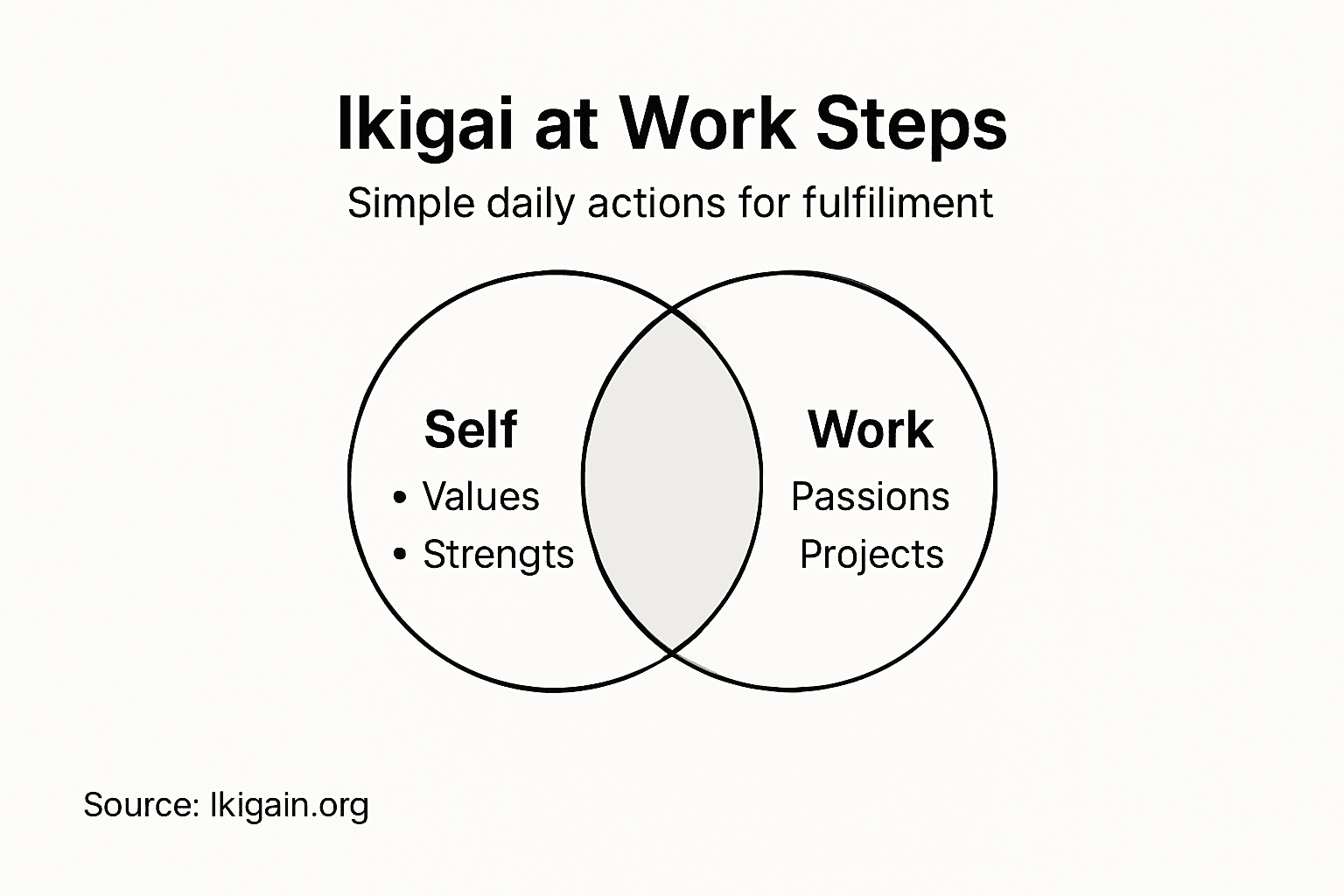
Unveiling your core values and strengths is the essential first step toward designing a fulfilling professional journey that genuinely resonates with who you are. By understanding your authentic motivational drivers, you’ll create a powerful foundation for career alignment and personal growth.
Start by engaging in deep self-reflection through strategic techniques. Mapping workplace values involves exploring several critical dimensions:
- Examine your emotional responses to different work scenarios
- Identify tasks that generate genuine excitement and energy
- Recognize environments where you consistently perform at your best
- List experiences that made you feel professionally proud
To systematically uncover your core values, ask yourself probing questions: What principles matter most in your professional life? What ethical standards guide your decision making? What workplace dynamics allow you to thrive?
These questions help you develop a nuanced understanding of your professional identity. Workplace values are deeply interconnected with your sense of well-being, dignity, and personal commitment.
Your core values are not just abstract concepts - they are the compass that guides your professional choices and defines your unique contribution.
Pro tip: Keep a reflection journal for two weeks, documenting moments when you feel most alive and engaged at work to reveal your underlying strengths and values.
Here’s a quick guide to connecting core values with workplace actions:
| Core Value | Action in the Workplace | Impact on Career |
|---|---|---|
| Integrity | Speak openly about ethics | Builds trust with peers |
| Creativity | Propose new solutions | Drives innovation |
| Growth | Pursue skill-building roles | Enhances advancement opportunities |
| Collaboration | Lead team efforts | Fosters supportive culture |
Step 2: Align your daily tasks with personal passions
Transforming your professional experience requires strategically connecting your daily work activities with the passions that genuinely motivate you. This step is about creating meaningful alignment between what energizes you and the tasks you perform.
Thriving at work involves deliberately integrating personal strengths into your professional routine. To achieve this, consider the following strategic approaches:
- Analyze your current tasks and identify potential passion points
- Seek opportunities to customize your workflow
- Request assignments that leverage your unique talents
- Negotiate projects aligned with your intrinsic motivations
Identifying passion-driven work involves understanding how your natural talents intersect with organizational needs. Core career values like creativity, innovation, and personal growth can serve as powerful guides in this process.
Your professional satisfaction emerges when you transform routine tasks into opportunities for personal expression and development.
Pay attention to moments when work feels effortless and engaging. These are signals pointing toward your authentic professional passions. By gradually reshaping your role to include more of these activities, you create a more fulfilling work experience.

Pro tip: Schedule a monthly “passion audit” where you review your tasks and intentionally reallocate time toward activities that genuinely excite and challenge you.
Step 3: Integrate purpose into workplace projects
Transforming workplace projects from routine tasks to meaningful experiences requires intentionally connecting your personal values with organizational goals. This step is about creating a powerful alignment between your deeper purpose and the work you perform daily.
Values-based career decisions involve strategically infusing your projects with authentic intention. Consider these practical approaches:
- Identify the core mission behind each project
- Connect organizational objectives to your personal values
- Seek projects that resonate with your professional ethics
- Articulate how your work contributes to broader societal goals
Organizational behavior research demonstrates that purpose-driven professionals experience significantly higher motivation and engagement. By understanding the deeper context of your work, you transform mundane tasks into meaningful contributions.
Purpose is not something added to your work - it’s the underlying energy that makes your work come alive.
Reflect on how your unique skills and perspectives can elevate projects beyond their immediate technical requirements. This approach allows you to develop a more holistic and fulfilling professional experience that transcends traditional job boundaries.
Pro tip: Create a personal mission statement that connects your professional projects to your broader life goals, using it as a compass for intentional work design.
Step 4: Communicate your ikigai vision with colleagues
Sharing your personal purpose transforms workplace dynamics from transactional interactions to meaningful collaborations. This step involves authentically articulating your professional vision in ways that inspire connection and mutual understanding.
Core leadership values require strategic and genuine communication that builds trust and alignment. Consider these approaches for effectively sharing your ikigai vision:
- Practice vulnerable and authentic storytelling
- Connect your personal mission to team objectives
- Use specific examples that illustrate your motivational drivers
- Listen actively when colleagues share their own perspectives
Professional values in action demonstrate that transparent communication creates deeper workplace relationships. By revealing the deeper motivations behind your work, you invite colleagues into a more meaningful professional dialogue.
Your ikigai is not a personal secret - it’s a powerful narrative waiting to connect and inspire those around you.
Reframe your vision as a collaborative opportunity. Instead of presenting a monologue, create a dialogue that explores how individual purposes can intersect and amplify collective potential. This approach transforms personal purpose from an individual pursuit into a shared organizational strength.
Pro tip: Develop a concise, compelling one-minute narrative about your professional purpose that invites curiosity and connection from your colleagues.
Step 5: Evaluate your progress and adjust for growth
Tracking your ikigai journey requires consistent reflection and intentional recalibration. This step focuses on developing a systematic approach to understanding how your professional path aligns with your deeper purpose and personal evolution.
Discovering core values involves creating a dynamic assessment framework that allows for continuous personal development. Consider implementing these strategic evaluation techniques:
- Conduct quarterly self-reflection sessions
- Document your professional and personal growth milestones
- Compare current experiences against your original ikigai vision
- Identify gaps between your intended purpose and actual experiences
Organizational values research emphasizes that meaningful progress emerges from honest, consistent evaluation. By maintaining a growth mindset, you transform potential obstacles into opportunities for deeper understanding and realignment.
Personal growth is not a destination - it’s a continuous journey of discovery and intentional adjustment.
Remember that your ikigai is not a static concept but a dynamic framework that evolves with your experiences, insights, and changing life circumstances. Approach your self-evaluation with curiosity, compassion, and a commitment to ongoing personal development.
Pro tip: Create a digital or physical “ikigai journal” where you regularly record insights, challenges, and reflections to track your personal and professional growth trajectory.
Here’s a summary of how each step enhances your professional fulfillment:
| Step | Main Focus | Resulting Benefit |
|---|---|---|
| Identify values | Self-awareness | Clear career direction |
| Align tasks | Daily engagement | Increased motivation |
| Integrate purpose | Project meaning | Greater job satisfaction |
| Communicate vision | Team collaboration | Stronger workplace relationships |
| Evaluate progress | Growth mindset | Continuous personal development |
Discover Your True Ikigai to Transform Your Work Experience
The journey described in “How to Apply Ikigai at Work for Greater Fulfillment” highlights common challenges such as identifying core values, aligning daily tasks with passions, and integrating meaningful purpose into everyday projects. Many professionals struggle to connect their work with what truly motivates them which can lead to disengagement and lack of satisfaction. This article’s focus on uncovering your authentic motivational drivers and communicating your ikigai vision echoes the need for clear self-awareness and intentional personal growth.
At Ikigain.org, you can take the next step toward turning these insightful concepts into actionable growth. Our comprehensive personality test is designed to help you pinpoint your core passions and strengths so that you can align your career with what deeply fulfills you. Explore how understanding your personal ikigai can empower you to reimagine your daily tasks, build purpose-driven projects, and share your unique vision with colleagues.
Discover Your Ikigai Today and start your transformation now. Don’t wait to create greater motivation, clarity, and lasting fulfillment in your professional life.

Frequently Asked Questions
How can I identify my core values at work?
Identifying your core values involves deep self-reflection. Ask yourself questions about what principles matter most in your professional life and document your feelings about different work scenarios to reveal what drives you.
What steps can I take to align my daily tasks with my passions?
To align your daily tasks with your passions, analyze your current responsibilities and pinpoint activities that genuinely excite you. Gradually shift your focus towards these tasks, aiming for at least 20% of your time each week to be spent on work that energizes you.
How do I connect my personal purpose with workplace projects?
To connect your personal purpose with workplace projects, identify the core mission behind each assignment you undertake. Look for ways to align your personal values with the project goals, ensuring that your contributions resonate with broader societal objectives.
What is the best way to communicate my ikigai vision with colleagues?
Communicate your ikigai vision by practicing authentic storytelling that connects your personal mission to team objectives. Share specific examples and listen actively to your colleagues, fostering a collaborative environment based on shared purpose.
How can I effectively evaluate my progress in applying ikigai at work?
To evaluate your progress, conduct quarterly self-reflection sessions. Document your growth milestones and compare your current experiences to your initial ikigai vision, making adjustments as needed to stay aligned with your personal and professional goals.