Feeling stuck in the daily routine can leave even the most driven American or Canadian questioning their sense of purpose. This search for meaning is a universal challenge, and Japanese philosophy offers a unique approach through the concept of ikigai. Instead of focusing only on professional success, ikigai encourages people to find fulfillment in everyday experiences, community connection, and personal growth. Discover how this holistic perspective can deepen your understanding of life’s value and help guide your journey to authentic purpose.
Table of Contents
- Defining The Meaning Of Life And Ikigai
- Global Perspectives Versus Japanese Insights
- The Four Pillars Of Ikigai Explained
- Practical Steps To Discover Your Ikigai
- Common Pitfalls And Misunderstandings
Key Takeaways
| Point | Details |
|---|---|
| Understanding Ikigai | Ikigai is a holistic approach to finding life’s purpose, emphasizing connection over individual achievement. |
| Japanese vs. Global Perspectives | Japanese views on ikigai highlight community and social harmony, contrasting with the Western focus on individual success. |
| Four Pillars of Ikigai | The intersection of Passion, Mission, Profession, and Vocation defines one’s ikigai, guiding individuals towards meaningful existence. |
| Ongoing Journey | Discovering ikigai is an iterative process requiring regular self-reflection and a willingness to embrace personal growth. |
Defining the Meaning of Life and Ikigai
Ikigai represents more than a simple philosophy; it’s a profound exploration of human purpose and fulfillment. Rooted in Japanese cultural understanding, this concept transcends mere self-optimization, offering a holistic approach to discovering life’s deeper meaning.
At its core, ikigai addresses the fundamental human quest of understanding what makes life worthwhile. Unlike Western interpretations that often focus on individual achievement, the Japanese perspective emphasizes connection, presence, and finding significance in everyday moments. Mieko Kamiya’s groundbreaking research suggests ikigai is not exclusively Japanese, but a universal psychological mechanism that helps individuals maintain hope and purpose.
Key elements that define ikigai include:
- Finding meaning through daily experiences
- Connecting with community and relationships
- Embracing both life’s joys and challenges
- Maintaining a present-moment awareness
- Discovering personal passions that provide intrinsic motivation
The concept goes beyond simple goal achievement, instead encouraging individuals to recognize the inherent value of existence. Psychological insights reveal that ikigai helps people navigate complex emotional landscapes, providing a framework for understanding personal purpose.
Pro Tip: Reflect on your daily activities and identify moments that bring you genuine satisfaction and connection, as these are potential indicators of your personal ikigai.
Global Perspectives Versus Japanese Insights
Ikigai has emerged as a fascinating concept that reveals profound differences between Japanese cultural philosophy and global interpretations. Western understanding often simplifies this complex idea, reducing it to a simplistic Venn diagram of passion, mission, vocation, and profession.
In contrast, the traditional Japanese perspective offers a much richer, more nuanced approach to life’s meaning. While global perspectives tend to focus on individual achievement and personal satisfaction, Japanese ikigai emphasizes deep community connections and social harmony. The concept extends far beyond personal goals, integrating social acceptance and collective well-being as fundamental components of individual purpose.
Key distinctions between global and Japanese perspectives include:
- Western focus on individual achievement
- Japanese emphasis on community and social integration
- Global tendency to quantify purpose through diagrams
- Traditional Japanese view of purpose as fluid and interconnected
- Differences in measuring personal fulfillment
The global interpretation often creates a reductive framework that overlooks the subtle, profound dimensions of ikigai. By attempting to standardize a deeply personal concept, Western approaches risk losing the intricate emotional and social nuances that make ikigai a transformative philosophy.
Here’s how the Japanese and global perspectives on ikigai differ in significant ways:
| Aspect | Japanese Perspective | Global (Western) Perspective |
|---|---|---|
| View of Purpose | Fluid, evolves with life | Static, often goal-based |
| Social Dimension | Emphasizes community connections | Focuses on individual achievement |
| Measurement of Fulfillment | Intrinsic value and meaning | External success and outcomes |
| Cultural Context | Deeply rooted in tradition | Often adapted, sometimes oversimplified |
| Personal Satisfaction | Linked to broader harmony | Centered on personal happiness |
Pro Tip: When exploring your personal ikigai, consider both individual passions and your broader community connections to gain a more holistic understanding.
The Four Pillars of Ikigai Explained
Ikigai represents a holistic framework for understanding life’s purpose through four interconnected dimensions that guide individuals toward meaningful existence. These pillars create a comprehensive approach to personal fulfillment, balancing internal desires with external realities.

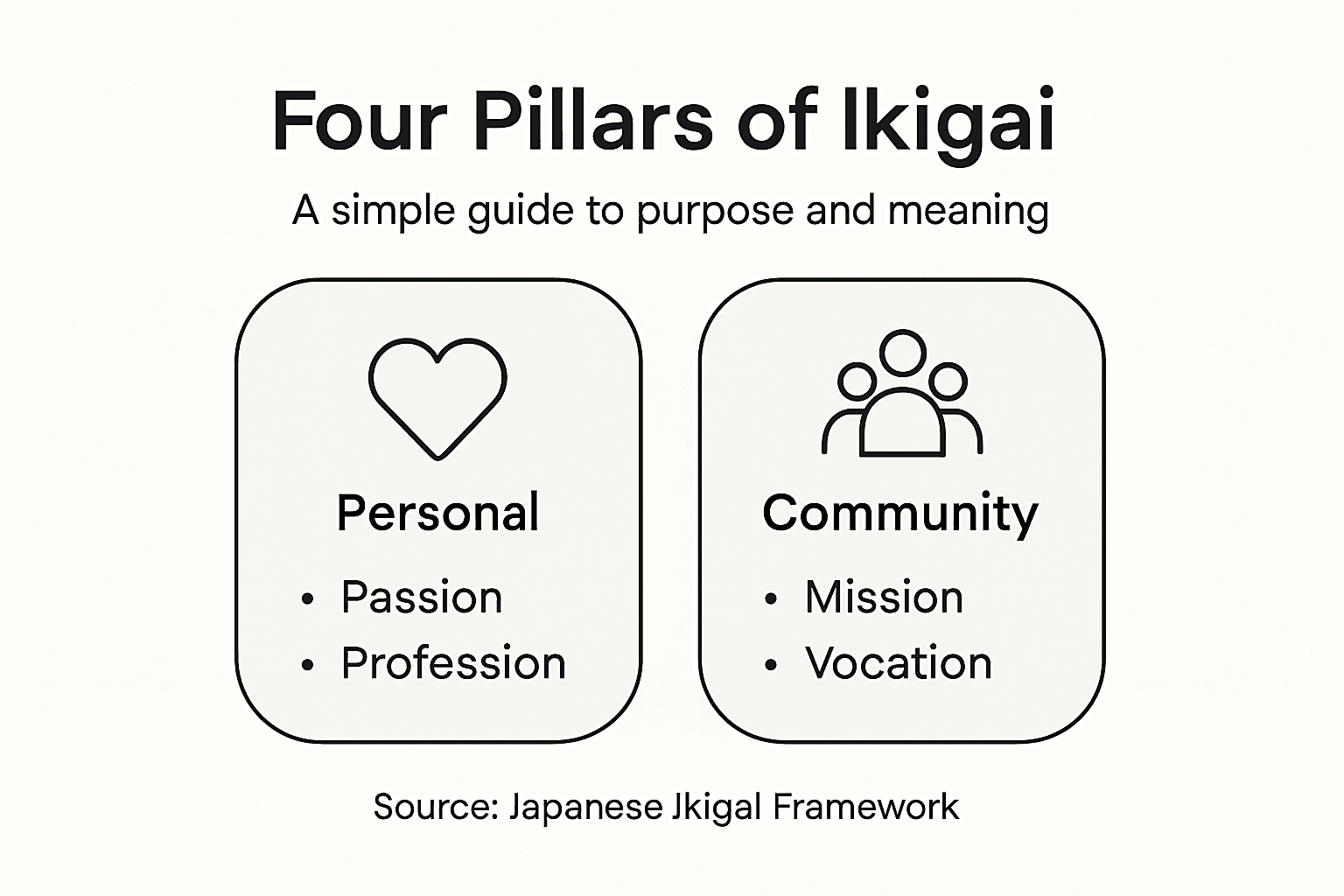
The four fundamental pillars of ikigai represent distinct yet overlapping domains of human experience. Passion represents what you love, Mission embodies what the world needs, Profession reflects what you can be paid for, and Vocation illustrates what you’re good at. These interconnected elements form a complex ecosystem of personal purpose that goes beyond simple career achievement or momentary satisfaction.
Detailed exploration of each pillar reveals nuanced insights:
- Passion: Personal interests that ignite intrinsic motivation
- Mission: Broader societal needs that align with individual capabilities
- Profession: Skills that generate economic value
- Vocation: Natural talents and developed competencies
Understanding these pillars requires deep self-reflection and an honest assessment of personal strengths, desires, and potential contributions. The magic of ikigai emerges when these four domains intersect, creating a harmonious space of genuine purpose and sustainable fulfillment.
Below is a summary of the four pillars of ikigai and their unique contributions to a meaningful life:
| Pillar | Primary Focus | Role in Ikigai | Example Contribution |
|---|---|---|---|
| Passion | What you love | Sparks personal motivation | Playing music for joy |
| Mission | What the world needs | Connects to greater purpose | Volunteering for a cause |
| Profession | What you can be paid for | Provides financial stability | Teaching or design work |
| Vocation | What you’re good at | Builds self-confidence | Gardening or storytelling |
When all four pillars align, individuals experience a profound sense of meaning that transcends traditional definitions of success.
Pro Tip: Regularly map your current life activities against these four pillars to identify areas of alignment and potential growth opportunities.
Practical Steps to Discover Your Ikigai
Ikigai is not a destination but a journey of continuous self-discovery, requiring intentional reflection and honest introspection. Psychological research reveals profound insights into understanding personal purpose through systematic exploration of inner motivations and external circumstances.
The path to discovering your ikigai involves a structured yet deeply personal approach. By breaking down complex self-understanding into manageable steps, individuals can uncover their unique intersection of passion, purpose, and potential. This process demands courage, vulnerability, and a commitment to genuine self-exploration beyond surface-level aspirations.
Key practical steps for ikigai discovery include:
- Conduct a comprehensive personal inventory of skills and interests
- Document past experiences that generated genuine excitement
- Identify intersection points between personal talents and societal needs
- Evaluate current life activities against core values
- Create a visual mapping of potential purpose pathways
- Experiment with diverse experiences to test potential directions
Successful ikigai discovery requires patience and a willingness to embrace uncertainty. The journey is iterative, with each reflection providing deeper insights into personal meaning and potential life directions.
Ikigai emerges not from external validation, but from internal alignment and authentic self-understanding.
Pro Tip: Schedule quarterly personal reflection sessions to reassess your ikigai journey and track your evolving understanding of personal purpose.
Common Pitfalls and Misunderstandings
Ikigai is frequently misunderstood as a simple formula for personal success, when in reality it represents a complex, nuanced approach to life meaning. Western interpretations often oversimplify this profound concept, reducing it to a superficial career optimization strategy that misses its deeper cultural significance.
The most common misconceptions about ikigai stem from a reductive approach that strips away its rich cultural context. Many individuals mistakenly view ikigai as a quick-fix solution for finding purpose, expecting an immediate, clear-cut answer to life’s complex questions. This linear, transactional perspective fundamentally contradicts the organic, evolving nature of personal meaning embedded in the original Japanese philosophy.
Key misunderstandings include:
- Treating ikigai as a one-time discovery instead of an ongoing journey
- Focusing exclusively on professional achievements
- Attempting to force purpose through external validation
- Ignoring the critical role of community and social connections
- Expecting a perfectly defined, static life purpose
- Prioritizing financial success over personal fulfillment
True ikigai requires a holistic, patient approach that embraces uncertainty and values personal growth over predetermined outcomes. It demands continuous reflection, adaptability, and a willingness to explore multiple dimensions of human experience.
Ikigai is not a destination to be reached, but a dynamic process of personal understanding and connection.
Pro Tip: Approach your ikigai journey with curiosity and openness, recognizing that meaning evolves alongside your personal growth and life experiences.
Discover Your Unique Ikigai and Transform Your Life Fulfillment
The article explores the profound challenge many face in finding lasting meaning and purpose in life through the concept of Ikigai. If you have felt stuck trying to balance what you love, what you are good at, and what the world needs, you are not alone. The key pain points highlighted include confusion over how to integrate your passions with practical life responsibilities and difficulty maintaining a sense of belonging and personal satisfaction. Understanding the four pillars of Ikigai is essential, but discovering your personal Ikigai requires deeper self-reflection and real tools that go beyond theory.

Start your transformative journey today with Ikigain.org, a dedicated platform designed to help you uncover your authentic purpose using a scientifically backed personality test. This test will reveal insights about your core passions, unique values, and strengths so you can align them with meaningful career and personal growth paths. Do not let confusion or uncertainty hold you back from experiencing true fulfillment. Explore a modern, culturally rich approach to purposeful living and take control of your Ikigai now at Ikigain.org. Your meaningful life awaits.
Frequently Asked Questions
What is the meaning of ikigai?
Ikigai is a Japanese concept that represents the intersection of your passions, mission, profession, and vocation, guiding individuals toward a meaningful and fulfilling life.
How can I discover my ikigai?
To discover your ikigai, conduct a personal inventory of your skills and interests, document experiences that brought you joy, and evaluate how your talents can meet societal needs.
What are the four pillars of ikigai?
The four pillars of ikigai are Passion (what you love), Mission (what the world needs), Profession (what you can be paid for), and Vocation (what you are good at). These pillars work together to define your purpose.
How does ikigai differ from Western concepts of purpose?
While Western concepts often focus on individual achievement and goal-setting, ikigai emphasizes community connections, social harmony, and an evolving understanding of purpose that integrates both personal fulfillment and collective well-being.