Many professionals wrestle with finding clarity amid busy routines and rising expectations. Exploring the Japanese concept of Ikigai alongside mindfulness reveals a powerful connection for those aiming to discover lasting purpose. Both approaches focus on present-centered awareness and meaningful engagement, supporting attention regulation and intentional living. This article gives practical insight into how these frameworks complement each other, helping you align motivation, values, and daily decisions through mindful practice.
Table of Contents
- Defining Mindfulness And Ikigai Connection
- Types Of Mindfulness Practices For Ikigai
- How Mindful Awareness Fosters Purpose
- Integrating Mindfulness Into Daily Life
- Common Misconceptions And Pitfalls
Key Takeaways
| Point | Details |
|---|---|
| Integration of Mindfulness and Ikigai | Mindfulness enhances one’s ability to discover and pursue their Ikigai, which represents a deeper sense of purpose beyond mere motivation. |
| Psychological Mechanisms | Both concepts share mechanisms like attention regulation, emotional flexibility, and cognitive clarity, fostering self-awareness and intentional living. |
| Types of Mindfulness Practices | Various techniques such as breathing and body scan meditations can be employed to cultivate awareness and connect with personal values. |
| Common Misconceptions | Mindfulness should not be seen as a quick fix or miracle cure; it is a gradual process requiring commitment, self-exploration, and non-judgmental awareness. |
Defining Mindfulness and Ikigai Connection
Mindfulness and Ikigai represent complementary philosophical approaches to understanding human purpose and well-being. At their core, both concepts emphasize present-moment awareness and meaningful engagement with life. Psychological research reveals critical connections between these powerful personal development frameworks.
The Japanese concept of Ikigai translates literally as “reason for living” - a profound idea extending beyond simple motivation to a deeper sense of purpose. Mindfulness serves as the foundational practice that allows individuals to recognize and cultivate their unique Ikigai. By maintaining deliberate, non-judgmental awareness, people can:
- Recognize their authentic passions
- Understand their intrinsic motivations
- Connect more deeply with personal values
- Develop greater self-awareness
Both mindfulness and Ikigai share fundamental psychological mechanisms centered on attention and intentional living. They encourage practitioners to move beyond reactive patterns and engage consciously with their experiences. Mindful awareness becomes the lens through which one discovers and pursues their life’s purpose.
Mindfulness transforms Ikigai from a concept into a lived experience of meaningful engagement.
Psychological research suggests that mindfulness supports Ikigai by enhancing cognitive flexibility, emotional regulation, and self-understanding. Motivational frameworks demonstrate how present-moment awareness directly contributes to identifying and pursuing one’s core life purpose.
Here’s a comparative overview of key psychological mechanisms linking mindfulness and Ikigai:
| Psychological Mechanism | Mindfulness Impact | Ikigai Impact |
|---|---|---|
| Attention Regulation | Enhances present awareness | Clarifies personal values |
| Emotional Flexibility | Improves resilience | Deepens motivation and purpose |
| Cognitive Clarity | Fosters insight into thoughts | Supports goal-setting and direction |
| Self-Compassion | Reduces self-criticism | Strengthens sense of fulfillment |
Pro tip: Practice daily 10-minute mindfulness meditation to gradually unveil your personal sense of Ikigai and deepen your connection with life’s meaningful pursuits.
Types of Mindfulness Practices for Ikigai
Mindfulness offers multiple approaches to cultivating awareness and connecting with one’s Ikigai. Psychological research identifies diverse mindfulness techniques that help individuals deepen their understanding of personal purpose and present-moment experience.
The Mindfulness Map Framework categorizes practices into four fundamental awareness domains:
- Somatic-Sensory Awareness: Body scan meditation, physical sensation tracking
- Affective Awareness: Emotional state recognition and compassionate observation
- Cognitive-Emotional Awareness: Thought pattern exploration and non-judgmental reflection
- Environmental Awareness: Mindful engagement with external surroundings
Each mindfulness practice serves as a unique pathway to understanding personal values and motivations. Specific techniques include:
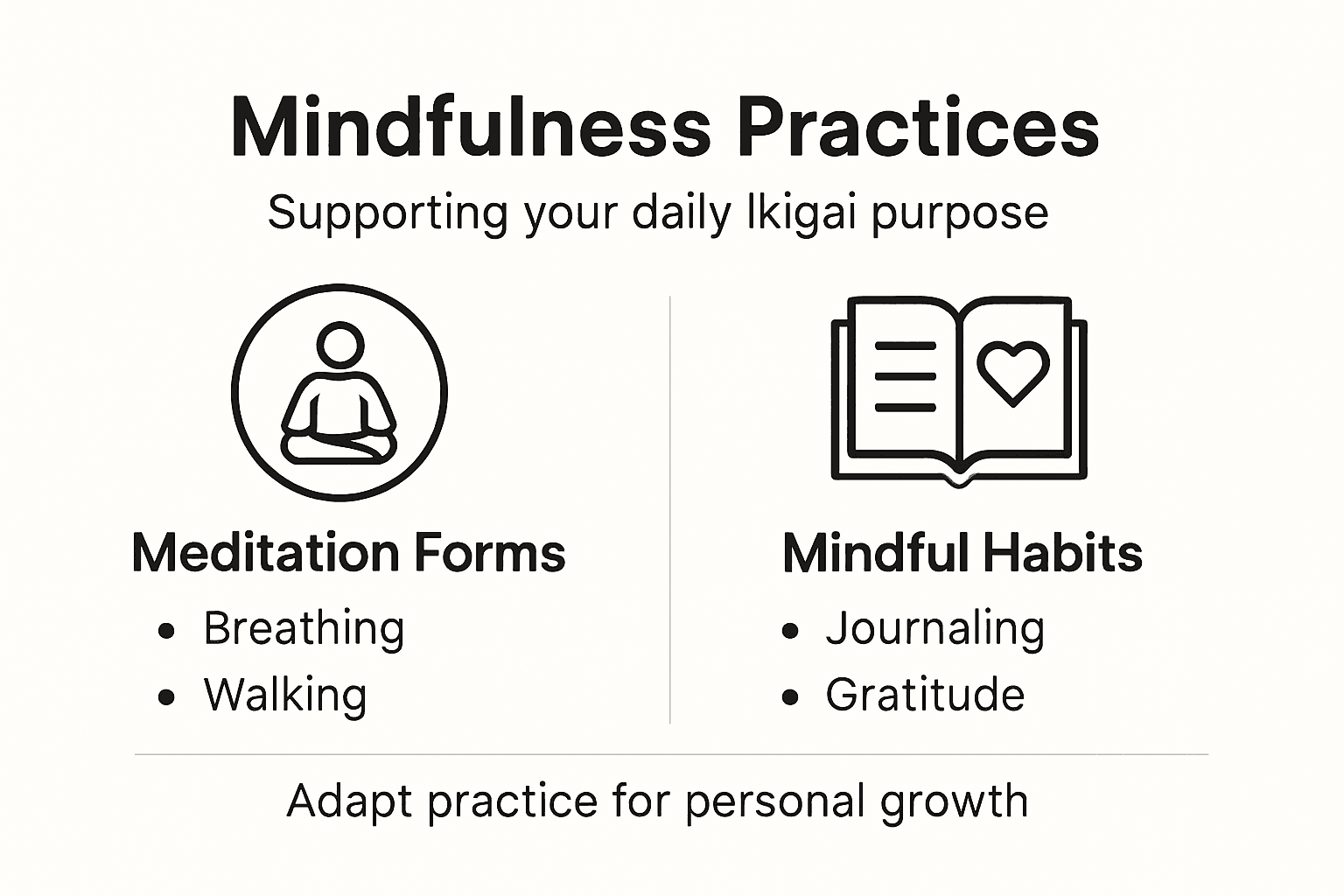
- Breathing Meditation: Focusing attention on respiratory rhythms
- Walking Meditation: Cultivating awareness during movement
- Loving-Kindness Meditation: Developing compassion toward self and others
- Body Scan Practice: Systematically exploring physical sensations
Mindfulness transforms passive experience into an active exploration of personal purpose.
Varied mindfulness practices demonstrate how intentional awareness can directly support the discovery and embodiment of Ikigai. By developing different dimensions of consciousness, practitioners can uncover deeper insights into their motivational patterns and life direction.
Pro tip: Experiment with multiple mindfulness techniques to discover which resonates most strongly with your personal sense of purpose and self-understanding.
How Mindful Awareness Fosters Purpose
Mindful awareness transforms the way individuals connect with their life’s purpose by creating a deeper, more intentional relationship with personal experiences. Research among university students demonstrates how cultivating present-moment consciousness directly enhances goal-oriented engagement and self-understanding.
The process of fostering purpose through mindfulness involves several key psychological mechanisms:
- Self-Regulation: Developing control over emotional and cognitive responses
- Attentional Control: Focusing deliberately on meaningful experiences
- Acceptance: Embracing present circumstances without judgment
- Emotional Clarity: Understanding underlying motivational patterns
Mindful practitioners develop unique capacities that support purposeful living:
- Increased awareness of personal values
- Enhanced ability to recognize authentic motivations
- Reduced reactivity to external distractions
- Improved capacity for meaningful decision-making
Mindful awareness transforms passive existence into an intentional journey of self-discovery.
Flow experiences mediate mindfulness and engagement, suggesting that present-moment awareness enables deeper absorption in meaningful activities. By cultivating this cognitive-emotional alignment, individuals can more effectively connect with their core purpose and navigate life’s complexities.

Pro tip: Integrate brief daily mindfulness practices to progressively develop a more intentional and purpose-driven approach to your personal and professional experiences.
Integrating Mindfulness Into Daily Life
Mindfulness integration transforms ordinary moments into opportunities for personal growth and self-awareness. Academic research demonstrates practical techniques for embedding mindful practices seamlessly into everyday routines, making intentional awareness an accessible and sustainable lifestyle choice.
Effective strategies for daily mindfulness include:
- Morning Rituals: Five-minute breathing exercises before starting the day
- Work Breaks: Short body scan meditations during transitions
- Commute Awareness: Mindful observation during travel
- Evening Reflection: Gratitude and non-judgmental review of daily experiences
Practical approaches to maintaining consistent mindfulness practice involve:
- Setting realistic, achievable practice goals
- Creating dedicated but brief meditation windows
- Using smartphone apps or timers as practice reminders
- Integrating mindful moments into existing routines
Mindfulness is not about perfection, but consistent, compassionate awareness.
Longitudinal studies of mindfulness programs reveal that sustained practice correlates with increased life satisfaction and reduced stress. The key lies in developing a flexible, non-judgmental approach that adapts to individual lifestyles and challenges.
Pro tip: Start with just three minutes of daily mindfulness and gradually expand your practice as it becomes more comfortable and natural.
Common Misconceptions and Pitfalls
Mindfulness practice extends far beyond simplistic interpretations, requiring nuanced understanding and thoughtful application. Current research highlights critical tensions surrounding misconceptions that can undermine the practice’s authentic potential and transformative power.
Common misconceptions about mindfulness include:
- Miracle Cure Myth: Believing mindfulness solves all personal problems
- Quick Fix Fallacy: Expecting immediate, dramatic results
- Spiritual Bypass: Using mindfulness to avoid confronting real issues
- Performance Pressure: Treating mindfulness as another achievement metric
Significant pitfalls practitioners should be aware of:
- Oversimplifying mindfulness as mere stress reduction
- Disconnecting practice from its ethical and cultural origins
- Approaching mindfulness without genuine curiosity
- Comparing personal progress against unrealistic standards
Mindfulness is a journey of awareness, not a destination of perfection.
Research exposes myths surrounding mindfulness practices, challenging over-commercialized and superficial interpretations. The practice requires depth, commitment, and an understanding that personal transformation is a gradual, non-linear process.
Below is a summary of common misconceptions versus authentic practices of mindfulness:
| Misconception | Reality | Practical Approach |
|---|---|---|
| Quick-fix cure | Gradual personal growth | Practice patience and consistency |
| Avoids real issues | Promotes self-exploration | Engage with emotions honestly |
| Measures achievement | Encourages non-judgement | Focus on progress, not outcomes |
| Mere stress relief | Broader self-awareness | Integrate into daily life routines |
Pro tip: Approach mindfulness with openness and compassion, recognizing that inconsistent practice is part of the learning journey, not a personal failure.
Discover Your Ikigai Through Mindfulness and Purpose
The article highlights the challenge of cultivating mindful awareness to uncover and live your Ikigai—your true reason for living. It recognizes common obstacles such as unclear values, emotional distractions, and the struggle to connect daily activities with meaningful goals. If you seek to deepen your self-awareness, regulate your emotions better, and align your life with purposeful engagement, understanding and applying mindfulness is essential.
At Ikigain.org, we offer a scientifically backed personality test designed to help you identify your core passions, strengths, and values—key components that form your unique Ikigai. This personalized insight guides you to embrace the mindful practices discussed, transforming theoretical knowledge into actionable, fulfilling life changes. You will gain clarity on how to integrate mindful awareness into everyday decisions, boosting emotional flexibility and cognitive clarity.
Take the first step to live fully engaged and purpose-driven today.

Explore how mindfulness intersects with Ikigai at Ikigain.org and claim your personalized roadmap to purpose. Don’t wait to create a life filled with intentional meaning. Start your journey now and transform mindful awareness into your everyday strength.
Frequently Asked Questions
What is the connection between mindfulness and Ikigai?
Mindfulness and Ikigai are complementary approaches that emphasize present-moment awareness and deep engagement with one’s life purpose. Mindfulness helps individuals recognize and cultivate their unique Ikigai by allowing for a clearer understanding of personal passions and values.
How can I practice mindfulness to discover my Ikigai?
You can practice mindfulness through various techniques such as breathing meditation, walking meditation, and loving-kindness meditation. These practices help you develop awareness of your thoughts and emotions, leading to a better understanding of what motivates you and brings you joy.
What are some daily mindfulness practices I can integrate into my routine?
Consider incorporating short practices like morning breathing exercises, mindful observation during your commute, or evening reflections on your day. These approaches help embed mindfulness into your daily life, enhancing your awareness and connection to your Ikigai.
What are common misconceptions about mindfulness?
Common misconceptions include the belief that mindfulness is a quick fix for personal issues or that it solely focuses on stress reduction. In reality, mindfulness is a journey that encourages self-exploration, emotional acceptance, and consistent practice for meaningful growth.