Making a career shift can leave you questioning what truly drives you and what matters most. For many professionals in their thirties, the search for deeper purpose sparks a need for honest reflection and new perspectives. By drawing from both modern self-assessment and the timeless concept of Ikigai, this guide reveals how uncovering your core values and unique strengths can illuminate your path to fulfillment and lasting satisfaction.
Table of Contents
- Step 1: Assess Your Passions And Core Values
- Step 2: Identify Strengths And Unique Talents
- Step 3: Integrate Insights With Japanese Philosophy
- Step 4: Apply Findings To Personal And Career Goals
- Step 5: Verify Alignment And Sustain Motivation
Quick Summary
| Key Point | Explanation |
|---|---|
| 1. Reflect on Passions and Values | Dedicate time to self-reflection to identify what truly motivates and inspires you, shaping your life’s purpose. |
| 2. Identify Unique Strengths and Talents | Recognize distinctive abilities through self-assessments and feedback, as they are critical for personal growth. |
| 3. Integrate Insights with Ikigai Philosophy | Connect your passions, strengths, and societal needs to create a holistic life strategy guided by Japanese philosophy. |
| 4. Set Actionable Personal and Career Goals | Break down goals into short, mid, and long-term categories, ensuring they align with your discovered insights for motivation. |
| 5. Regularly Review and Adjust Goals | Conduct quarterly evaluations to track progress and maintain alignment with your evolving understanding of purpose. |
Step 1: Assess your passions and core values
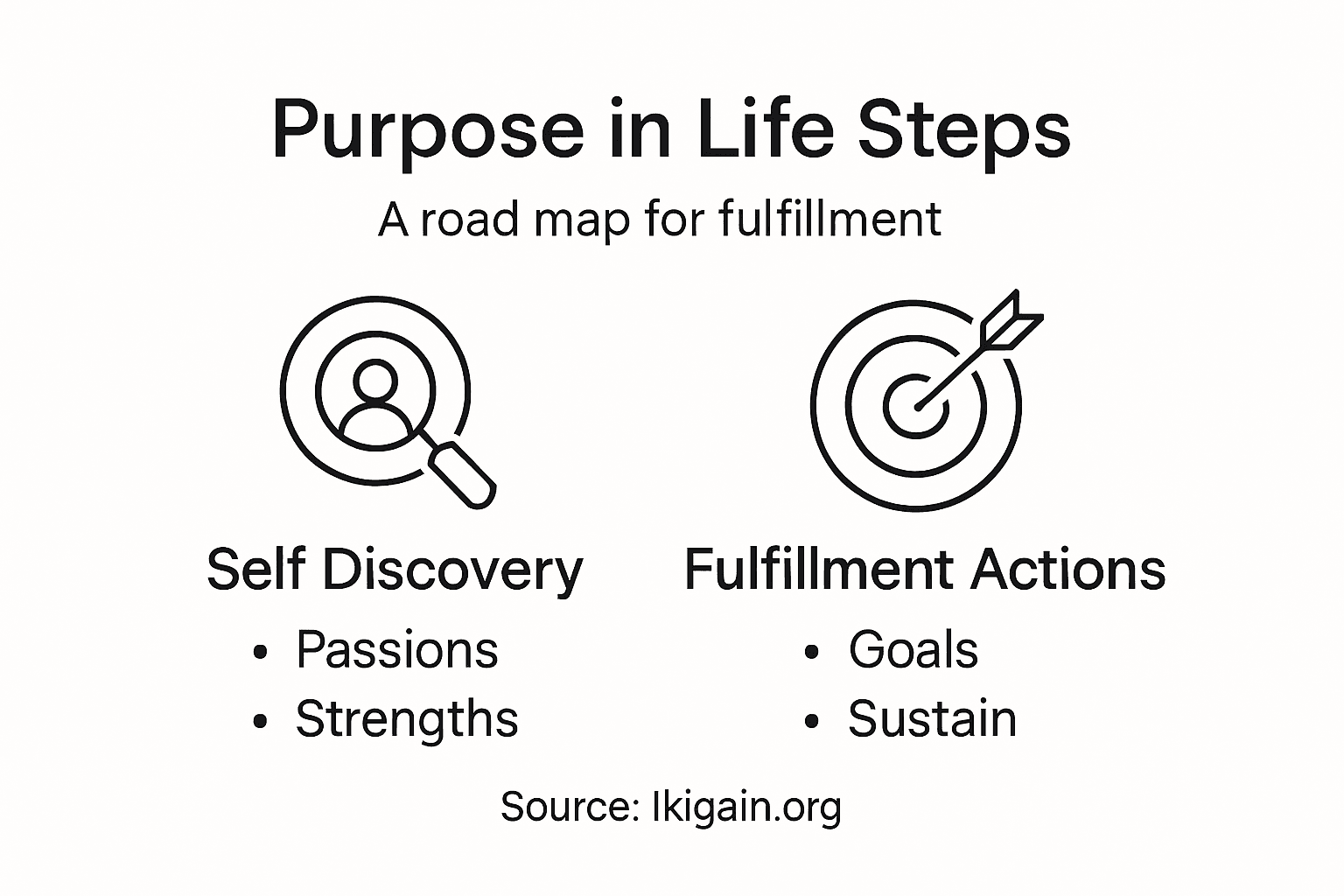
Discovering your true passions and core values is the foundational step in unlocking your life’s purpose. In this stage, you’ll explore the unique intersection of what you love, what you’re good at, and what truly matters to you.
Begin by setting aside dedicated time for honest self-reflection. Exploring personal values systematically helps you understand your deeper motivations and desires. Start with these targeted assessment strategies:
- Write down activities that energize and excite you
- List professional experiences where you felt most fulfilled
- Identify moments that made you feel proud and accomplished
- Examine your emotional responses to different work and life scenarios
Pay special attention to the underlying themes in your experiences. Are you driven by creativity? Solving complex problems? Making meaningful connections? Discovering core values requires deep introspection beyond surface-level observations.
Your values are the compass that guides your most authentic decisions and defines your unique path to fulfillment.
Consider using structured assessment tools like personality inventories or career reflection exercises to gain additional insights. These can help uncover patterns you might not recognize on your own.
Comparison of popular self-assessment tools and their outcomes:
| Tool Type | Typical Outcome | When to Use |
|---|---|---|
| Personality Inventories | Clarifies natural traits | Early self-discovery |
| Skills Assessments | Highlights abilities | Planning career moves |
| Values Reflection Exercises | Reveals motivations | Big life decisions |
| Feedback from Others | External perspective | Strength validation |
Pro tip: Keep a journal documenting your reflections, as your understanding of your passions and values will evolve over time.
Step 2: Identify strengths and unique talents
Understanding and leveraging your unique talents is crucial for personal and professional growth. In this step, you’ll dive deep into recognizing the distinctive abilities that set you apart from others.
Talent identification involves more than simply listing skills - it’s about uncovering your intrinsic capabilities and potential. Start by gathering comprehensive insights through multiple approaches:
- Reflect on past achievements and moments of exceptional performance
- Ask trusted colleagues and friends about strengths they consistently observe in you
- Review performance evaluations and feedback from professional settings
- Take structured personality and skills assessments
- Analyze situations where you felt most confident and energized
Strengths-based approaches emphasize identifying natural talents that emerge organically. Pay attention to activities where time seems to fly by and you feel genuinely engaged.
Your unique talents are not just skills, but the distinctive ways you approach challenges and create value.
Consider creating a personal inventory of your top strengths, categorizing them into professional, creative, and interpersonal domains. This holistic view helps you understand your multifaceted capabilities.

Pro tip: Schedule periodic self-assessments every six months to track the evolution of your strengths and talents.
Step 3: Integrate insights with Japanese philosophy
Now that you’ve discovered your passions, strengths, and values, it’s time to connect these insights with the profound wisdom of Japanese philosophical concepts. This step will help you transform your personal discoveries into a meaningful life strategy.
Ikigai offers a transformative framework for understanding your purpose by exploring four critical dimensions:
- What you love (passion)
- What you are good at (talents)
- What the world needs (mission)
- What you can be paid for (profession)
Japanese philosophies provide deep insights into finding harmony between personal fulfillment and societal contribution. By mapping your unique talents and passions onto these intersecting circles, you create a holistic approach to life design.
Your Ikigai is not just a destination, but a dynamic journey of continuous self-discovery and alignment.
Reflect on how your identified strengths and passions can serve a greater purpose. Consider ways your talents can address societal needs or create meaningful impact in your professional and personal spheres.
Pro tip: Create a visual Ikigai diagram to help you see the connections between your passions, skills, and potential contributions.
Step 4: Apply findings to personal and career goals
Transforming your self-discovery insights into actionable goals requires strategic planning and intentional implementation. This step bridges the gap between understanding yourself and creating meaningful progress in both personal and professional spheres.
Aligning personal aspirations with professional goals is crucial for sustained motivation and fulfillment. Break down your goals into these critical categories:
- Short-term goals (next 3-6 months)
- Mid-term goals (1-3 years)
- Long-term goals (3-5 years)
- Personal development objectives
- Career progression milestones
Effective career planning requires creating a flexible roadmap that adapts to your evolving understanding of yourself. Develop goals that are specific, measurable, and aligned with your newly discovered Ikigai.
Your goals are living documents that should evolve as you grow and gain deeper self-understanding.
Ensure each goal connects directly to the insights you’ve gained about your passions, strengths, and core values. This alignment creates powerful intrinsic motivation and increases the likelihood of sustained commitment.
Pro tip: Review and adjust your goals quarterly, treating them as dynamic guides rather than rigid prescriptions.
Step 5: Verify alignment and sustain motivation
Reaching the final stage of your purpose discovery journey requires consistent evaluation and commitment to your personal growth path. This step focuses on ensuring your goals remain authentic and your motivation stays strong through strategic self-reflection and adaptive planning.
Constructing alignment between personal values involves creating a dynamic narrative that connects your inner motivations with external opportunities. Develop a robust verification process through these key strategies:
- Quarterly personal review of goals and progress
- Honest self-assessment of emotional engagement
- Tracking personal growth indicators
- Identifying potential misalignments
- Adjusting goals proactively
Sustaining academic and career motivation requires integrating self-regulation techniques that maintain your enthusiasm and commitment. Focus on building confidence through consistent effort and strategic planning.
Motivation is not a constant state, but a skill you can deliberately cultivate and strengthen.
Establish a personal accountability system that allows flexibility while maintaining your core vision. Regular check-ins will help you stay connected to your purpose and make meaningful adjustments as you evolve.
Pro tip: Create a motivation journal to document your progress, challenges, and insights, helping you maintain perspective and momentum.
Here’s a quick overview of the five steps for uncovering your life’s purpose:
| Step | Focus Area | Main Goal | Key Benefit |
|---|---|---|---|
| 1 | Passions & Values | Self-reflection | Greater self-awareness |
| 2 | Strengths & Talents | Identifying unique abilities | Build personal confidence |
| 3 | Japanese Philosophy | Integrate insights | Holistic life direction |
| 4 | Goal Application | Create actionable plans | Enhanced motivation |
| 5 | Alignment & Motivation | Evaluate and adapt | Sustained growth & fulfillment |
Unlock Your True Purpose with Ikigai Insights
Struggling to connect your passions, strengths, and values into a clear life purpose can feel overwhelming. This article highlights the challenge of integrating self-discovery with meaningful action by using concepts like Ikigai and Japanese philosophy to guide your journey. If you find yourself needing structure and clarity to master your purpose in life process for fulfillment, Ikigain.org offers exactly what you need. Our comprehensive personality test is designed to help you uncover your core motivations and align them with actionable goals for lasting satisfaction.

Take the next step toward living a purpose-driven life today. Visit Ikigain.org to explore powerful assessment tools and gain personalized insights that mirror the transformative process described. Start realigning your passions and unique talents with your career and personal growth goals. Don’t wait for motivation to appear—build it with expert guidance at Ikigain.org. Your journey toward fulfillment begins now.
Frequently Asked Questions
How do I assess my passions and core values?
Start by dedicating time for honest self-reflection. Write down activities that energize you, list fulfilling professional experiences, and examine your emotional responses to different scenarios to discover what truly matters to you.
What are some effective ways to identify my strengths and unique talents?
Reflect on past achievements and ask trusted colleagues for their observations. You can also review performance evaluations and take structured assessments to identify situations where you felt confident and energized.
How can I integrate Japanese philosophy, like Ikigai, into my purpose discovery?
Map your passions, strengths, and societal needs using the Ikigai framework, which focuses on what you love, what you’re good at, what the world needs, and what you can be paid for. This holistic view helps create a meaningful life strategy.
What steps should I take to apply my findings to personal and career goals?
Break down your goals into short-term, mid-term, and long-term categories, ensuring they align with your discovered passions, strengths, and values. Regularly review and adjust these goals to reflect your evolving understanding.
How do I verify alignment between my goals and my personal values?
Conduct quarterly personal reviews to assess your progress and emotional engagement. This will help you identify any misalignments and allow you to make proactive adjustments to stay on track with your purpose.
What can I do to sustain my motivation throughout this process?
Establish a personal accountability system and create a motivation journal to track your progress and challenges. Regular self-reflection will help you maintain focus and enthusiasm for your journey toward fulfillment.