Shifting careers can make anyone question what truly matters beyond job titles and paychecks. For many young professionals from Canadian, American, and British backgrounds, finding a purpose-driven life means looking past surface achievements to discover deeper meaning. This article helps clarify what genuine life purpose really is, debunks the common myths around it, and explores practical ways to find lasting fulfillment—drawing inspiration from both scientific perspectives and Japanese philosophies.
Table of Contents
- Defining Life Purpose And Its Misconceptions
- Key Types Of Purpose People Experience
- How Purpose Shapes Motivation And Wellbeing
- Scientific Insights On Purpose And Fulfillment
- Practical Approaches To Discovering Life Purpose
Key Takeaways
| Point | Details |
|---|---|
| Life purpose is a dynamic process | It evolves through personal exploration and reflection rather than being a fixed destination or achievement. |
| Misconceptions can hinder understanding | Common beliefs equating purpose with career success or external validation oversimplify its true nature and impact on well-being. |
| Different types of purpose enrich life experience | Engaging with various purpose types—such as People-Oriented, Propensity-Based, and Prosocial—can enhance motivation and fulfillment. |
| Purpose improves well-being | A strong sense of life purpose correlates with better mental health, resilience, and overall satisfaction in life. |
Defining Life Purpose and Its Misconceptions
Life purpose represents more than a simple career goal or momentary aspiration. It is a comprehensive psychological construct that provides direction, motivation, and profound personal meaning. Understanding this nuanced concept requires moving beyond surface-level interpretations and exploring its intricate psychological dimensions.
Researchers have identified several key characteristics that define life purpose, highlighting its complexity:
- A sense of intentional direction in life
- Long-term goal orientation
- Deep personal commitment to specific values
- Integration of individual identity and broader objectives
- Psychological mechanism for resilience and personal growth
Purpose is not a static trait but a dynamic process of psychological integration and meaning-making. Many individuals misunderstand purpose as a predetermined destiny or a singular achievement. In reality, purpose evolves through continuous personal exploration, experiences, and intentional reflection.
Common misconceptions about life purpose often stem from oversimplified interpretations. People frequently conflate purpose with:
- Temporary career achievements
- Financial success
- Social status
- External validation
- Rigid life plans
Purpose is not a destination, but a continuous journey of self-discovery and meaningful engagement.
Research reveals that authentic life purpose transcends these narrow definitions. Psychological mechanisms underlying purpose demonstrate that it involves complex cognitive and emotional processes that contribute to overall mental well-being and personal development.
Pro tip: Treat life purpose as an evolving narrative, not a fixed destination, and remain open to reinterpreting your goals as you grow and change.
Here is a summary comparing the primary misconceptions about life purpose with the scientific realities:
| Misconception | Scientific Reality | Impact on Wellbeing |
|---|---|---|
| Purpose is a fixed, single achievement | Purpose evolves and adapts over time | Greater adaptability with growth |
| Equals only career or financial success | Encompasses identity, values, and relationships | Broader sense of fulfillment |
| Driven by external validation | Rooted in internal meaning and self-understanding | Higher intrinsic motivation |
| Follows a rigid life plan | Supports flexibility and reflective change | Enhanced resilience |
Key Types of Purpose People Experience
Life purpose manifests in diverse and complex ways, reflecting the unique psychological landscape of individual experience. Researchers have identified multiple dimensions through which people understand and engage with their sense of purpose, revealing a rich tapestry of motivational frameworks that extend far beyond simplistic career-oriented perspectives.
Four primary purpose types emerge as particularly significant in psychological research:
- People-Oriented Purpose: Driven by deep connections and relationships
- Propensity-Based Purpose: Aligned with natural talents and inherent abilities
- Passion-Driven Purpose: Characterized by intense personal enthusiasm
- Prosocial Purpose: Focused on creating positive community impact
Beyond these core types, individuals often experience purpose through multiple interconnected lenses. Graduate-level research suggests additional nuanced purpose categories that reflect complex personal motivations:
- Humanitarian/Civic Purpose
- Professional/Career Purpose
- Academic/Research Purpose
- Entrepreneurial Purpose
- Philosophical/Reflective Purpose
Purpose is not a monolithic concept, but a dynamic, multifaceted experience that evolves with personal growth and social context.
Each purpose type represents a unique approach to meaning-making, influenced by individual backgrounds, cultural contexts, and personal aspirations. The interconnected nature of these purpose types highlights the complexity of human motivation and the deeply personal journey of understanding one’s life direction.
Pro tip: Explore multiple purpose dimensions simultaneously, recognizing that your sense of purpose can simultaneously encompass different motivational streams.
To help you explore the types of purpose and their benefits, see the table below:
| Purpose Type | Core Motivation | Typical Example | Personal Benefit |
|---|---|---|---|
| People-Oriented | Building relationships | Mentoring or caregiving | Strengthens social bonds |
| Propensity-Based | Utilizing strengths | Creative work or analysis | Boosts self-confidence |
| Passion-Driven | Pursuing enthusiasm | Artistic or athletic pursuits | Increases daily motivation |
| Prosocial | Contributing to society | Volunteering, activism | Enhances sense of impact |
How Purpose Shapes Motivation and Wellbeing
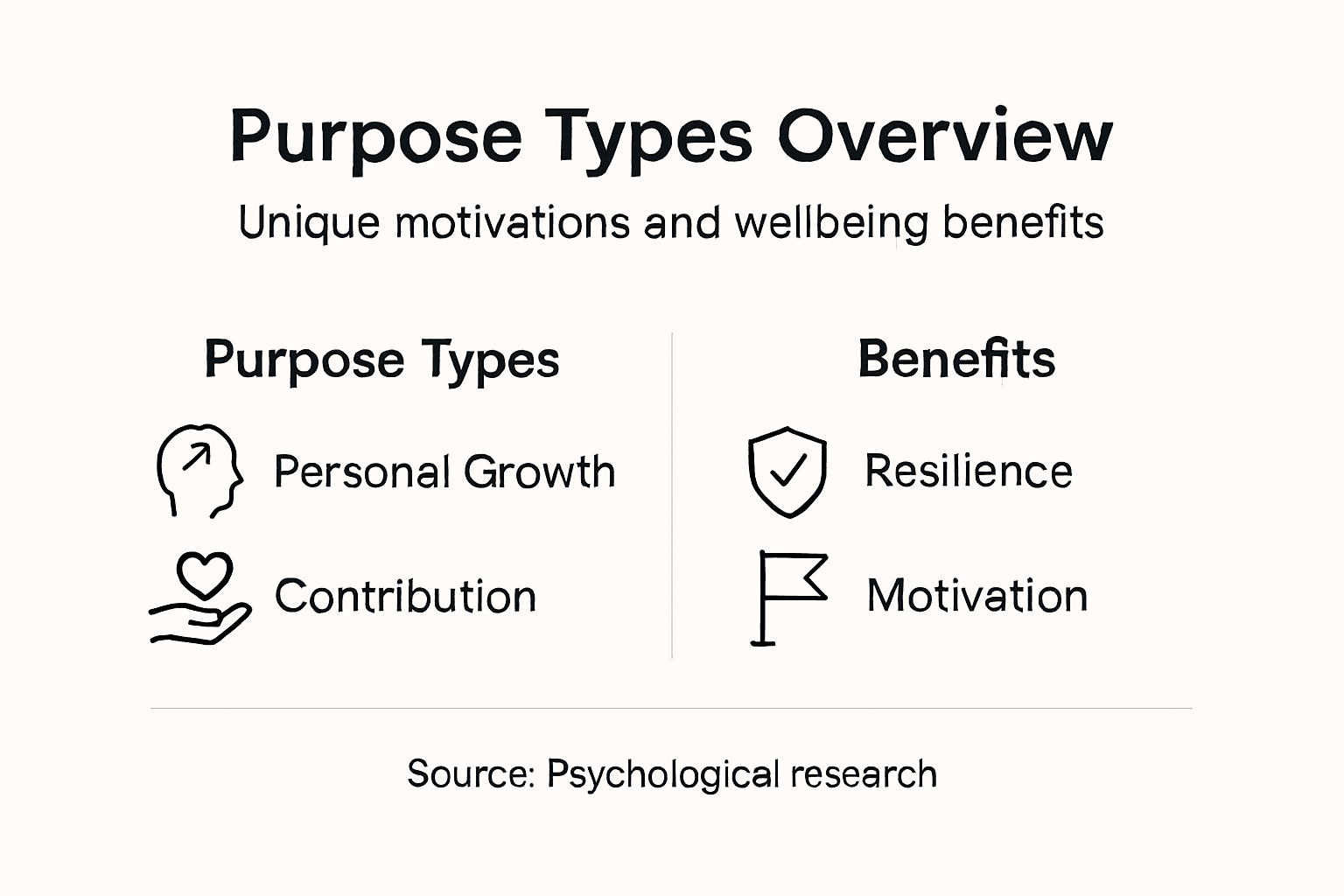
Purpose operates as a powerful psychological mechanism that fundamentally transforms human motivation and overall well-being. Cognitive and affective mechanisms reveal how purpose serves as a critical driver of personal resilience, goal achievement, and psychological flourishing.
The profound impact of purpose on motivation manifests through several key psychological processes:
- Provides clear directional energy for personal goals
- Enhances intrinsic motivation and commitment
- Increases psychological resilience under stress
- Generates a sense of meaning and personal significance
- Promotes proactive behavioral engagement
Research consistently demonstrates that individuals with a strong sense of purpose experience significantly improved life outcomes. These benefits extend across multiple domains of human experience:
- Enhanced mental health
- Improved cognitive functioning
- Greater social connectedness
- Increased personal and professional satisfaction
- Higher levels of sustained motivation
Purpose transforms external challenges into opportunities for personal growth and meaningful achievement.
Translational science approaches highlight how purpose acts as a self-organizing life aim that fundamentally reshapes an individual’s approach to challenges and opportunities. By providing a comprehensive framework for understanding personal motivation, purpose enables individuals to navigate complex life transitions with greater psychological flexibility and resilience.

Pro tip: Regularly reflect on and articulate your purpose, understanding that it can evolve and adapt with your personal growth and changing life circumstances.
Scientific Insights on Purpose and Fulfillment
Scientific research has increasingly illuminated the profound connections between life purpose and human well-being, revealing purpose as far more than an abstract concept. Longitudinal studies demonstrate compelling evidence of purpose’s transformative impact on psychological and physiological health across human lifespans.
Key scientific insights into purpose and fulfillment reveal multiple interconnected dimensions:
- Reduces mortality risk
- Enhances health behaviors
- Improves psychological resilience
- Predicts positive emotional states
- Supports long-term personal development
Researchers have identified several critical mechanisms through which purpose influences human functioning:
- Psychological regulation of stress responses
- Motivation and goal-directed behavior
- Neurological mechanisms of emotional processing
- Social connection and relationship quality
- Adaptive coping strategies
Purpose is not merely a subjective experience, but a measurable biological and psychological phenomenon with tangible health implications.
The ecological perspective suggests that the effectiveness of purpose depends on its congruence with individual values and feasibility of implementation. Not all purposes yield equal benefits, highlighting the importance of authentic, personally meaningful life directions.
Pro tip: Regularly assess your life purpose against your current values and experiences, recognizing that a meaningful purpose can dynamically evolve with your personal growth.
Practical Approaches to Discovering Life Purpose
Discovering one’s life purpose requires a deliberate and introspective approach that goes beyond surface-level self-reflection. Understanding your personal motivation involves developing a structured framework for exploring your deepest values, passions, and potential contributions.
Effective strategies for uncovering life purpose include:
- Conducting comprehensive self-assessments
- Exploring personal values and core motivations
- Identifying unique strengths and talents
- Reflecting on meaningful life experiences
- Experimenting with diverse personal and professional experiences
A systematic approach to discovering life purpose involves several key methodological steps:
- Self-reflection and personal inventory
- Exploring intrinsic and extrinsic motivations
- Identifying intersections between passion and capability
- Testing potential purpose directions
- Continuous refinement and adaptation
Purpose is not a destination to be discovered, but a dynamic journey of ongoing self-understanding and personal growth.
Authentic purpose emerges from the intersection of personal passion, inherent capabilities, and potential societal contribution. This requires a holistic approach that balances internal insights with external opportunities, creating a meaningful and sustainable life direction.
Pro tip: Create a personal purpose journal to document your evolving insights, tracking patterns of motivation, joy, and meaningful engagement.
Discover Your True Purpose and Elevate Your Wellbeing Today
Finding authentic life purpose is a journey filled with self-discovery, evolving motivations, and meaningful connection. If you feel stuck trying to define your purpose or want to embrace its full power to transform motivation and well-being, you are not alone. This article highlights how purpose shapes resilience, mental health, and personal satisfaction — challenges many people face when seeking clarity and fulfillment.

Take control of your life direction by exploring your core passions, values, and strengths with the comprehensive personality test at Ikigain.org. This scientifically-backed tool blends timeless Japanese philosophy with modern psychology to help you uncover the multi-dimensional purpose that fits your unique identity and life situation. Start your purposeful living journey now and experience the difference a well-defined purpose can make for your motivation and overall happiness. Visit Discover Your Ikigai to begin your transformation and embrace a life of meaning.
Frequently Asked Questions
What is the definition of life purpose?
Life purpose is a comprehensive psychological construct that provides direction, motivation, and meaning in a person’s life, evolving through personal exploration and experiences.
How does having a sense of purpose impact mental well-being?
A strong sense of purpose enhances mental health, boosts resilience under stress, increases motivation, and contributes to greater overall life satisfaction.
What are common misconceptions about life purpose?
Common misconceptions include equating purpose with fixed achievements, financial success, or external validation, while purpose is actually dynamic and evolves over time through personal growth.
What are the different types of purpose people experience?
Individuals can experience various types of purpose, including people-oriented, propensity-based, passion-driven, and prosocial purpose, each reflecting different motivations and ways to find meaning in life.