Many young professionals find themselves questioning if traditional career paths truly align with their passions or values. Burnout, uncertainty, and the search for purpose are becoming common in cities from New York to London and Tokyo. Exploring ikigai, a Japanese philosophy that balances passion, skills, societal needs, and personal values, offers a holistic approach to fulfillment far beyond chasing titles or paychecks. This introduction reveals how understanding ikigai can help you redefine meaning, well-being, and growth during pivotal career shifts.
Table of Contents
- Defining Ikigai and Common Misconceptions
- The Four Pillars of Ikigai Explained
- How Ikigai Impacts Career Decisions
- Modern Applications in Self-Discovery and Wellness
- Mistakes to Avoid When Pursuing Ikigai
Key Takeaways
| Point | Details |
|---|---|
| Understanding Ikigai | Ikigai is a holistic philosophy about personal fulfillment that transcends career success and financial metrics. |
| Four Pillars of Ikigai | The pillars—Passion, Mission, Profession, and Vocation—integrate to guide individuals toward a balanced and meaningful life. |
| Impact on Career Choices | Ikigai fosters introspection in career decisions, emphasizing alignment with personal values and societal contributions over mere financial gain. |
| Common Mistakes to Avoid | Avoid conflating financial success with purpose and rushing the self-discovery process, as ikigai is an evolving journey. |
Defining Ikigai and Common Misconceptions
Ikigai is far more than a trendy self-help concept - it’s a profound Japanese philosophy about discovering one’s deeper purpose and meaning in life. Unlike popular misconceptions, ikigai isn’t simply about career success or financial achievement, but represents a holistic approach to personal fulfillment that integrates passion, values, and societal contribution.
Traditionally rooted in Japanese culture, ikigai transcends cultural boundaries by offering a universal framework for understanding personal purpose. Cross-cultural research on life purpose reveals that ikigai encourages adaptability, resilience, and self-driven personal growth across diverse contexts. The concept challenges individuals to look beyond external metrics of success and instead explore their intrinsic motivations and potential.
Common misconceptions about ikigai often stem from oversimplified interpretations. Many people mistakenly believe ikigai is:
- A quick formula for finding a perfect career
- A guaranteed path to happiness
- Something that can be determined instantly
- Exclusively related to professional achievements
In reality, ikigai is a nuanced, evolving journey of self-discovery. Research on aging and well-being demonstrates that ikigai encompasses both emotional satisfaction and meaningful social engagement, extending far beyond superficial life goals.
The essence of ikigai lies in understanding that personal fulfillment emerges from aligning individual passions with broader life contexts. It requires ongoing reflection, emotional intelligence, and a willingness to explore one’s authentic self beyond societal expectations.
Here’s a summary comparing traditional views of success with the Ikigai philosophy:
| Criteria | Traditional Success Model | Ikigai Philosophy |
|---|---|---|
| Focus | Financial achievement | Personal fulfillment |
| Measurement | External metrics (salary, title) | Internal alignment (passion, values) |
| Motivation | Societal expectations | Intrinsic purpose |
| Outcome | Career advancement | Holistic life satisfaction |
Pro tip: Start your ikigai exploration by reflecting on activities that make you lose track of time and bring genuine satisfaction, not just monetary rewards.
The Four Pillars of Ikigai Explained
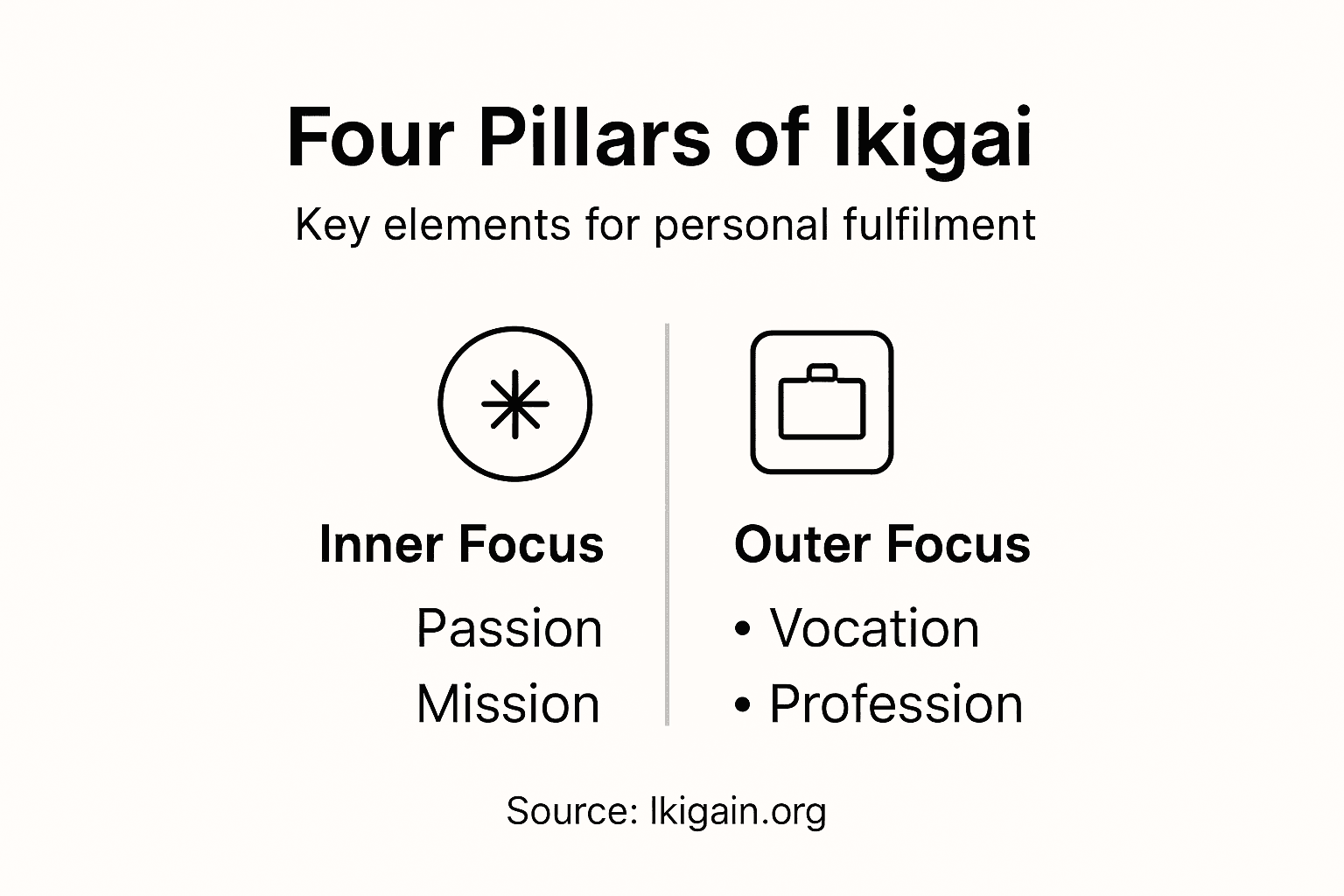
Ikigai represents a profound framework for understanding personal purpose, built upon four fundamental interconnected pillars that guide individuals toward meaningful existence. Integrated life purpose framework reveals how these elements work synergistically to create a balanced and fulfilling life approach.
The four essential pillars of ikigai encompass:
- Passion: Activities that genuinely excite and motivate you
- Mission: Contributions that align with your broader societal values
- Profession: Skills and talents you’ve developed professionally
- Vocation: Economic opportunities that sustain your lifestyle
Each pillar represents a critical component of personal fulfillment. Your passion represents the activities that make you feel alive and energized, while your mission connects those passions to meaningful societal contributions. The profession pillar reflects the skills you’ve cultivated, and the vocation pillar ensures practical economic sustainability.

Successful integration of these pillars doesn’t happen accidentally. It requires intentional self-reflection, continuous learning, and a willingness to align your inner motivations with external opportunities. The magic of ikigai emerges when these four elements intersect, creating a harmonious approach to personal and professional development.
Understanding these pillars isn’t about achieving perfection, but about creating a dynamic, evolving relationship with your personal purpose. Each pillar offers unique insights into your potential, challenging you to grow beyond conventional definitions of success.
Pro tip: Conduct a quarterly self-assessment by mapping your current activities against these four pillars to identify areas of alignment and potential growth.
How Ikigai Impacts Career Decisions
Ikigai transforms career decision-making from a transactional process into a deeply introspective journey of self-discovery and professional alignment. Holistic career counseling framework demonstrates how this approach goes beyond traditional job selection methods, integrating personal values, skills, and societal contributions.
The impact of ikigai on career decisions manifests through several critical dimensions:
- Motivation: Aligning work with genuine passions
- Purpose: Connecting individual skills to broader societal needs
- Sustainability: Ensuring economic viability alongside personal fulfillment
- Growth: Continuously evolving professional capabilities
Understanding ikigai requires recognizing that career choices are not just about financial compensation, but about creating a meaningful professional narrative. Workplace motivation model reveals how ikigai functions as a cognitive-motivational system that enhances engagement and mental well-being in professional contexts.
By applying the ikigai framework, professionals can make more intentional career decisions that transcend traditional metrics of success. This approach encourages individuals to evaluate opportunities through a multidimensional lens, considering not just salary and title, but personal growth, societal impact, and intrinsic satisfaction.
The most powerful career decisions emerge when professionals align their unique talents with meaningful opportunities that simultaneously challenge and fulfill them. Ikigai provides a comprehensive roadmap for navigating complex career landscapes with purpose and authenticity.
Pro tip: Create a personal career vision board that visually maps your skills, passions, societal contributions, and economic goals to identify potential career paths.
Modern Applications in Self-Discovery and Wellness
Ikigai has emerged as a transformative approach to wellness, moving beyond traditional self-help paradigms to offer a holistic framework for personal development and mental health. Comprehensive wellness research demonstrates how this philosophy integrates mental, physical, and social well-being into a unified approach to personal growth.
The modern applications of ikigai span multiple domains of personal wellness:
- Mental Health: Reducing depression and anxiety
- Personal Development: Enhancing life satisfaction
- Social Connections: Improving interpersonal relationships
- Holistic Well-being: Creating meaningful life experiences
Beyond traditional therapeutic approaches, ikigai offers a proactive model of wellness that empowers individuals to take intentional steps toward personal fulfillment. This approach recognizes that well-being is not a destination, but a continuous journey of self-discovery, personal growth, and meaningful engagement with the world around us.
To illustrate how Ikigai enhances wellness, here’s a breakdown of its influence across personal growth domains:
| Domain | Impact of Ikigai | Result |
|---|---|---|
| Mental Health | Fosters emotional resilience | Reduced stress and anxiety |
| Personal Development | Promotes self-awareness | Greater life satisfaction |
| Social Connections | Encourages authentic relationships | Stronger sense of belonging |
| Physical Well-being | Supports balanced lifestyle choices | Improved overall health |
Professionals in psychology, coaching, and wellness industries are increasingly integrating ikigai principles into their practice. By focusing on purpose, passion, and personal values, this approach provides a more nuanced and comprehensive strategy for addressing mental health and personal development challenges.
Ikigai represents a paradigm shift from treating symptoms to cultivating a meaningful, purpose-driven life experience.
Pro tip: Create a weekly reflection journal that explores your personal values, passions, and sense of purpose to deepen your understanding of your unique ikigai.
Mistakes to Avoid When Pursuing Ikigai
Pursuing ikigai is a nuanced journey that requires careful navigation and self-awareness. Critical insights on ikigai pursuit reveal several common misconceptions that can derail personal growth and authentic self-discovery.
Key mistakes individuals often make in their ikigai journey include:
- Confusing financial success with true purpose
- Rushing the process of self-discovery
- Neglecting personal health and relationships
- Adopting a rigid, linear approach to finding meaning
- Comparing your path to others’ journeys
- Expecting instant clarity or transformation
Many people mistakenly view ikigai as a destination rather than an ongoing process of personal exploration. This misunderstanding can lead to frustration and a sense of failure when immediate results are not achieved. The true essence of ikigai lies in embracing continuous growth, remaining open to change, and understanding that purpose evolves with personal experiences and insights.
Professional burnout and external pressure often drive individuals to seek quick solutions, but ikigai demands patience, introspection, and a holistic approach. It requires balancing personal aspirations with social connections, maintaining physical and mental well-being, and staying true to one’s authentic self.
Ikigai is not about finding a perfect path, but about creating a meaningful journey that resonates with your unique values and potential.
Pro tip: Schedule monthly reflection sessions to assess your current understanding of purpose, allowing space for your ikigai to naturally unfold and transform.
Discover Your True Ikigai and Transform Your Life Today
The article highlights the deep challenge many face in understanding their authentic purpose beyond surface-level success and fleeting happiness. If you find yourself confused by common misconceptions like equating ikigai with instant career bliss or financial gain, you are not alone. Many people struggle with aligning passion, mission, profession, and vocation in a way that brings lasting fulfillment. Your journey to personal fulfillment requires more than quick fixes—it demands clarity, self-reflection, and intentional growth.

Unlock your unique path with the comprehensive personality test offered at Ikigain.org. This scientifically backed assessment helps identify your core passions, values, and strengths to guide meaningful career decisions and enhance life satisfaction. Begin your exploration today by visiting Ikigain.org and discover how integrating traditional Japanese wisdom with modern self-discovery tools can create powerful and lasting change. Don’t wait to embrace a purpose-driven life—start now and take control of your personal growth journey.
Frequently Asked Questions
What is the meaning of ikigai?
Ikigai is a Japanese philosophy that represents a holistic approach to personal fulfillment, focusing on discovering one’s deeper purpose in life by aligning passion, values, and contributions to society.
How can ikigai influence my career decisions?
By applying the ikigai framework, individuals can make intentional career choices that align their unique skills and passions with meaningful opportunities, enhancing job satisfaction and overall well-being.
What are the four pillars of ikigai?
The four pillars of ikigai are passion (activities that excite you), mission (contributions aligned with your values), profession (skills developed professionally), and vocation (economic opportunities that support your lifestyle).
What mistakes should I avoid when pursuing my ikigai?
Common mistakes include confusing financial success with true purpose, rushing the self-discovery process, neglecting personal health and relationships, and comparing your journey to that of others.