Changing careers or searching for deeper fulfillment often leaves you wondering why certain roles energize you while others drain you. The answer lies in understanding your authentic patterns through personality assessment, a scientific discipline that reveals measurable traits, motivations, and interpersonal tendencies. These tools do more than guess who you are—they provide reliable insights that help you align your career choices and personal growth with your true self, especially when paired with Japanese philosophies like Ikigai.
Table of Contents
- Defining Personality Assessment And Core Ideas
- Major Types Of Personality Tests Explained
- How Personality Assessments Work In Practice
- Real-Life Applications For Growth And Purpose
- Common Pitfalls And Ethical Considerations
Key Takeaways
| Point | Details |
|---|---|
| Personality Assessments Provide Structured Insights | Unlike casual self-reflections, these assessments deliver measurable data about traits and behaviors based on psychological research. |
| Different Assessments Serve Various Purposes | Tools like the Big Five focus on trait data for career fitting, while MBTI offers personality type insights for personal growth. |
| Personality Insights Facilitate Meaningful Action | Use assessment results to guide career transitions, personal development, and improve team dynamics based on individual strengths. |
| Ethical Use is Crucial | Assessments should not dictate life outcomes; they require transparency, informed consent, and fair interpretation to avoid discrimination. |
Defining Personality Assessment and Core Ideas
Personality assessment is far more than a casual quiz or quick self-reflection exercise. It’s a scientific discipline that emerged in the 1920s, grounded in decades of research about how people think, feel, and behave consistently over time. Rather than guessing who you are, assessments provide structured, measurable insights based on proven psychological principles.
At its core, personality assessment systematically measures psychological characteristics like your enduring traits, motivations, and how you interact with others. Think of it as the difference between someone telling you “I think you’re a good listener” and actual data showing you score high in empathy and attentiveness across multiple situations. One feels nice; the other feels true.
What Personality Assessment Actually Does
Personality assessments operate using trait models—frameworks that describe measurable differences between individuals. Rather than labeling you as “good” or “bad,” they identify patterns in how you naturally respond to the world around you.
The assessments use reliable tools:
- Standardized questionnaires that ask the same questions to everyone
- Rating scales measuring intensity of traits or behaviors
- Behavioral tasks that observe responses in real situations
- Multiple-source data collection for richer understanding
These tools are built on psychometric principles, meaning they’re rigorously tested for reliability (consistent results) and validity (measuring what they claim to measure). You’re not getting opinions; you’re getting measurements.
Why This Matters for Your Life
The real power of assessment emerges when results predict actual outcomes. Personality assessment identifies how your traits connect to educational, occupational, and social success. Someone high in conscientiousness tends to excel in organized roles. Someone high in openness often thrives in creative fields.
But prediction is only one purpose. Assessments also:
- Describe your actual strengths and patterns
- Explain why certain situations energize or drain you
- Support decisions about career moves or personal development
- Guide interventions tailored specifically to your profile
This is why the Japanese philosophy of Ikigai pairs so well with personality assessment. Both seek clarity about who you genuinely are, not who you think you should be.
Personality assessment transforms vague self-doubt into specific, actionable insights about your capabilities and preferences.
The Japanese Connection
While personality assessment emerged from Western psychology, it aligns perfectly with Ikigai principles. Both frameworks ask: What do you naturally gravitate toward? Where do your talents meet the world’s needs? Your personality traits form the foundation for answering these questions authentically.
You’re not forcing yourself into ill-fitting boxes. You’re uncovering which boxes were always yours.
Pro tip: When reviewing your personality results, focus first on your strengths and natural patterns rather than areas labeled “low.” Building from your natural wiring leads to sustainable motivation and genuine fulfillment.
Major Types of Personality Tests Explained
Not all personality tests are created equal. Some focus on clinical diagnosis, others on career fit, and still others on personal growth. Understanding the differences helps you choose the right tool for your specific goals.
The field includes dozens of assessments, but a handful dominate both research and practical application. The Big Five framework leads modern scientific research due to its extensive empirical validation across cultures and populations. Other significant tests include MBTI, HEXACO, Enneagram, and specialized organizational tools like the Hogan Personality Inventory.
The Two Main Approaches
Personality tests fall into two primary categories, each serving different purposes and using different methodologies.
Objective self-report inventories ask you to rate statements about yourself on scales. These produce numerical data that researchers can analyze statistically. The Big Five measures five core dimensions:
- Openness (curiosity, creativity, willingness to try new things)
- Conscientiousness (organization, discipline, reliability)
- Extraversion (sociability, energy, assertiveness)
- Agreeableness (compassion, cooperation, empathy)
- Neuroticism (emotional stability, anxiety, stress responses)
Typological tests like MBTI classify you into categories rather than measuring degrees. MBTI sorts people into 16 distinct types based on four preferences: how you gain energy, gather information, make decisions, and organize your life.
Tests for Different Contexts
Your choice depends on what you’re trying to accomplish. Major assessments serve different purposes across clinical, personal growth, and organizational development settings.
For career exploration:
- Big Five provides precise trait data employers understand
- DISC focuses on communication and work style
- Hogan Assessment predicts job performance and leadership potential
- StrengthsFinder emphasizes what you do well, not weaknesses
For personal insight:
- Enneagram offers a spiritual, archetypal framework
- MBTI helps you understand your natural preferences
- HEXACO adds honesty-humility dimension for deeper self-awareness
For clinical purposes:
Here’s a quick comparison of major personality test frameworks:
| Assessment Type | Key Features | Typical Uses | Scientific Support |
|---|---|---|---|
| Big Five | Measures five core traits | Career, personal growth | Strong empirical backing |
| MBTI | Categorizes into 16 types | Team building, self-understanding | Limited scientific evidence |
| DISC | Focuses on work style | Workplace dynamics | Moderate research support |
| Enneagram | Explores nine archetypes | Personal insight, spiritual growth | Variable evidence |
| Hogan | Assesses leadership and risk | Corporate hiring, leadership | Good predictive validity |
| MMPI-2 | Diagnoses psychological conditions | Clinical settings | Robust clinical support |
- MMPI-2 diagnoses mental health conditions
- NEO PI-R measures Big Five with clinical precision
Different tests measure different things—choose based on whether you want precise traits, type classifications, or clinical insights.
Which Test Aligns with Ikigai?
For discovering your Ikigai, you need assessments revealing genuine patterns, not forced categories. The Big Five’s trait-based approach works best because it shows where your natural strengths lie, what genuinely interests you, and how you naturally interact with the world.
Typological tests like MBTI offer valuable self-understanding but can oversimplify. You’re not one type forever; you’re a unique combination of traits that shift with context and growth.
Pro tip: Start with the Big Five or a similar trait-based assessment to identify your genuine patterns, then explore typological tools like MBTI or Enneagram for deeper self-reflection and personal meaning-making.
How Personality Assessments Work in Practice
Personality assessments shift from theory to action when organizations and individuals apply them to real decisions. Understanding how they function in actual settings reveals both their power and their limitations.

When a company screens job applicants, personality assessments predict concrete outcomes. Personality traits correlate with job performance, satisfaction, and employee retention far better than intuition alone. Someone scoring high in conscientiousness typically arrives on time, follows procedures, and completes projects. Someone high in extraversion excels in client-facing roles but might struggle in solitary analytical work.
The Assessment Process
Most personality assessments follow a straightforward structure:
- Complete a standardized questionnaire (online or paper)
- Your responses are scored against established benchmarks
- Results generate a profile showing your trait levels or type classification
- The profile gets interpreted in context (job fit, personal growth, team dynamics)
Modern assessments use forced-choice formats where you pick between equally appealing options. This reduces the ability to game the system or give socially desirable answers. Rapid response measurement captures how quickly you answer, adding another validity layer.
Real-World Applications
Different settings deploy personality assessments strategically:
Hiring and team building: MBTI and Big Five help identify traits related to leadership, communication, and productivity in workplace contexts. Organizations use results to place candidates in appropriate roles and build balanced teams.
Career transitions: Understanding your traits guides decisions about role changes, industry shifts, or entrepreneurship.
Personal development: Results reveal growth areas and confirm natural strengths worth building on.
Conflict resolution: Team assessments explain why people clash and how to leverage differences.
To clarify where personality assessments have practical impact, here’s an overview:
| Application Area | Typical Benefit | Assessment Used |
|---|---|---|
| Hiring & Team Selection | Improved job fit, reduced turnover | Big Five, Hogan, MBTI |
| Personal Growth | Identifies strengths, guides development | Big Five, Enneagram |
| Career Planning | Matches traits to ideal roles | Big Five, DISC, StrengthsFinder |
| Mental Wellness | Early detection, stress coping | MMPI-2, NEO PI-R |
Important Limitations
Assessments work best alongside other information, never in isolation. A high conscientiousness score doesn’t guarantee success if someone lacks technical skills. Personality alone doesn’t predict everything.
Consider these realities:
- Response bias exists: people answering what they think is expected
- Context matters more than tests admit; you behave differently in different situations
- Self-awareness gaps mean some people misunderstand their actual traits
- Cultural differences can affect interpretation across diverse populations
Assessments are spotlight tools, not crystal balls—they illuminate patterns but require wise interpretation.
Integration with Ikigai Discovery
For Ikigai work, assessments provide the self-awareness foundation. They reveal what energizes you naturally versus what drains you. This distinction matters enormously when aligning career with purpose.
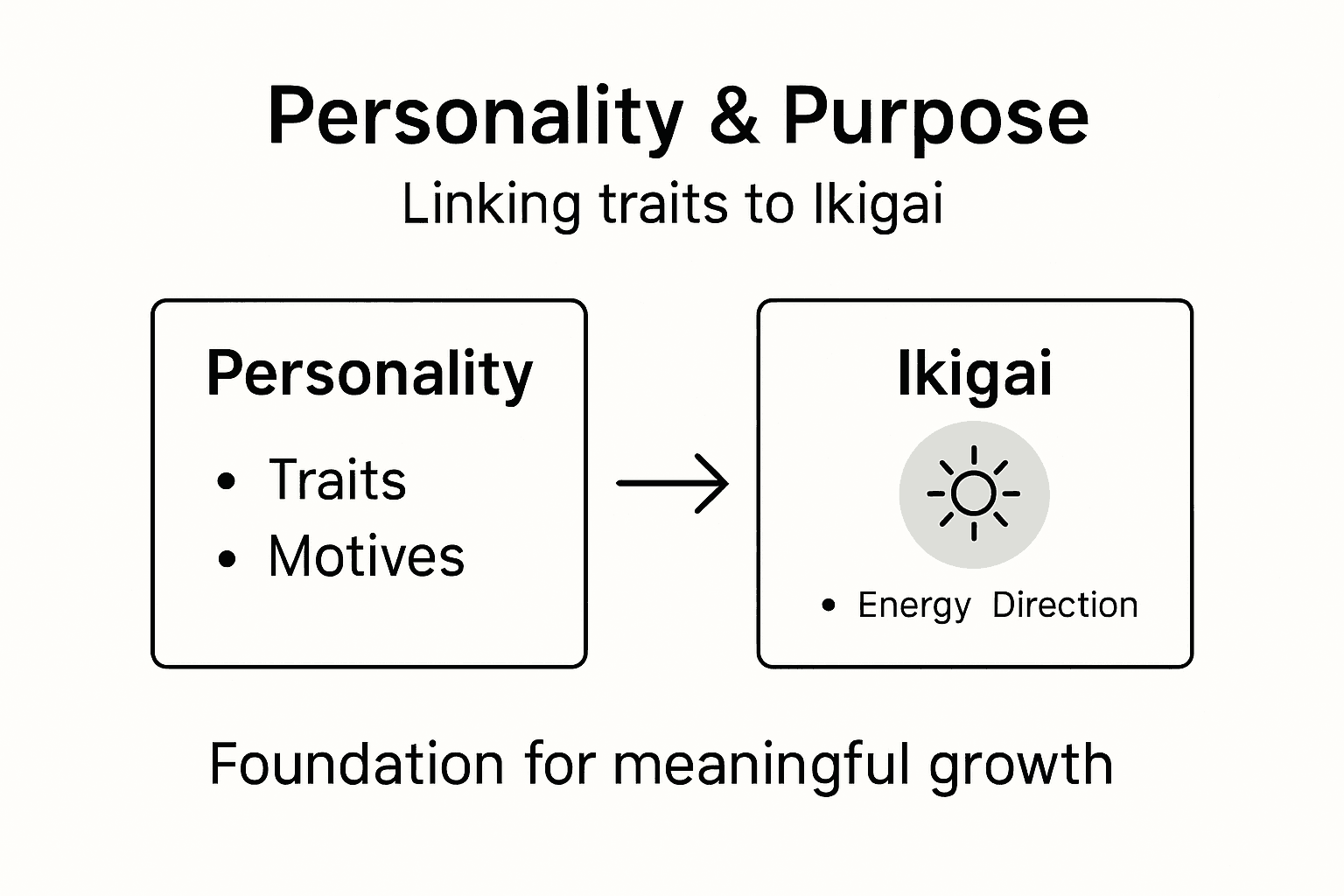
Your personality isn’t your destiny. It’s baseline data showing where you function best, not where you’re permanently locked.
Pro tip: Take assessments when you’re well-rested and honest, not under stress or trying to impress. Your most authentic responses reveal the insights that matter most for life direction.
Real-Life Applications for Growth and Purpose
Personality assessments only matter when they drive real change. Understanding your traits means nothing without translating insights into concrete action toward meaningful goals.
When you recognize your actual strengths and limitations, career decisions shift from guessing to strategy. Someone discovering high openness might explore creative industries or entrepreneurship. Someone with strong conscientiousness excels in structured roles requiring precision and reliability. The role of purpose in life depends heavily on alignment between your personality and your work—assessments create that alignment.
Career and Life Transitions
Personality insights guide major life decisions far better than gut feelings alone.
Use assessments when:
- Considering a career change to ensure the new field matches your actual traits
- Starting a business to identify roles you’ll genuinely enjoy
- Choosing educational paths aligned with your learning and working style
- Evaluating whether to stay in current roles or move forward
- Building teams where diverse personalities complement each other
A mid-career transition requires honest self-assessment. Personality data removes the emotional fog clouding these decisions. You stop forcing yourself into uncomfortable molds.
Personal Relationships and Team Dynamics
Assessments improve how you relate to others by explaining different perspectives and working styles.
In teams, understanding personality differences:
- Reduces conflict by explaining why people approach tasks differently
- Builds stronger partnerships when you know how to communicate with different types
- Improves collaboration by assigning roles matching natural strengths
- Increases psychological safety when people understand they’re valued despite differences
Couples and families benefit similarly. Personality assessments show why your partner processes stress differently or why a family member withdraws when you need connection. Understanding isn’t agreement, but it stops misinterpretation.
Mental Health and Personal Growth
Beyond career, assessments support mental wellness. Recognizing high neuroticism scores helps you develop stress-management strategies before burnout hits. Understanding low conscientiousness prompts systems-building rather than self-blame.
Personality insights also reveal strengths worth celebrating. Too many people focus on “fixing” low traits instead of leveraging high ones. AI-powered assessment tools provide real-time evaluations supporting personalized mental health monitoring and development paths tailored to your profile.
From Insight to Action
The assessment-to-action pipeline looks like this:
- Complete the assessment honestly
- Review results without judgment
- Identify 2-3 traits most relevant to your current situation
- Develop specific strategies leveraging those insights
- Take action and observe results
- Adjust based on what you learn
Personality assessments are maps, not destinations. The real journey starts when you use them to navigate toward authentic living.
Aligning with Your Ikigai
Your Ikigai—the intersection of passion, skill, purpose, and contribution—rests on honest self-knowledge. Personality assessments provide that foundation. They show what genuinely interests you versus what you think should interest you. They reveal where your natural talents lie.
This alignment is everything. Work that matches your personality doesn’t feel like work.
Pro tip: After reviewing assessment results, write down three concrete actions you’ll take based on your top insights. Attach each to a specific timeline—this transforms awareness into change.
Common Pitfalls and Ethical Considerations
Personality assessments are powerful tools, but power without ethics creates harm. Understanding where these assessments fail protects you from misuse and helps you use them responsibly.
The biggest trap? Treating assessment results as permanent truth. Your personality isn’t fixed. You grow, adapt, and respond differently to new contexts. A test capturing you today won’t perfectly describe you next year.
Reliability and Validity Issues
Tests can fail to consistently or accurately measure intended traits, even when designed well. Some assessments predict group patterns but perform poorly for individuals. Others have limited research supporting their use in specific contexts.
Common problems include:
- Low reliability: Results differ significantly if you retake the test weeks later
- Limited validity: Test measures something, but not what it claims to measure
- Weak predictive power: Scores don’t actually predict job success or life satisfaction
- Cultural bias: Questions and norms reflect one culture, failing to fairly assess others
Not all assessments are equally rigorous. The Big Five has decades of empirical support. Other popular tests lack comparable scientific validation.
The Faking Problem
When stakes are high—like job hiring—people answer strategically rather than honestly. Social desirability bias and intentional faking undermine assessment accuracy. Someone applying for a leadership role inflates conscientiousness and agreeableness while downplaying neuroticism.
Modern forced-choice formats and rapid response measurement reduce—but don’t eliminate—faking. The real solution? Use assessments for self-discovery, not gatekeeping decisions alone.
Ethical Misuse Risks
The most serious concern is discrimination. When hiring managers use personality tests to exclude candidates based on protected characteristics or without proper validation, they cause real harm.
Ethical usage requires:
- Transparent purpose: You know why you’re being assessed and how results are used
- Informed consent: You agree voluntarily with full understanding
- Confidentiality: Results stay private, not shared without permission
- Fair interpretation: Tests don’t stereotype or discriminate
- Professional guidelines: Qualified interpreters follow ethical standards
A test shouldn’t decide your job eligibility without additional evidence. It shouldn’t label you “unsuitable” for roles based on limited predictive validity.
Ethical assessment respects the person taking it, acknowledges test limitations, and never treats results as destiny.
What This Means for You
When encountering assessments, ask critical questions: Who validated this test? What’s the evidence it predicts what’s claimed? How are results being used?
For your Ikigai journey, assessments should clarify—not confine. Use them to understand patterns, not to accept limiting conclusions about who you can become.
Pro tip: If an organization uses assessments for hiring or major decisions, request information about the test’s validity, how results are interpreted, and what safeguards protect fairness. Your skepticism is healthy.
Discover Your True Potential with Ikigain.org
Struggling to transform personality insights into real-life purpose and fulfillment can feel overwhelming. This article highlights the challenge of moving beyond generalized test results to actionable self-knowledge that aligns with your authentic strengths and values. If you are seeking clarity about your natural traits and how they connect to your passions, career, and relationships, embracing a scientifically backed, culturally inspired approach is essential.
At Ikigain.org, we offer a comprehensive personality test designed specifically to illuminate your core passions and strengths through the lens of Japanese philosophy. Our tools help you bridge the gap between vague self-doubt and clear understanding, empowering you to make purposeful decisions that resonate with your unique personality.
Take the first step toward unlocking your Ikigai and living a life aligned with your true self. Visit Ikigain.org today to explore our personality assessment and access resources that support your authentic journey. Don’t wait to transform insight into meaningful action.
Frequently Asked Questions
What is a personality assessment?
Personality assessment is a scientific method used to systematically measure psychological characteristics such as traits, motivations, and behaviors. Unlike casual quizzes, these assessments provide quantitative insights based on proven psychological principles.
How do personality assessments differ from each other?
Personality assessments can be categorized into objective self-report inventories and typological tests. The former, like the Big Five, produce measurable data based on trait levels, while the latter, such as MBTI, classify individuals into distinct types. Each test serves different purposes based on your goals, such as career fit or personal growth.
Why is personality assessment important for career choices?
Personality assessments can predict job performance and satisfaction by identifying how your traits connect to specific roles. For instance, someone high in conscientiousness is often successful in organized roles, while those high in openness may thrive in creative positions.
Can personality assessments change over time?
Yes, personality assessments capture your traits at a specific point in time, and your personality can evolve due to experiences, growth, and changing contexts. They should not be viewed as fixed labels but rather as tools for understanding your current tendencies.
Recommended
- Role of Purpose in Life – Impact on Wellbeing
- Why Discover Your Purpose: Unlocking Fulfillment
- Why Choose Ikigai Method for Lasting Fulfillment
- 7 Key Japanese Philosophy Principles for Life Purpose
- Sales Team Motivation Explained: Driving Consistent Results
- One-Page OPPO Worksheet (Objective → Prompt → Proof of Outcome) - CEU Builder