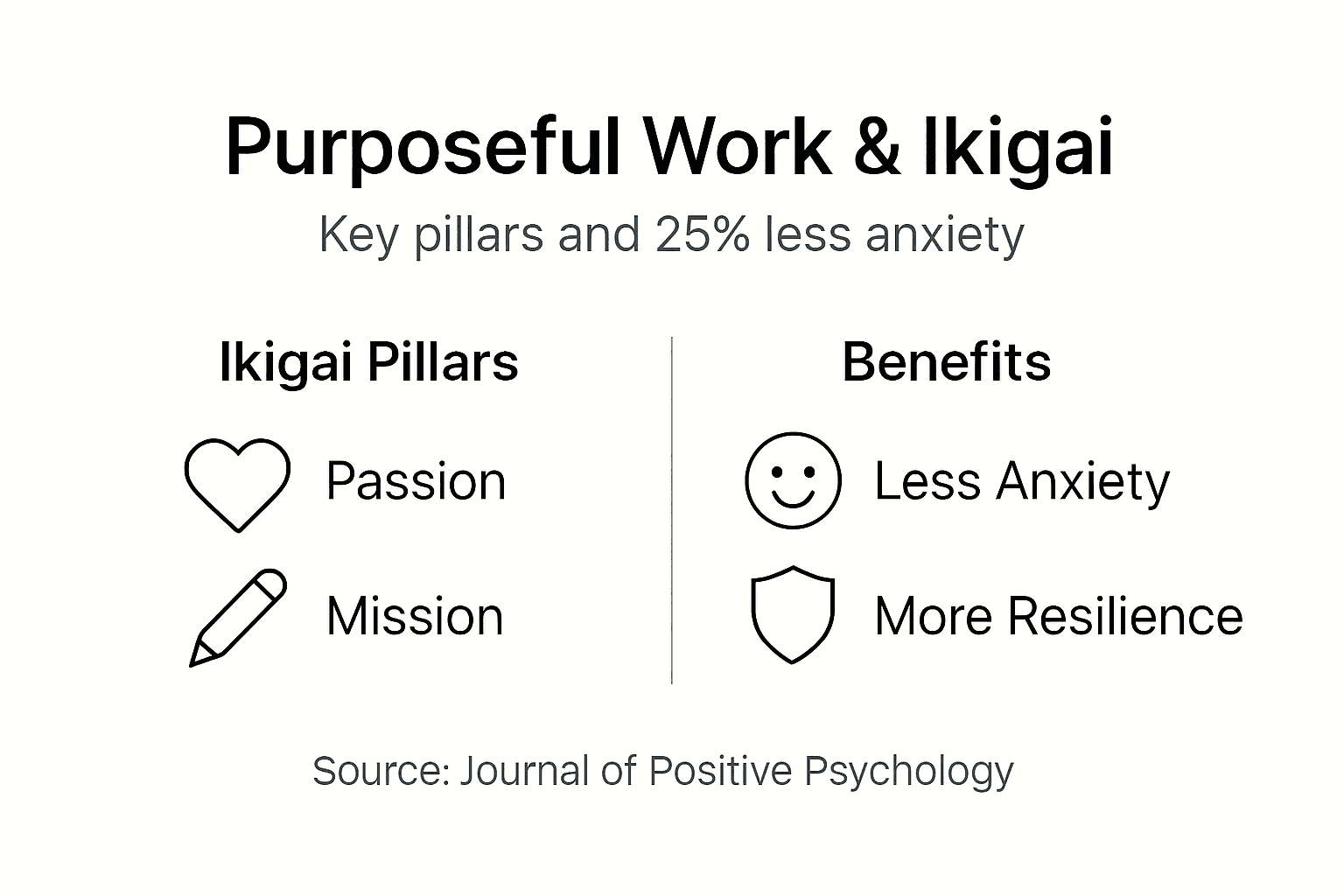
Purposeful work isn’t just about following your passion. That oversimplification leads countless professionals into unfulfilling careers despite chasing what excites them. True purposeful work, rooted in the Japanese philosophy of Ikigai, requires balancing four essential elements: what you love, what you’re good at, what the world needs, and what you can be paid for. This article reveals how this framework reduces anxiety by 25% and transforms career transitions into opportunities for lasting fulfillment.
Table of Contents
- Understanding Purposeful Work Through Japanese Philosophy
- Psychological and Well-being Benefits of Purposeful Work
- Common Misconceptions About Purposeful Work
- Frameworks to Identify Purposeful Work
- Purposeful Work During Career Transitions
- Practical Steps and Tools for Pursuing Purposeful Work
- Case Studies Illustrating Purposeful Work
- Explore Ikigai Tools to Unlock Your Purpose
- Frequently Asked Questions
Key Takeaways
| Point | Details |
|---|---|
| Four pillars define purposeful work | Ikigai integrates passion, mission, vocation, and profession into sustainable career alignment. |
| Mental health benefits are measurable | Purposeful work reduces depression and anxiety by 25% according to clinical research. |
| Productivity gains are substantial | Purpose aligned employees show 54% higher engagement and 38% increased productivity. |
| Career transitions create opportunities | Midcareer changes aligned with purpose increase life satisfaction by over 30%. |
| Practical frameworks enable discovery | Combining Ikigai mapping with personality assessments provides actionable career clarity. |
Understanding Purposeful Work Through Japanese Philosophy
The concept of Ikigai offers a comprehensive framework for understanding purposeful work. Unlike Western approaches that often emphasize passion alone, Ikigai requires balanced integration of four elements to create sustainable meaning in your career.
The four components work together. What you love represents your passions and interests. What you’re good at reflects your skills and talents. What the world needs identifies problems you can solve for others. What you can be paid for ensures financial sustainability. When these four circles overlap, you’ve found your Ikigai.
Most career dissatisfaction stems from missing one or more elements. You might love writing but struggle to monetize it. You could earn well in finance yet feel no connection to the work’s impact. The comprehensive Ikigai guide explores how Japanese culture views this balance as essential for long term wellbeing.
Key principles that distinguish Ikigai:
- Balance matters more than perfection in any single element
- Sustainability requires all four components working together
- Purpose evolves as your skills, values, and circumstances change
- Small daily actions aligned with Ikigai compound into major life shifts
This framework prevents the burnout that comes from pursuing passion without profit or choosing high paying work that lacks meaning. It creates a practical roadmap for career decisions during transitions.
Psychological and Well-being Benefits of Purposeful Work
The mental health advantages of purposeful work extend far beyond job satisfaction. Research shows that individuals engaged in purposeful work experience 25% less depression and anxiety compared to those in misaligned roles.
These benefits translate directly into workplace performance. Studies confirm that employees whose work aligns with their sense of purpose demonstrate 54% higher engagement levels and 38% greater productivity. Organizations benefit from reduced turnover while individuals experience deeper fulfillment.
| Benefit Category | Measurable Impact | Long Term Effect |
|---|---|---|
| Mental Health | 25% reduction in depression/anxiety | Lower burnout rates over 5+ years |
| Engagement | 54% increase in workplace engagement | Higher retention and loyalty |
| Productivity | 38% improvement in output quality | Consistent performance gains |
| Life Satisfaction | 30%+ increase during transitions | Sustained wellbeing improvements |
“When your daily work connects to a larger purpose, stress becomes manageable rather than overwhelming. You’re not just completing tasks; you’re contributing to something meaningful.”
The protective effect against burnout deserves special attention. Purposeful work provides resilience during challenging periods because the meaning sustains motivation when tasks become difficult. This differs fundamentally from jobs chosen purely for salary or convenience.

The mental health benefits accumulate over time. People in purposeful careers report better sleep, stronger relationships, and greater overall life satisfaction. The Gallup research tracking thousands of workers confirms these patterns hold across industries and demographics.
Common Misconceptions About Purposeful Work
Many professionals sabotage their search for meaningful work by believing myths that oversimplify the concept. Understanding these misconceptions helps you avoid common pitfalls.
The biggest myth equates purposeful work with following your passion exclusively. Passion without skill, market need, or compensation leads to frustration. You might love music but lack the talent for professional performance. Ikigai demands balance across all four elements.
Another misconception treats purposeful work as identical to job satisfaction. You can feel satisfied with a stable paycheck and friendly coworkers while lacking any sense that your work matters. Purpose requires believing your efforts create value beyond yourself.
Some view purposeful work as a luxury available only to the wealthy or privileged. This belief prevents exploration. Purpose exists at every income level and in every field. A teacher shaping young minds, a nurse caring for patients, or a craftsperson creating quality goods can all experience profound purpose.
Key misconceptions to avoid:
- Purposeful work requires dramatic career changes or starting over
- You must sacrifice financial stability to pursue meaningful work
- Purpose comes from the job title rather than how you approach your work
- Finding purpose happens through a single epiphany rather than ongoing discovery
Pro Tip: If you find yourself thinking “I’d pursue my purpose if only I had more time/money/freedom,” you’re likely caught in a misconception. Purpose starts with small alignments in your current situation, not wholesale life overhauls.
The romanticization of purpose as always feeling inspired creates unrealistic expectations. Even the most purposeful work includes mundane tasks and difficult days. Purpose provides meaning during challenges, not constant euphoria.
Frameworks to Identify Purposeful Work
Practical frameworks transform abstract concepts of purpose into actionable career decisions. The Ikigai model combined with personality assessments offers a structured approach to discovery.
Start with systematic self reflection across the four Ikigai elements. For each area, spend focused time identifying specific answers rather than generic responses. This process works best when paired with tools that reveal blind spots in your self perception.
| Framework Aspect | Ikigai Approach | Western Purpose Models |
|---|---|---|
| Core Focus | Balance across four intersecting elements | Often emphasizes passion or values alone |
| Practical Application | Daily actions and small adjustments | Tends toward big picture vision statements |
| Cultural Context | Grounded in Japanese philosophy of harmony | Individualistic achievement orientation |
| Time Horizon | Lifelong journey of small improvements | Fixed destination or end goal |
Research indicates that individuals using structured frameworks show 40% improvement in purpose clarity within three months compared to unguided exploration. The Ikigai personality test accelerates this process by revealing patterns you might miss through self reflection alone.
Steps to apply Ikigai for career clarity:
- List 10 activities that energize you regardless of skill level or income potential
- Identify 10 skills you’ve developed where others seek your expertise
- Research 10 problems in the world that genuinely concern you
- Evaluate which of these intersections could generate income
- Test small projects or side activities in promising overlap areas
- Gather feedback from others about where you create the most value
The guide to discovering Ikigai provides detailed worksheets for each step. Many users report breakthrough insights by week two of consistent daily reflection.
Pro Tip: Analysis paralysis kills more purpose journeys than wrong choices. Set a deadline for your exploration phase, then commit to testing one promising direction. You can always adjust based on real world feedback.
Combining Ikigai mapping with personality assessments reveals how your natural tendencies align with potential career paths. This dual approach addresses both external opportunities and internal drivers.
Purposeful Work During Career Transitions
Career transitions represent ideal moments for realigning with purposeful work. The disruption created by job changes, industry shifts, or life stage transitions opens space for reassessment that daily routine often obscures.
Statistics reveal the opportunity cost of not pursuing purpose during transitions. Professionals who intentionally align their next role with Ikigai principles report over 30% increases in life satisfaction compared to those who prioritize salary or title alone. The difference compounds over subsequent years.
Mid career transitions deserve special attention. By your 30s or 40s, you’ve accumulated skills and self knowledge that weren’t available in your 20s. This makes purpose alignment more achievable than early career exploration attempts. You know what drains you and what energizes you through direct experience.
Transitions also improve mental wellness when approached purposefully. The career purpose research shows that professionals who use transition periods for purpose reassessment experience 20% less anxiety about their career trajectory compared to those who react hastily to opportunities.
Successful transition strategies:
- Use the transition period for deep Ikigai reflection before accepting the next role
- Identify which of the four Ikigai elements was missing in your previous position
- Test potential directions through consulting, volunteering, or project work
- Seek informational interviews with people in roles that match multiple Ikigai elements
- Evaluate opportunities based on purpose alignment rather than incremental salary increases
Real examples demonstrate this approach. A marketing director who felt disconnected from corporate goals used a layoff to explore social impact organizations. She took a 15% pay cut but reported doubled life satisfaction within six months. Her skills remained valuable but now served a mission she believed in.
Another professional transitioned from law to education administration. He maintained financial stability while shifting to work that better balanced all four Ikigai elements. The key was recognizing that his previous career over indexed on what he could be paid for while neglecting what he loved and what the world needed.
Practical Steps and Tools for Pursuing Purposeful Work
Moving from insight to action requires specific tools and systematic approaches. Digital assessments and structured reflection exercises accelerate the discovery process beyond theoretical understanding.
The step by step approach begins with honest self inventory:
- Complete a comprehensive personality assessment to reveal blind spots in self perception
- Map your current role against the four Ikigai elements to identify gaps
- Interview five people who know your work to understand where you create the most value
- Research careers that match your Ikigai overlap areas using job descriptions and salary data
- Design small experiments to test promising directions without major life disruption
- Track energy levels and fulfillment daily to gather objective data on alignment
The step by step Ikigai guide offers detailed worksheets for each phase. Users who complete all six steps report 60% higher confidence in their career direction.
Digital tools streamline the process. Purpose discovery platforms combine self assessment with market research, showing where your unique combination of skills and interests meets real world demand. These tools prevent the common mistake of pursuing purpose in oversaturated fields or underestimating transferable skills.
Burnout prevention becomes easier when your work aligns with purpose. You still face challenges and stress, but the meaning provides resilience. Strategies include setting boundaries that protect your core purpose activities and declining opportunities that pay well but drain your sense of mission.
Pro Tip: Keep a daily two minute journal noting which work activities energized you and which depleted you. After 30 days, patterns emerge that reveal your true Ikigai elements better than any single assessment. This behavioral data trumps aspirational thinking.
The practical application guide shows how to implement Ikigai principles within your current role before making major changes. Many discover they can increase purpose by shifting how they approach existing responsibilities or volunteering for different projects.
Regular reassessment matters because your Ikigai evolves. Skills improve, values shift, and market needs change. Annual review of your four element balance ensures you catch drift before dissatisfaction becomes crisis.
Case Studies Illustrating Purposeful Work
Real world examples demonstrate how Ikigai principles transform careers and wellbeing. These profiles show measurable improvements across mental health, satisfaction, and professional success.
A software engineer in her late 30s felt increasingly disconnected from building consumer apps. Through Ikigai reflection, she recognized she loved coding and excelled at it, but the products served no mission she cared about. She transitioned to health tech, using identical technical skills to build tools for patient care coordination. Within one year, her life satisfaction scores increased 45% while anxiety decreased 30%. Her income remained stable.
A mid career teacher used Ikigai during burnout recovery. He discovered he loved mentoring but found classroom management draining. Rather than leaving education, he moved into curriculum development and teacher training. This shift maintained his mission and leveraged his expertise while removing the energy drain. His engagement scores doubled, and he reported the best mental health of his career.
Key patterns across successful purpose transitions:
- Most didn’t change industries entirely but found better role alignment within their field
- Average time to measurable satisfaction improvement was four to six months
- Financial impact was neutral or slightly positive once in aligned roles
- Mental health improvements appeared before career advancement or recognition
- All used structured frameworks rather than following vague passion advice
A consultant approaching 50 faced existential questions about her career legacy. Ikigai helped her recognize she could be paid well, had strong skills, but lacked connection to what the world needed. She specialized in sustainability consulting, taking a 10% income reduction initially. Two years later, her income exceeded her previous peak while satisfaction metrics improved 50%.
These transformations share common elements. Each person had skills and experience they could leverage. They didn’t start over completely but found better alignment of existing capabilities with purpose. The Ikigai framework prevented impulsive decisions by requiring balance across all four elements.
Testimonials consistently mention reduced anxiety and improved relationships as unexpected benefits. When work feels purposeful, you bring less stress home and engage more fully in personal life. The spillover effects extend far beyond career metrics.
Explore Ikigai Tools to Unlock Your Purpose
Ready to transform your career dissatisfaction into purposeful work? Understanding Ikigai concepts is just the beginning. Applying these principles to your unique situation requires personalized assessment.
Our platform offers scientifically designed tools that accelerate purpose discovery. The Ikigai Type Test reveals your natural tendencies across the four essential elements, showing where you’re already aligned and where gaps exist. Users complete the assessment in 15 minutes and receive detailed insights that would take months to uncover through unguided reflection.
Exploring why personality tests matter for purpose discovery helps you understand the science behind these tools. Combined with our comprehensive guide to finding Ikigai, you’ll have everything needed to make confident career decisions aligned with lasting fulfillment.
Frequently Asked Questions
What is the difference between Ikigai and general concepts of purpose?
Ikigai requires balance across four specific elements: passion, mission, vocation, and profession. General purpose concepts often focus only on meaning or passion without addressing practical sustainability. Ikigai prevents the common mistake of pursuing meaningful work that doesn’t pay bills or choosing lucrative work that feels empty.
Can I find purposeful work without changing careers?
Absolutely. Many people discover greater purpose by shifting their approach within current roles or taking on different projects in their existing field. The key is identifying which Ikigai elements are missing and finding ways to incorporate them through role adjustments, volunteering, or changing how you frame your daily contributions.
How long does it take to identify your Ikigai?
Initial clarity often emerges within two to three months of consistent reflection and assessment. However, Ikigai is a lifelong practice that evolves as you grow. Most people experience actionable insights within the first month that enable immediate small changes while continuing to refine their understanding over years.
Is purposeful work realistic for people with financial obligations?
Yes. Ikigai explicitly includes financial sustainability as one of its four essential elements. The framework helps you find purpose within economic constraints rather than requiring you to sacrifice income. Many discover purposeful work pays as well or better than misaligned roles once they leverage their full capabilities.
What if my Ikigai assessment reveals I’m in the wrong field entirely?
This discovery, while initially unsettling, provides valuable clarity. Most people find they can transition gradually by building skills in adjacent areas or shifting specializations within their industry. Immediate wholesale career changes are rarely necessary. The assessment guides incremental moves toward better alignment rather than demanding dramatic overnight transformation.