Feeling stuck or burned out in your career is all too common for young professionals, especially when the path ahead seems uncertain. The search for personal and subjective meaning often gets tangled in myths and expectations that leave you questioning what truly matters. Drawing upon Japanese philosophy, this article breaks down how you can actively build a sense of meaning, clarify the difference between purpose and satisfaction, and spot the traps that keep you from feeling fulfilled.
Table of Contents
- Defining Life Meaning And Common Myths
- Types Of Meaning: Personal, Social, And Professional
- The Ikigai Framework For Purposeful Living
- Benefits Of Meaning: Well-Being And Career Growth
- Risks Of Meaninglessness And How To Avoid Them
Key Takeaways
| Point | Details |
|---|---|
| Life Meaning is Personal | Meaning is built through individual choices, relationships, and work rather than discovered mysteriously. |
| Reject Common Myths | Don’t expect automatic fulfillment from your career; meaning develops over time through alignment with your values and contributions. |
| Interconnected Dimensions of Meaning | Understand and nurture personal, social, and professional meaning to create a fulfilling career that integrates all three. |
| Ikigai as a Practical Framework | Use the Ikigai framework to align your passion, skills, market needs, and social contributions for a purposeful life and career. |
Defining Life Meaning and Common Myths
Life meaning isn’t some cosmic force you discover. It’s something you actively build through your choices, relationships, and work.
Meaning differs fundamentally from the abstract “meaning of life” question philosophers debate. Meaning in life is personal and subjective—it’s about how you individually evaluate what matters to you right now. Research on how meaning is created within cultural contexts shows meaning emerges from your specific circumstances, values, and how you connect with others.
Young professionals often confuse several core concepts:
- Life meaning versus life purpose: Purpose is directional (your goal), while meaning is the emotional satisfaction you get from pursuing it
- Meaning versus happiness: You can find deep meaning in challenging work that isn’t always “fun” in the moment
- Fixed versus created meaning: Meaning isn’t waiting to be found; you construct it deliberately through your decisions
Three dangerous myths undermine your ability to build meaning:
Myth 1: Your career should automatically feel meaningful. Most people expect their job to deliver instant fulfillment. Reality? Meaning develops gradually as you align work with your values, impact others, and see progress. Your role at 25 looks different at 35.
Myth 2: There’s one “right” meaningful path. You’re waiting for clarity before committing. But how purpose in meaningful careers develops shows that meaning emerges through experimentation, not prior revelation. Try something, evaluate it, adjust.
Myth 3: Meaningful lives are exceptional. You assume meaningful people are doing world-changing work. Wrong. Meaning comes from consistent contribution to something larger than yourself—whether that’s mentoring junior staff, building products, or strengthening your team’s culture.
Your meaning isn’t hidden waiting for discovery. You’re actively creating it through how you spend your time and energy today.
Pro tip: Write down three recent moments when you felt genuinely engaged or proud of your work. These clues reveal what activities activate your sense of meaning, guiding where to invest your professional energy.
Types of Meaning: Personal, Social, and Professional
Meaning isn’t one-dimensional. You experience it across three interconnected areas of your life, and understanding each helps you build a fuller, more intentional career.
Personal meaning connects to your individual values, strengths, and growth. This is meaning you create for yourself—pursuing skills you genuinely want to develop, setting goals aligned with your beliefs, or working toward personal milestones that matter only to you.
Social meaning emerges from your relationships and impact on others. You feel it when you support a colleague through a crisis, mentor someone, build trust with your team, or contribute to your community. Connection and mutual support fuel this type.
Professional meaning comes from the work itself and its broader purpose. This happens when your role contributes to something larger, when you see tangible results, or when your work aligns with organizational values you actually believe in.

Here’s how the three types of meaning compare across key factors:
| Type of Meaning | Main Focus | Typical Source | Primary Benefit |
|---|---|---|---|
| Personal Meaning | Individual growth | Values, strengths, self-goals | Confidence, motivation |
| Social Meaning | Relationship building | Helping others, team support | Connection, belonging |
| Professional Meaning | Career contribution | Work roles, organizational impact | Achievement, advancement |
How these meaning dimensions interplay reveals that they’re not separate buckets—they overlap and strengthen each other. A meaningful career integrates all three.
Here’s how they interact in real professional life:
- Personal + Professional: You develop expertise in something you care about, making work feel purposeful
- Professional + Social: Your work directly helps others, creating impact beyond your paycheck
- Social + Personal: Relationships at work push your personal growth and challenge your perspectives
- All three together: You feel genuinely fulfilled, not just satisfied
Young professionals often neglect one dimension. You might chase professional achievement while ignoring social connections, leaving you successful but isolated. Or you might prioritize relationships but avoid work that actually challenges you, feeling underutilized.
The strongest version of your career activates all three simultaneously. That’s where real fulfillment lives.
Your meaning emerges from the intersection of what matters to you personally, who you serve, and the work you actually do every day.
Notice which dimension feels weakest in your current role. That’s your starting point for building more meaning.
Pro tip: List one strength from each meaning type—a personal value you live by, a relationship that energizes you, and a professional contribution you’re proud of. Use these three elements to identify roles where all three dimensions align.
The Ikigai Framework for Purposeful Living
Ikigai means “reason for being.” This Japanese philosophy offers young professionals a practical map for aligning passion, skills, market demand, and social contribution into one coherent life direction.
Unlike Western frameworks that often separate these elements, ikigai treats them as interconnected. You’re not choosing between doing what you love and making money. You’re finding where passion and profit intersect.
The framework rests on four pillars:
- What you love: Your genuine interests, values, and activities that energize you
- What you’re good at: Your skills, talents, and natural strengths
- What the world needs: Problems you can solve, communities you can serve, value you can create
- What sustains you: Income, stability, and economic viability for your life
How ikigai integrates personal values with economic sustainability shows it’s not just spiritual philosophy—it’s a practical career-planning tool. The sweet spot emerges where all four overlap.
Most young professionals live in partial alignment. You might love your work but struggle financially. Or you earn well but feel disconnected from purpose. Ikigai pushes you toward the intersection where none of these elements compete.
Here’s what happens when you find it:
- Engagement increases: You show up differently when work aligns with your identity
- Resilience builds: Purpose sustains you through difficult seasons
- Decision-making clarifies: You evaluate opportunities against a clear framework
- Stress decreases: Misalignment and inner conflict fade
The power lies in recognizing these four dimensions work together. Your passion means nothing without skills. Your skills matter little if the world doesn’t need them. And no meaningful work survives without sustainability.
Ikigai isn’t a destination you reach; it’s a practice you refine as your skills, circumstances, and understanding evolve.
Young professionals often expect to find their ikigai fully formed. Reality? It develops through experimentation, feedback, and gradual alignment. Your ikigai at 27 transforms at 32 as you grow.
Pro tip: Map your current life against the four pillars, rating each from 1-10. The lowest-scoring pillar reveals where to invest next—whether that’s developing new skills, exploring different work, increasing income, or clarifying what matters to you.
Benefits of Meaning: Well-Being and Career Growth
Meaningful work transforms more than just your job satisfaction. It rewires your entire relationship with career, health, and personal fulfillment.
When work aligns with your values and purpose, your brain responds differently. You’re not just collecting a paycheck—you’re building something you believe in. This shift creates measurable benefits across every dimension of your life.
Meaningful work directly reduces turnover intentions and boosts organizational commitment, but the personal benefits run deeper. You experience less burnout, better sleep, and reduced stress-related health issues.
Here’s what meaningful work actually delivers:
- Mental health improvements: Lower anxiety, depression rates, and stress-related illness
- Physical well-being: Better sleep quality, stronger immune function, reduced inflammation
- Engagement and motivation: You initiate projects, learn faster, and solve problems creatively
- Career trajectory: Purpose-driven professionals advance faster because they stay longer and perform better
- Resilience during difficulty: When challenges emerge, meaning sustains you through them
The career growth impact is particularly significant for young professionals. You’re building your reputation and skill foundation right now. When work feels meaningful, you invest deeper, develop expertise faster, and attract better opportunities.
Meaningful employees also demonstrate higher organizational citizenship—they help colleagues, mentor newer team members, and contribute beyond their job description. These behaviors accelerate your advancement and strengthen your professional network.
Alignment of personal purpose with organizational culture fosters psychological fulfillment and sustained job satisfaction. You’re not grinding away until retirement. You’re building a career that feeds your growth.
The compounding effect matters most. At 25, choosing meaningful work over higher salary seems risky. By 32, you’ve developed expertise, built relationships, and created opportunities that high-paying misaligned roles never offered.
Meaningful work isn’t a luxury—it’s the foundation for both well-being and career success.
Young professionals often underestimate this. You think meaning is secondary to stability or income. Reality shows the opposite: meaning drives stability and income over time.
Pro tip: Audit your current role against three measures: Does it develop skills you value? Does it serve people or causes you care about? Does it align with how you want to spend your time? If you score low on any measure, that’s where meaning is leaking away.
Risks of Meaninglessness and How to Avoid Them
Meaninglessness creeps in quietly. You don’t wake up one day disconnected from your work. It builds gradually when you stop questioning whether your effort actually matters.
The dangers accumulate fast. Without meaning, burnout accelerates, relationships suffer, and your career stalls. You’re trading years of your life for paychecks that feel increasingly hollow.
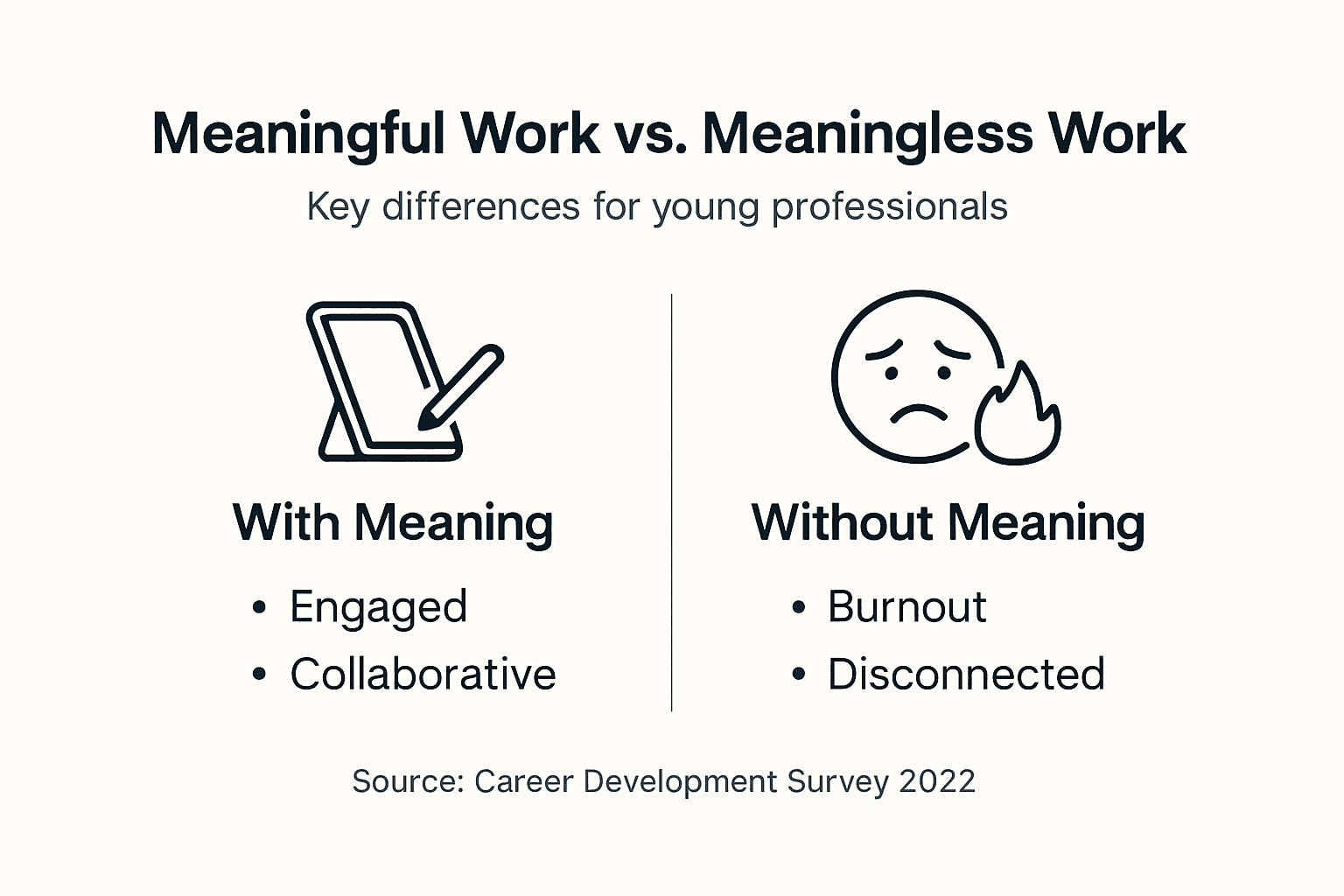
Consider these outcomes when meaning is present versus absent in your career:
| With Meaning | Without Meaning |
|---|---|
| Lower stress and burnout | Faster burnout and fatigue |
| Higher professional growth | Career stagnation and plateau |
| Stronger relationships | Workplace isolation |
| Increased resilience | Low motivation and apathy |
Young professionals face specific vulnerabilities. You’re still forming your professional identity and establishing patterns. Choosing meaningless work now compounds over decades.
Three major risks emerge from meaningless work:
- Burnout acceleration: Without purpose to sustain you, stress becomes purely negative
- Career stagnation: You disengage, stop learning, and miss advancement opportunities
- Health deterioration: Chronic stress from misalignment triggers anxiety, depression, and physical illness
The trap deepens because meaningless work pays. You earn money, gain skills, build a resume—but feel increasingly empty. The financial security makes it harder to leave, even as your well-being erodes.
Meaninglessness also corrupts your decision-making. Relying solely on external metrics without internal alignment causes you to chase the wrong goals. You optimize for salary, title, or status rather than purpose, guaranteeing continued emptiness.
How to avoid this trap:
- Question regularly: Every quarter, ask if your work aligns with your values and contributes something you believe in
- Stay curious about yourself: Your ikigai evolves. What mattered at 25 might shift at 28. Keep exploring
- Assess impact honestly: Can you articulate what problem you solve or who benefits from your work?
- Maintain agency: If meaning vanishes, take action rather than tolerating it indefinitely
Ensuring ethical diligence and validity in how you spend your time prevents you from wasting years on meaningless pursuits. This applies to career choices as much as research.
The antidote starts early. If you’re considering a role, investigate its purpose before accepting. Talk to current employees about whether the work feels meaningful, not just whether it pays well.
Meaninglessness isn’t inevitable. It’s a choice you make repeatedly when you stop asking whether your work matters.
Pro tip: Set a six-month review date. Write down your current role’s purpose, who it serves, and whether you’d choose it again today. If your answer is “I’m not sure,” that’s your signal to actively explore what would feel more meaningful.
Discover Your Personal Ikigai and Unlock True Career Meaning
The challenge of finding authentic meaning in your work and life is real and urgent for young professionals today. If you feel stuck balancing personal values, professional growth, and social impact as outlined in the article “Why Life Meaning Matters for Young Professionals” then you are not alone. Many struggle to integrate these dimensions into a fulfilling career and life path. This is exactly where Ikigain.org can help. Our comprehensive personality test guides you to uncover your core passions, strengths, and what truly sustains you. By applying the Japanese philosophy of Ikigai, you learn how to align what you love, what you are good at, what the world needs, and what provides stability.
Take control of your journey now with insights that transform vague aspirations into clear direction. Do not wait until feeling burnt out or disconnected forces you to reexamine your path. Explore how meaning deeply influences mental well-being and career success and gain personalized guidance to build a purposeful life today. Begin your self-discovery process at Ikigain.org and move toward a career and life where fulfillment and growth support each other fully.
Frequently Asked Questions
What is the difference between life meaning and life purpose?
Life meaning focuses on the emotional satisfaction you derive from your choices, while life purpose is more about the directional goals you set for yourself. Purpose can guide you, but meaning is about the fulfillment you feel along the way.
How can I find personal meaning in my career?
To find personal meaning, reflect on your values, strengths, and the goals that matter to you. Engage in activities that align with these aspects and keep exploring opportunities that can develop your skills and interests.
What are the benefits of having a meaningful career?
A meaningful career enhances mental health, reduces stress, improves engagement and motivation, fosters professional growth, and builds resilience. It can lead to better job satisfaction and a sense of fulfillment in life.
How can I avoid feelings of meaninglessness in my work?
Regularly assess whether your work aligns with your values and contributes to a cause you believe in. Stay curious about your personal growth and be open to exploring new roles or fields that seem more aligned with your sense of purpose.