Each day blends into the next when your work and relationships feel disconnected from what truly matters. Young professionals across continents are seeking something beyond routine achievement—a sense of direction that feels authentic and lasting. Ikigai, rooted in Japanese philosophy, offers a pathway to purposeful living by balancing joy, personal growth, and contribution. Discover how aligning passion with real-world impact creates a dynamic, fulfilling life designed for your generation’s unique challenges.
Table of Contents
- Purposeful Living Defined by Ikigai Principles
- Types of Purpose and the Modern Context
- Health, Career, and Well-Being Impacts
- Common Obstacles to Finding Purpose
- Steps to Cultivate Purposeful Living
Key Takeaways
| Point | Details |
|---|---|
| Understanding Ikigai | Ikigai combines what you love, what you’re good at, what the world needs, and what is rewarded, offering a pathway to purposeful living. |
| Importance of Multi-Dimensional Purpose | Purpose varies by individual and can encompass career, personal relationships, and social contributions, requiring a conscious approach to identify what resonates. |
| Impact on Well-Being | Aligning your life with ikigai positively influences mental health, career satisfaction, and social connections, leading to a more fulfilling life. |
| Overcoming Barriers | Common obstacles like identity confusion and fear of failure can hinder finding your ikigai, so it’s vital to identify and navigate these challenges effectively. |
Purposeful Living Defined by Ikigai Principles
Purposeful living isn’t about chasing status or accumulating achievements. It’s about finding what gives your life genuine direction and satisfaction. Ikigai, a Japanese philosophy translating to “reason for being,” offers a framework for understanding what makes life feel meaningful on a deeper level.
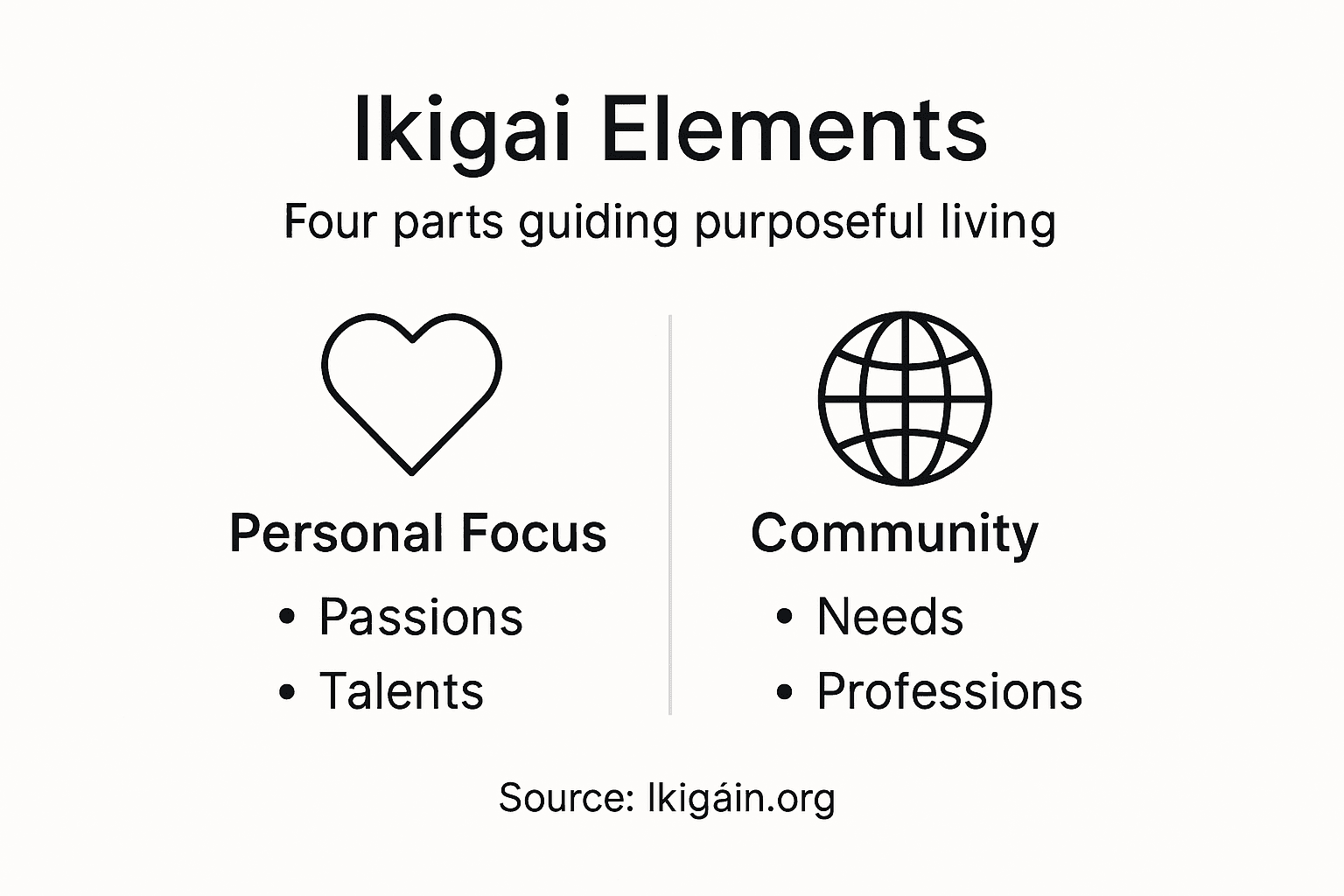
The concept originated in Okinawan culture and has become a global approach to well-being. At its core, ikigai asks you to examine four intersecting dimensions: what you love doing, what you’re naturally talented at, what the world needs from you, and what brings you financial or personal reward. When these four elements align, you’ve found your ikigai—the place where purpose lives.
Ikigai encompasses life satisfaction, personal growth, and challenge, creating a comprehensive framework rather than a simple checklist. This means purposeful living isn’t static. It evolves as you grow, learn, and change. You’re not searching for a single answer you’ll find and keep forever. Instead, you’re engaging in an ongoing process of discovery that keeps your life dynamic and engaged.
What distinguishes ikigai from other purpose-driven philosophies is how it integrates both happiness and meaning. Most people chase either immediate pleasure or long-term significance, but rarely both simultaneously. Ikigai bridges this gap. It asks you to find activities that feel joyful in the moment while also contributing to something larger than yourself. Flow and joy in everyday life become central—not as rewards you earn after grinding through boring work, but as essential components of the work itself.
Here’s a comparison of the four core elements of Ikigai and their roles in purposeful living:
| Ikigai Element | Description | Impact on Life Direction | Example Activity |
|---|---|---|---|
| What You Love | Activities that spark deep joy | Fuels motivation and passion | Painting, playing music |
| What You Are Good At | Natural talents and developed skills | Builds confidence and mastery | Coding, teaching, writing |
| What the World Needs | Ways to serve or contribute to others | Creates societal relevance | Volunteering, eco-projects |
| What Is Rewarded | Brings financial or personal rewards | Ensures sustainability | Freelancing, entrepreneurship |
For your generation specifically, this matters enormously. You’re navigating careers that didn’t exist a decade ago, with economic uncertainty your parents never faced. Traditional paths feel less reliable. Purposeful living grounded in ikigai principles offers something more stable than any job title: a personal compass that helps you make decisions aligned with who you actually are, not who you’re supposed to become.
Pro tip: Start by writing down activities where you lose track of time completely—moments when hours pass without you noticing. These clues often reveal what genuinely engages you, providing the foundation for discovering your ikigai.
Types of Purpose and the Modern Context
Purpose isn’t one-size-fits-all. The sources that fuel your sense of direction vary wildly depending on who you are, what you value, and what’s happening in your life right now. Understanding the different types of purpose helps you recognize which ones resonate with you and why they matter.
Research identifies multiple types and sources of purpose including sustainability, faith, security, community, and personal growth. This matters because each type interacts differently with your overall well-being. Someone driven by community purpose might feel energized by volunteer work, while another person finds purpose through creative expression or environmental sustainability. Neither is “more correct”—they’re just different pathways to meaningful living.
In modern contexts, purpose operates across multiple dimensions simultaneously. You might find vocational purpose through your career, personal purpose through relationships and hobbies, and social purpose through contributing to causes you believe in. The complexity here reflects reality. You’re not a one-dimensional person, so your purpose shouldn’t be either.
For your generation specifically, this multi-layered approach to purpose feels especially relevant. You’re less likely than previous generations to build your entire identity around a single job. Instead, you’re constructing purpose from various sources: side projects, volunteer work, creative pursuits, professional advancement, and social impact all contribute simultaneously. This flexibility is powerful, but it requires conscious awareness of what drives you across different life areas.
The challenge in today’s context is that more options can actually create confusion. You have access to unlimited possibilities for where to direct your energy. Without clarity on which types of purpose genuinely matter to you, you risk spreading yourself too thin or chasing purposes that sound impressive but don’t actually fulfill you.
This table summarizes how different types of purpose can influence overall well-being:
| Purpose Type | Area of Life Most Affected | Example Positive Outcome |
|---|---|---|
| Community | Social health and belonging | Stronger relationships |
| Personal Growth | Mental resilience and learning | Higher self-esteem |
| Sustainability | Environmental awareness | Engaging in eco-friendly habits |
| Faith | Emotional stability | Sense of hope and comfort |
| Security | Financial and emotional safety | Reduced stress and anxiety |
Pro tip: Map your current activities across purpose types: which bring financial reward, which serve your community, which challenge your growth, and which align with your values? This reveals where you’re already living purposefully and where gaps exist.
Health, Career, and Well-Being Impacts
Purposeful living isn’t just feel-good philosophy. The research backs up what many people intuitively sense: aligning your life with your ikigai creates measurable improvements across physical health, mental well-being, and career satisfaction.
The evidence is compelling. A scoping review of 86 studies documents that ikigai positively affects mental health by reducing depression and enhancing life satisfaction. Beyond mental health, the same research shows ikigai lowers risks of mortality and disability while increasing social connectedness. These aren’t marginal improvements. We’re talking about meaningful differences in how long you live, how healthy you feel, and how connected you are to others.
Your career represents a massive portion of your adult life. Most people spend roughly one-third of their waking hours working. When that work aligns with your purpose, everything changes. Ikigai serves as a framework in career counseling that integrates intrinsic motivation, competencies, values, and economic sustainability. This matters enormously in today’s job market where technological disruption and unpredictability are constants. Rather than chasing whoever’s hiring, ikigai helps you make career decisions grounded in what actually fulfills you.

The practical impact shows up in job satisfaction and motivation. When your work aligns with your ikigai, you’re not just earning a paycheck. You’re building something meaningful, using skills you’re genuinely good at, contributing value you believe matters. This alignment reduces burnout significantly. You’re still working hard, but you’re working toward something that feels worthwhile.
Social health improves through ikigai as well. People living purposefully tend to have stronger relationships and community involvement. Purpose creates natural connection points with others who share similar values and passions.
Pro tip: If you’re unhappy in your current role, evaluate it against ikigai’s four dimensions rather than immediately jumping ship—sometimes small changes in how you approach work unlock unexpected fulfillment.
Common Obstacles to Finding Purpose
Finding your ikigai sounds straightforward until you actually try it. Most people run into real obstacles that make the process harder than expected. Understanding these barriers helps you recognize them when they show up and navigate around them.
Psychological barriers like lack of motivation, identity confusion, and fear of failure limit purpose acquisition significantly. Identity confusion is especially relevant for your generation. You’ve been told to pursue your passion, follow your dreams, and find your calling. But nobody teaches you how. You’re left wondering if you’re supposed to already know who you are.
Fear of failure compounds this. What if you invest time and energy exploring a potential purpose and it turns out you’re not good at it? What if you pursue something and realize it doesn’t fulfill you after all? The stakes feel high, so many people choose paralysis instead.
Another major obstacle is lack of accessibility. Certain purposeful activities require resources you might not have: time, money, connections, or educational credentials. Someone working two jobs to pay rent has less bandwidth to explore their ikigai than someone with financial stability. This isn’t a personal failing. It’s a systemic reality that affects your ability to pursue purpose.
Time constraints are brutal. Between work, responsibilities, and maintaining basic self-care, many young professionals struggle to find space for purposeful exploration. You’re exhausted. Finding purpose takes energy you don’t have left.
Identity confusion and lack of clarity about your actual talents creates another block. You might genuinely not know what you’re good at or what brings you joy because you’ve been optimizing for grades, promotions, or approval from others.
Pro tip: Start small: identify one activity this week where you felt engaged or accomplished, then trace backward to understand what made it meaningful—this builds awareness without requiring massive time investment.
Steps to Cultivate Purposeful Living
Cultivating purposeful living isn’t mystical or complicated. It’s a practical process that unfolds through specific, actionable steps. Research shows concrete approaches that actually work across different populations and life situations.
Start by identifying your strengths. Not what you wish you were good at, but what you genuinely excel at right now. This grounds purpose discovery in reality rather than fantasy. Many people skip this step because it feels too simple. Don’t. Your strengths are the foundation everything else builds on.
Next, reflect on life transitions and moments when you felt most alive. That promotion you got. The volunteer project that energized you. The conversation that changed your perspective. Cultivating purpose involves recognizing daily progress toward meaningful goals and positively engaging with challenges. These moments reveal patterns about what matters to you.
Build your support system intentionally. Fostering positive emotions and character strengths requires enhancing support from family, school, and community. You can’t cultivate purpose in isolation. Find people who believe in what you’re pursuing. Join communities around your interests. Seek mentors who’ve walked similar paths. This network becomes crucial when motivation dips.
Engage in skill development deliberately. Purpose isn’t passive. You need to actively build competencies in areas that matter to you. Take classes, read, practice, experiment. As you develop skills, your confidence grows and opportunities expand.
Commit to purposeful activities consistently. Purpose compounds over time. Small daily actions accumulate into real change. You don’t need dramatic transformation. You need sustained engagement with what matters to you.
Pro tip: Schedule one weekly activity directly tied to your potential ikigai, treating it with the same importance as work meetings—consistency matters far more than intensity when building purposeful momentum.
Discover Your Ikigai and Embrace Purposeful Living Today
The journey to purposeful living begins with understanding your unique strengths, passions, and values as highlighted in the article “Why Seek Purposeful Living Real Benefits of Ikigai.” If you struggle with identity confusion, fear of failure, or feel overwhelmed by endless choices about your career and personal growth you are not alone. Finding your real reason for being takes clarity and guidance that connects your natural talents with what the world needs and what brings you fulfillment.

At Ikigain.org you can take a scientifically designed personality test built on the Ikigai philosophy to reveal your core passions and strengths. This personalized insight acts as your modern compass helping you navigate career decisions and life challenges with confidence and purpose. Don’t wait until frustration or burnout takes hold. Explore how aligning your activities with your Ikigai leads to better mental well-being stronger social connections and sustained motivation. Take your first step now by visiting Ikigain.org and start uncovering your path to a fulfilling life.
Frequently Asked Questions
What is ikigai and how does it relate to purposeful living?
Ikigai is a Japanese philosophy that translates to “reason for being.” It consists of four overlapping dimensions: what you love, what you’re good at, what the world needs, and what brings financial or personal reward. Purposeful living comes from aligning these dimensions to find joy and meaning in life.
How can ikigai improve my mental health?
Research shows that identifying and pursuing your ikigai can enhance mental health by reducing depression, increasing life satisfaction, and fostering social connections, leading to a more fulfilling life.
What practical steps can I take to discover my ikigai?
Start by identifying your strengths and reflecting on moments that made you feel alive. Build a support system, engage in skill development, and commit to consistent activities related to your ikigai, treating them as important as work responsibilities.
How does purposeful living impact career satisfaction?
When your career aligns with your ikigai, you’re more likely to experience job satisfaction and motivation, reducing burnout and helping you work towards something meaningful rather than just earning a paycheck.