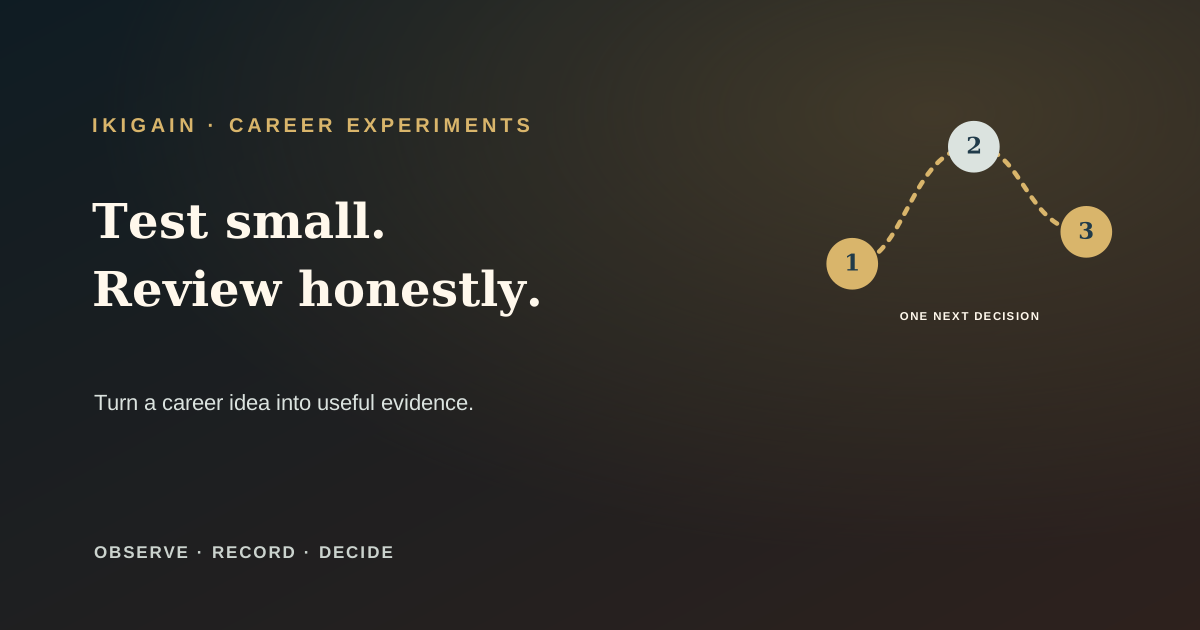
A small career experiment gives you better information than a career idea kept entirely in your head. But the experiment only helps if you record more than whether you felt excited. Note the task, the conditions, the effort, the result, and what you want to learn next.
One good afternoon does not prove that a direction is right. One awkward attempt does not prove that it is wrong. The point is to collect a few comparable observations so you can decide whether to repeat, adjust, investigate, or stop.
The short answer: record five things
After each experiment session, write down:
- The task: what you actually did, not the job title you imagined.
- The conditions: time available, level of support, pace, tools, and interruptions.
- Your experience: attention, energy, difficulty, and willingness to continue.
- The evidence: what you produced, learned, or heard from another person.
- The next decision: repeat it, change one condition, ask a question, or stop.
This turns “I think I might like this” into a small record. It also protects you from forcing the experiment to confirm the story you started with.
An experiment is not a mood test
People often evaluate a new direction with one question: “Did I enjoy it?” Enjoyment matters, but it is not the whole decision.
You can enjoy a task because it is new and still dislike its repeated version. You can feel clumsy during a first attempt and still want to learn. You can find a task meaningful but discover that the pace, income, schedule, or social demands do not fit your life.
Use a wider set of questions:
- Did the task hold my attention once the novelty faded?
- Which part was difficult: the skill, the instructions, the environment, or the stakes?
- Did the effort leave me tired in a satisfying way or simply depleted?
- Would I choose another session after seeing the ordinary work involved?
- What condition would make the task more sustainable?
Do not turn each answer into a personality label. Keep it attached to the situation you observed.
Choose one question before you start
A career experiment becomes too vague when it tries to answer everything at once. Choose one question that can change your next step.
| Question | Useful experiment |
|---|---|
| Do I enjoy explaining a complex topic? | Prepare and deliver a short explanation to one person |
| Do I want to work with data? | Clean a small dataset and describe one pattern |
| Do I like supporting people through a problem? | Have a structured conversation and summarise the next step |
| Do I want to build digital products? | Map one user problem and make a simple prototype |
| Do I want more independent work? | Complete a bounded task with your own process and deadline |
The experiment does not need to imitate an entire profession. It needs to expose one activity that matters to the direction you are considering.
Record a baseline before the first session
Before you begin, write three predictions:
- I expect to enjoy…
- I expect to find difficult…
- I will need… in order to continue.
Add a starting rating from 1 to 5 for curiosity, confidence, and available energy. These ratings are not scientific measurements. They make your expectations visible so you can compare them with what actually happened.
Also write what the experiment cannot tell you. A two-hour writing task cannot establish whether a writing career is financially viable. A conversation with a professional cannot show your own response to the daily work. Clear limits make the evidence more honest.
Use this five-minute session log
Complete the log immediately after each session. Keep the language concrete.
| Field | Note |
|---|---|
| Date and duration | When did I do it, and for how long? |
| Task | What did I make, solve, explain, organise, or test? |
| Conditions | Where was I, who helped, and what interrupted me? |
| Before | What did I expect, and what was my energy from 1–5? |
| During | Which part held my attention? Where did I get stuck? |
| After | What did I feel like doing next? Energy from 1–5? |
| Evidence | What exists now that did not exist before? |
| Question | What do I need to find out next? |
“It was interesting” is a starting point, not a review. Add one visible detail: “I kept revising the structure after the first version,” “I wanted clearer instructions,” or “I enjoyed the conversation but not the follow-up administration.”
Check the conditions before judging the direction
An experiment can fail because of its design. If you try a new activity while exhausted, with unclear instructions and no chance to ask questions, the result tells you about that setup.
Record conditions such as:
- time of day and length of the session;
- whether you worked alone or with someone;
- how much control you had over the method;
- access to the necessary tools or information;
- interruptions, noise, or competing responsibilities;
- whether you knew what a finished result should look like.
You are not looking for perfect conditions. You are looking for the conditions that the activity requires and the conditions you can realistically create. If the direction only works when every constraint disappears, that is important evidence too.
Review patterns, not your most dramatic moment
At the end of three sessions, put the logs next to each other. Do not start with the strongest emotional reaction. Start with repeated details.
Look for repetition
Did the same part attract your attention each time? Did the same obstacle appear? Did you keep asking for more context, more autonomy, more feedback, or more contact with the people affected by the work?
Look for exceptions
Was one session different because you had better preparation, a clearer brief, or a helpful partner? An exception can identify a condition worth testing, rather than invalidating the whole experiment.
Look for costs
What did the task require from the rest of your life? A direction can be interesting and still demand a schedule, income, travel pattern, or emotional load that you cannot accept. Record those costs without treating them as a lack of commitment.
A composite example: Nina tests research work
Illustrative example: the person and situation are fictional.
Nina is considering a move into user research. She reads about interviews and analysis, then designs a small experiment: speak with two people about a simple product problem, group their answers, and write three observations.
Her first log says she enjoyed asking follow-up questions but felt lost when the answers did not fit one pattern. She expected analysis to be the most interesting part; instead, she kept returning to the wording of the questions. Her second session uses a clearer interview guide and a fixed sorting method. She finishes with more confidence but notices that writing a concise summary takes longer than expected.
After two sessions, Nina has not proved that she should become a researcher. She has learned three useful things: she likes structured curiosity, she needs practice turning notes into themes, and she wants to test whether repeated interviewing remains engaging. Her next step is a third session with a different topic and a conversation with someone who does the work professionally.
That is a successful experiment even if she later chooses another direction. The record changed the quality of her decision.
Separate a good task from a good role
A career includes more than the activity you tested. After recording the task, add a second line: “What would surround this activity in the real role?”
For example:
- A teacher does not only explain; they plan, assess, communicate with families, and manage a room.
- A designer does not only create; they interpret briefs, revise work, discuss trade-offs, and meet deadlines.
- A developer does not only code; they read existing systems, test, document, coordinate, and maintain what already exists.
- A coach does not only listen; they prepare, keep boundaries, document, and handle uncertainty responsibly.
Ask which surrounding tasks you need to investigate next. A strong interest in one activity is a reason to learn more, not a guarantee that the full role will suit you.
Review feedback without surrendering your decision
Feedback adds evidence, but another person’s reaction is not an identity verdict. Ask what they actually observed:
- What was clear in my work?
- Where did the process slow down?
- What would make the result more useful?
- Which skill should I practise next?
Write the feedback beside your own observation. Agreement is helpful, but disagreement is informative. You may value a part of the work that the other person did not see, or you may have missed a problem because you were focused on the result.
Choose one of four next decisions
After reviewing the logs, choose a decision rather than writing a general conclusion.
Repeat
The activity still interests you and the main uncertainty needs more exposure. Repeat it with a slightly different task or audience.
Adjust
The direction is plausible, but one condition distorted the experience. Change the time, support, instructions, tools, or level of autonomy and try again.
Investigate
The task was useful but raised a question you cannot answer alone. Speak with someone in the field, read real job descriptions, or inspect training and entry requirements.
Stop or pause
The repeated evidence does not justify more investment right now, or the costs are outside what you can accept. Stopping one experiment is not rejecting your capacity or closing every future option.
What research can and cannot add
Research on meaningful work connects personal experiences with the quality and structure of the work itself. The Annual Review of decent work and meaningful work is useful background because it treats meaning as more than an individual attitude. Your small experiment cannot validate a career scientifically, but it can help you identify which tasks and conditions deserve further investigation.
Connect the experiment to a wider decision
If the experiment came from a self-discovery result, keep the result in the background and focus on what you observed. The guide on using self-discovery tests for a career decision explains how to choose the missing evidence instead of collecting more labels.
If you are unsure whether the problem is the career or the current workplace, compare your notes with the career-change questions worth investigating. A Work Values Test can help you name conditions to include in the next experiment, but the real week still supplies the evidence.
A 15-minute review worksheet
When the experiment ends, answer these questions:
- What did I actually do?
- What did I predict incorrectly?
- Which part held my attention after the novelty faded?
- Which condition helped or harmed the experience?
- What did I produce, learn, or hear from someone else?
- What cost would this direction add to my life?
- What is the smallest next decision I can make with this evidence?
End with one sentence that begins, “I am more informed about…” and another that begins, “I still need to learn…” The second sentence is not a failure. It is the reason to design the next step.
FAQ: reviewing a career experiment
How long should a career experiment last?
Long enough to expose the activity more than once, but small enough to fit your current responsibilities. Three comparable sessions can reveal more than one dramatic trial. Increase the scale only when the next question requires it.
What if I feel tired after every session?
Separate useful effort from harmful depletion. Check the task, pace, time of day, recovery, and conditions. Tiredness alone does not decide the direction, but repeated exhaustion deserves attention.
What if the experiment goes badly?
Describe what went wrong before deciding what it means. The difficulty may involve a missing skill, unclear instructions, the setting, or the activity itself. Change one factor and repeat only if the question remains worth answering.
Should I record a score for enjoyment?
You can use a simple rating to notice change, but never treat it as the whole result. Pair it with a concrete observation, an output, a condition, or feedback from another person.
Can an experiment tell me which career to choose?
No. It can reduce uncertainty about a task, condition, or skill. A career decision also needs information about training, opportunities, income, health, responsibilities, and the wider role.