AI can help you explore meaningful work, but it cannot discover your purpose for you.
It can help turn a vague question into smaller questions, compare job descriptions, suggest people to learn from, practise an interview, or design a low-risk experiment. It can also produce confident nonsense, repeat stereotypes, expose private information, and recommend paths based on assumptions you never agreed with.
The useful role for AI is closer to a research assistant or thinking partner than an oracle. You remain responsible for the question, the evidence, the decision, and the consequences.
Quick answer
Use AI to expand and organize your exploration, not to make the final judgment about what is meaningful for you.
Good uses include:
- turning a broad purpose question into a short list of testable questions;
- summarizing several real job descriptions you provide;
- identifying repeated tasks, skills, and working conditions;
- generating questions for an informational conversation;
- helping you plan a small project, observation, or skills experiment; and
- rehearsing how to describe your interests without pretending to have certainty.
Weak or risky uses include:
- asking a chatbot to name your one perfect career;
- sharing sensitive personal or workplace information without checking the tool’s privacy terms;
- accepting invented salary, qualification, or labour-market claims;
- treating an AI-generated personality analysis as a psychological assessment; and
- letting recommendations narrow your options before you have explored real experiences.
The International Labour Organization’s 2025 update on generative AI and jobs is a useful reminder that AI exposure is better understood at the task and occupation level than through dramatic claims that entire careers will simply disappear. That same task-level thinking helps with personal exploration: examine the work itself before deciding whether the label fits you.
What AI can do well in career exploration
1. Make a large question smaller
“What should I do with my life?” contains several different questions:
- What activities hold my attention?
- Who do I want to help, and in what way?
- Which skills do I want to develop?
- What conditions can I sustain?
- What constraints must my next choice respect?
- Which options are realistic to investigate now?
AI can help you separate those questions and turn them into a worksheet. It can also show where your question is still too vague.
For example, instead of asking “What is my purpose?”, ask:
I am comparing three possible directions. Help me turn each one into a two-hour experiment. For each experiment, list what I could learn, what evidence would support the direction, and what the experiment cannot prove.
That prompt asks for structure rather than a prediction.
2. Organize information you already have
You can provide several real job descriptions and ask AI to extract:
- repeated tasks;
- required and preferred skills;
- likely working conditions;
- points of difference between the roles; and
- questions that the job descriptions do not answer.
This can save time when you are comparing options. But the output is only a summary. Check it against the original listings, the employer’s current information, and conversations with people who do the work.
A summary may miss what matters most: how much time is spent on routine administration, who makes decisions, how performance is judged, how often priorities change, or what the team is like in practice.
3. Translate a result into a question
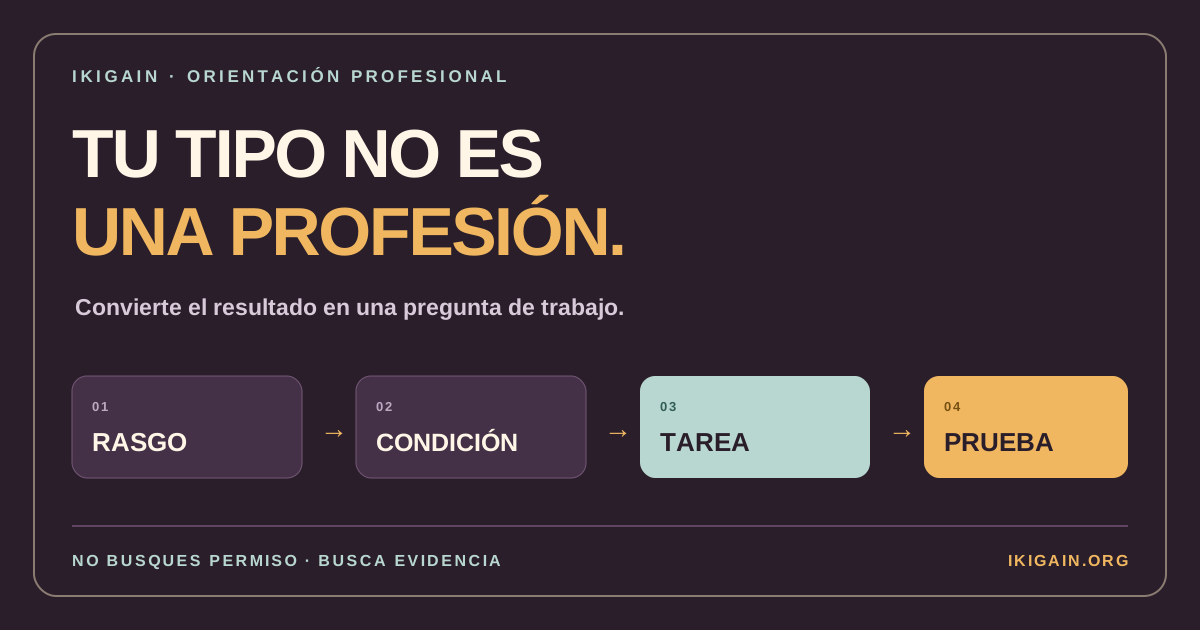
If you have taken the Career Interests Test, Work Values Test, or a personality assessment, AI can help you turn a result into questions about tasks and environments.
You can also use the Big Five Personality Test as a prompt for noticing work conditions, then compare it with the Ikigain guide to choosing a first test. Different tools answer different questions; AI should not blur them into one score.
For example:
My result suggests I may enjoy structured problem-solving. Give me five different work contexts where that could appear, and for each one write a question I could ask someone who does the work. Do not recommend a career or assume the result is definitive.
This keeps the result in proportion. The AI is not validating the assessment. It is helping you move from a label to an investigation.
4. Help design a small experiment
AI is useful when the next step is practical and reversible. It can help you turn an interest into an activity with a time limit, a clear question, and an observation plan.
Examples:
- create a short project that uses one skill from a job description;
- draft questions for a 20-minute informational conversation;
- make a checklist for attending an introductory workshop;
- compare a volunteer task with the ordinary tasks in a possible role; or
- plan how to review what gave you energy, difficulty, or curiosity afterward.
The seven-day Ikigai experiment uses this same principle without requiring AI. Technology can help you prepare the experiment, but direct participation is where the most useful evidence usually appears.
5. Rehearse a conversation
You can ask AI to play the role of a skeptical interviewer, a potential manager, or a person working in a field you are exploring. This can help you practise explaining:
- why you are curious about the field;
- which experience you already have;
- what you still need to learn;
- what kind of work conditions you want to understand; and
- what questions you would ask before making a commitment.
Rehearsal is not a replacement for a real conversation. It is preparation for one.
What AI cannot know about your purpose
AI does not directly experience your life. It cannot feel the meaning of a relationship, understand the bodily cost of a schedule, know what you will regret, or decide which responsibility you are willing to carry.
It also cannot reliably infer your values from a short chat. A fluent explanation of your “hidden strengths” may sound personal while being built from common patterns in language. A confident career recommendation may reflect the prompt, the model’s training, or generic associations rather than your actual circumstances.
Do not ask AI to make claims it cannot support:
- “Tell me the career I am destined for.”
- “Diagnose why I cannot find motivation.”
- “Infer my personality from this short message.”
- “Guarantee that this career will make me happy.”
- “Tell me what I should sacrifice to succeed.”
Turn those into questions that preserve your agency:
- “What assumptions are hidden in the options I am considering?”
- “What evidence would help me compare these directions?”
- “What small experiment could distinguish interest from an attractive idea?”
- “What constraints should I discuss with a qualified career professional?”
AI is a mirror only if you question the reflection
When you ask AI for career ideas, it often reflects the words and assumptions in your prompt. If you say you are “bad with people,” it may build recommendations around that statement without asking where it came from. If you say you are “creative,” it may suggest a narrow set of creative occupations without exploring what kind of creativity you enjoy.
Before trusting the output, ask:
- What did I tell the system that shaped these suggestions?
- What did it assume without evidence?
- Which options did it fail to mention?
- What would a person who disagreed with me say?
- Which recommendation can I test in the real world?
This is why it helps to ask for alternatives, counterexamples, and missing information. A good prompt does not only ask for more ideas. It asks the tool to expose the limits of its ideas.
A safe prompt pattern
Use this five-part structure:
- Context: What are you exploring?
- Question: What do you want to understand?
- Evidence: What information can the tool actually use?
- Limits: What must it not assume or claim?
- Output: What practical format would help?
Example:
I am comparing instructional design, user research, and technical writing. I am interested in explaining complex information and need a sustainable schedule. Based only on the three job descriptions below, make a table of tasks, collaboration patterns, skills, and unanswered questions. Do not rank the careers, infer my personality, or invent salary and hiring information. End with one low-risk experiment for each direction.
The limit sentence is important. It tells the tool what kind of help you want and reduces the temptation to treat a generated answer as an assessment.
Protect private information
Do not paste personal information merely because it might make a recommendation feel more tailored. Be cautious with:
- health or mental-health details;
- financial information;
- names and contact details;
- confidential workplace documents;
- private messages and identifiable stories about other people;
- assessment reports containing sensitive data; and
- information that could identify a child, client, patient, or colleague.
Use a generalized description when possible. Replace names, employers, exact dates, and unique details with neutral placeholders. Check the tool’s current privacy settings and terms before entering anything sensitive.
NIST’s AI Risk Management Framework emphasizes that trustworthy AI requires attention to context, privacy, transparency, fairness, and accountability. You do not need to become an AI engineer to apply the basic principle: the more consequential or personal the decision, the more carefully you should examine the system, the data, and the human oversight around it.
Watch for bias and recommendation loops
AI systems learn from existing examples and patterns. Those patterns can reproduce stereotypes about gender, age, education, disability, culture, language, class, or what a “successful” career looks like.
Bias can enter through your prompt too. If you ask for careers “for someone like me,” the system may treat a few facts as a complete identity. It may recommend familiar occupations because they are well represented in its training material, while overlooking local, emerging, informal, or less visible paths.
Ask for a diversity check:
- What options are missing because they are less common online?
- How might this advice change by country, language, disability, age, or financial constraint?
- Which claims require current local research?
- What would I need to ask a human practitioner?
Then verify current requirements, salaries, training routes, and labour-market information using reliable local sources. AI should not be the only source for a decision involving money, education, health, immigration, or a major career change.
A seven-day AI-assisted purpose experiment
You can combine the earlier Ikigai exercise with AI without making technology the centre of it.
Day 1: Clarify the question
Ask AI to turn “I need meaningful work” into five narrower questions. Choose one that you can investigate in a week. Keep the original output and your edits so you can see which assumptions you accepted.
Day 2: Compare real work
Provide three current job descriptions and ask for a task-and-condition comparison. Verify the summary against the source. Mark one unanswered question for each role.
Day 3: Add a human source
Use AI to prepare five questions for a person who does one of the jobs. Have the actual conversation if possible. Record what surprised you and what the job description did not show.
Day 4: Design a small task
Ask for three low-risk experiments that resemble the work. Choose one with a clear finish line. Avoid experiments that require a costly course, public promise, resignation, or irreversible commitment.
Day 5: Do the task
Complete it without asking AI to interpret every feeling in real time. Notice what you did, what you wanted to learn, and which conditions affected the experience.
Day 6: Reflect without outsourcing the judgment
Write your own observations first. Then ask AI to organize them into “evidence for,” “evidence against,” “unknown,” and “next question.” Correct any summary that does not sound accurate.
Day 7: Choose the next experiment
Decide whether to continue, adjust, or release the possibility. AI may help you plan the next step, but you make the decision and define what evidence would change your mind.
A founder note from Sindy’s search for ikigai
When I was looking for ikigai, I could generate endless possible directions and still feel no closer to a decision. The useful question became smaller: can this tool help me design one honest experiment, while I keep the meaning and the choice in human hands?
That is the boundary I find most helpful. AI can make the exploration wider and more organized. It cannot make a life choice meaningful on your behalf.
When not to use AI alone
Bring in a qualified human professional or a trusted person with relevant lived experience when:
- the decision involves mental health, disability, or an accommodation;
- you are choosing expensive training or leaving a job;
- your situation includes financial, legal, immigration, or safety constraints;
- you need an assessment or diagnosis;
- the recommendation affects another person’s employment or education; or
- the conversation is producing distress rather than useful clarity.
AI can help you prepare questions for that conversation. It should not be used to impersonate the professional, make a diagnosis, or turn a complex life situation into a neat label.
FAQ
Can AI tell me which career is right for me?
No. AI can organize information, suggest questions, compare tasks, and help design experiments, but it cannot know your full context or decide what meaning you will find in a life. Treat recommendations as hypotheses that need human judgment and real-world evidence.
Can AI analyze my personality and find my Ikigai?
It can generate a description from the information you provide, but that is not a validated personality assessment or a reliable discovery of your Ikigai. Use personality and purpose tools as reflection prompts, and avoid sharing sensitive information just to receive a more personalized answer.
How can AI help with a career change safely?
Give it generalized information, ask it to compare real job tasks, require it to state assumptions, and verify current claims with reliable sources. Use it to prepare conversations and small experiments rather than making an expensive or irreversible choice from one generated recommendation.
Will AI replace meaningful work?
There is no single answer for every occupation. AI exposure varies by task, workplace, technology, and the choices organizations make. Focus on the work you want to learn, the human contribution involved, and the skills and conditions that could remain valuable as tasks change.
Final takeaway
AI can help you explore meaningful work when it expands your questions, organizes real information, and supports small experiments.
It becomes unhelpful when it pretends to know your purpose, hides its assumptions, or makes you less willing to speak with people and try things yourself. Use the tool to prepare the next step. Keep the judgment, the values, and the life decision yours.