If you keep thinking about a career change, that does not automatically mean you should resign. It may mean that something in your working life needs attention: the tasks, the people around you, the conditions, the direction, or the stage of life you are in.
The useful question is not “Am I unhappy enough to leave?” It is “What pattern keeps repeating, and what would I need to learn before I make a large move?” A bad Tuesday can pass. A pattern that appears in different jobs, weeks, and conversations deserves a closer look.
Before you update your résumé or announce a new identity, separate the decision into two parts. First, investigate what is not working. Then run a small test of the direction you are considering. That gives you information without forcing you to make an irreversible choice from a tired moment.
The short answer: look for a pattern, not a bad day
Career change becomes worth serious investigation when three things meet:
- the problem has lasted long enough to notice a pattern;
- the problem is connected to the kind of work or conditions you want to change; and
- you can name a direction you are curious enough to test.
If only the first point is true, you may need recovery or a conversation with your manager. If the first two are true but you have no direction yet, you need exploration rather than a dramatic exit. If all three are true, a structured career experiment can help you decide what deserves more investment.
This is not a test with a pass or fail result. It is a way to replace a vague feeling with better evidence.
Are you tired of the work, the workplace, or this season of life?
“I hate my job” can describe several different problems. They may require completely different solutions.
| What may be wrong | Questions to ask | A smaller first move |
|---|---|---|
| The work itself | Which recurring tasks make you feel flat, even when the day is calm? | Try a project that uses a different skill or contact someone in another field |
| The workplace | Would the same work feel different with a reasonable manager, clearer priorities, or more control? | Explore an internal transfer or one conversation about conditions |
| The role’s level | Do you want more challenge, responsibility, or learning rather than a new profession? | Ask to own a defined project or study the next role in your field |
| Your current season | Are sleep, health, money, care responsibilities, or grief changing your capacity? | Protect recovery and stability before interpreting exhaustion as a calling |
| The direction | Do you keep returning to another kind of problem, client, or activity? | Run one realistic experiment and record what you learn |
The categories can overlap. A job with no control can make interesting work feel unbearable. A difficult season can make a good career look impossible. Naming the difference does not minimise your experience; it makes the next decision more precise.
Four signals that a career change deserves a real investigation
1. The same mismatch follows you across situations
Notice what happens when the circumstances improve. If a different manager, shorter commute, or quieter week helps, the issue may be the environment rather than the profession. If the same feeling returns whenever you perform the central tasks of the role, the work itself may be a better place to investigate.
Write down three recent moments instead of summarising the whole year. What were you doing? What did the situation require from you? What part felt draining, and what part still held your attention? Specific scenes are more useful than the sentence “I want something more meaningful.”
2. You are drawn toward a type of contribution, not only away from discomfort
There is a difference between wanting to escape and wanting to move toward something. Escape matters; it may be telling you that a boundary has been crossed. But a sustainable change also needs a positive question.
Perhaps you keep wanting to explain complicated information, design better systems, work with your hands, support people one-to-one, or solve problems with more independence. Do not turn that observation into a job title too quickly. A verb is often more useful than a label: teach, repair, organise, investigate, make, translate, guide.
The direction can stay provisional. “I want to work in education” is still broad. “I want to help adults understand difficult information without feeling embarrassed” gives you several experiments to try.
3. You are willing to test the ordinary version of the idea
Many imagined careers are attractive because we picture the best ten percent: the creative meeting, the satisfying result, the freedom. The daily version may include administration, repetition, selling, deadlines, or difficult conversations.
Ask yourself whether you are curious about the ordinary work, not only the identity attached to it. Read a real job description. Speak with someone who does the work. Ask what they spend most of their week doing and what beginners usually underestimate. Curiosity that survives detail is better evidence than a burst of excitement.
4. You can make the move without pretending that your limits do not exist
Money, health, immigration status, family responsibilities, location, and recovery time belong in the decision. They are not proof that you lack courage. A plan that ignores them may create a second crisis while trying to solve the first.
You can still move toward a new direction gradually. A course, a portfolio project, a conversation, a volunteer shift, or a small freelance assignment may reveal more than a year of imagining. The point is not to make the smallest life possible. It is to make a test you can actually finish.
Write a decision memo before you search for jobs
Open a blank page and complete these five lines:
- What I want less of: name the repeated task or condition, not just the emotion.
- What I want more of: describe the activity, contribution, or working relationship.
- What I need to protect: list the limits that cannot be treated as an afterthought.
- What I am assuming: write the belief you have not yet tested.
- What I can test this month: choose one action that produces information.
For example, “I need a completely different career” may become: “I want less of constant interruption, more time to explain and improve processes, I need to keep my income stable, and I am assuming another field would give me more control. I will interview two people and volunteer for one process-improvement project.”
That version is less dramatic, but it is much easier to act on. It also leaves room for the evidence to change your mind.
Use self-discovery tests as clues, not permission
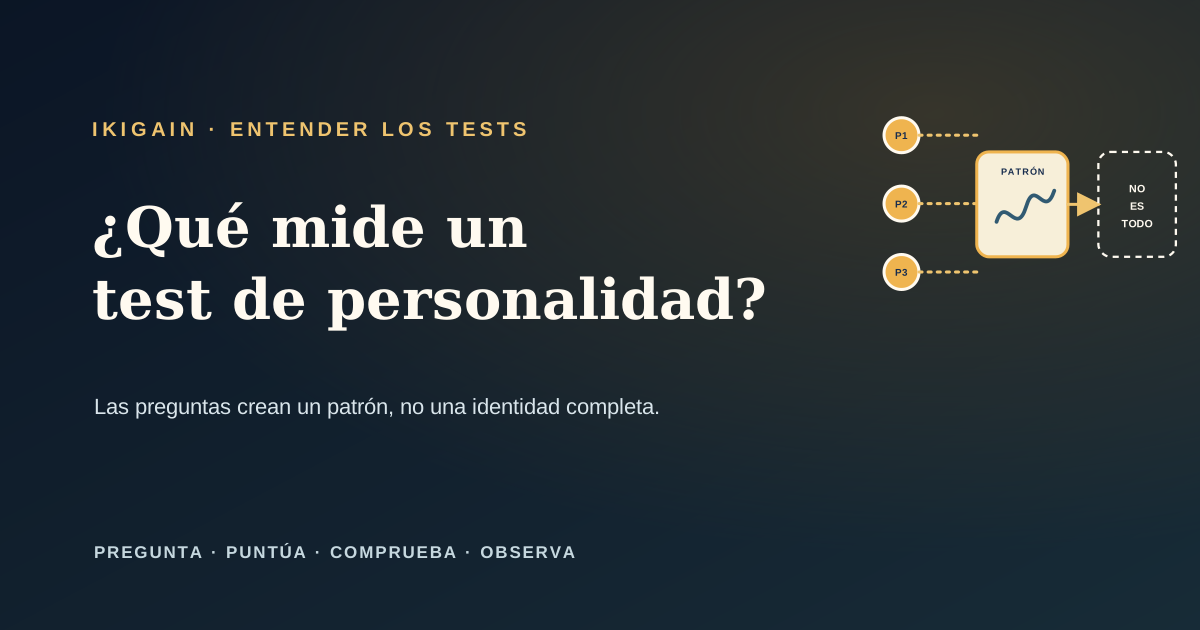
Personality, values, interests, and strengths tests can help you find language for a question. They cannot tell you whether a particular workplace will be healthy, whether a salary will support your household, or whether you will enjoy the ordinary tasks of a new role.
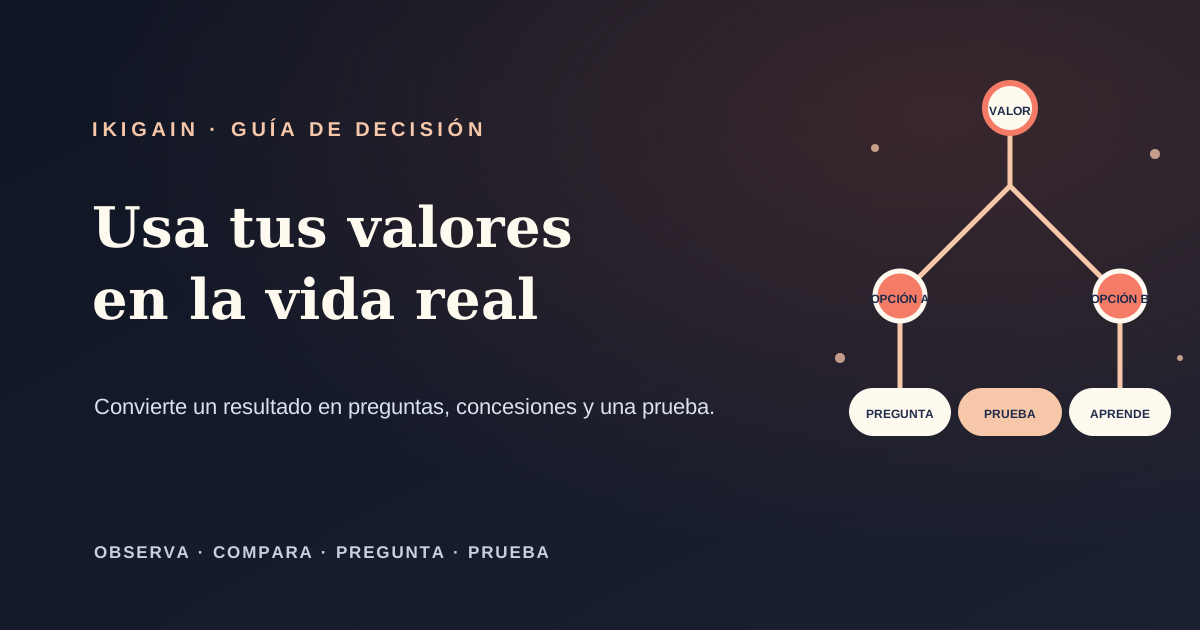
You might start with the work values test, the career interests test, or the Ikigai test. Read the result as a set of hypotheses. Which sentence matches an experience you can describe? Which one sounds flattering but gives you nothing to test? Keep the examples that survive contact with your real week.
The same caution applies to personality labels. A result can suggest that you prefer variety, autonomy, collaboration, or careful planning. It does not turn those preferences into a guaranteed occupation. Compare the result with the seven-day ikigai experiment and use a small action to gather better evidence.
When you need more concrete information, compare real occupations rather than relying on a title that sounds appealing. O*NET OnLine is a useful starting point for looking at tasks, skills, and work contexts, while the OECD’s research on career guidance for adults places career decisions in the wider context of learning and changing working lives.
A three-week reality check
If you have a possible direction, give it three weeks of deliberate attention. You do not need to leave your job during the experiment.
Week one: listen. Speak with two people who do the work or work close to it. Ask about a normal week, an unpleasant part of the job, the skills that matter at entry level, and what they wish they had known earlier.
Week two: do. Complete a small version of the work. Analyse a public example, make a sample, shadow a session, repair something, write a short explanation, or help a real person with a bounded problem. Keep the task close to the ordinary reality of the field.
Week three: review. Write down what held your attention, what drained you, what you learned quickly, and what you would need to practise. Then decide whether to stop, adjust the question, or run a larger experiment.
Do not score the experience as if you were grading your future. Look for useful friction. Finding out that you dislike a central task is valuable information. Finding out that you like the task but need a different pace or setting is also valuable.
When not to make a rushed career decision
Sometimes the right next step is not career exploration. If you are severely exhausted, unsafe at work, being harassed, in financial danger, or experiencing a mental-health crisis, deal with the immediate risk first and seek appropriate personal or professional support. A career questionnaire cannot solve an urgent safety problem.
Even when the situation is not urgent, avoid making a permanent decision at the lowest point of a temporary cycle. Take a short pause, ask what support or accommodation is available, and then return to the decision memo. Leaving may still be right; you will simply be making the choice with more information and protection around you.
FAQ: career-change questions people ask
How do I know if I need a new career or a new job?
Compare the work with the setting. If the central tasks still interest you when the environment improves, investigate a new team, employer, or role level. If the core work repeatedly drains you across settings, explore a different kind of contribution.
Can a personality test tell me which career to choose?
No. It can suggest preferences and give you language for reflection. Confirm any idea with real tasks, conversations, working conditions, and your practical limits.
Is it too late to change careers?
There is no universal age at which change stops being possible. The useful question is what kind of transition your current responsibilities can support. A gradual move, adjacent role, or skill-building project may be more realistic than starting from zero.
Should I quit before I know what I want to do next?
Usually, do not treat quitting as the first experiment if you can investigate safely while employed. Health, safety, and financial circumstances matter, so make a plan that protects your basic needs and get advice suited to your situation.
What if I have no idea what career I want?
Start with what you can observe. List tasks that hold your attention, problems you do not mind solving, and conditions that help you work well. Choose one conversation or small project that tests a pattern; clarity often follows evidence rather than arriving before it.
A career change does not have to start with a dramatic declaration. Start with one honest pattern, one direction that interests you, and one experiment small enough to complete. The answer can become clearer without asking you to gamble your whole life on a guess.