A guide to meaning in everyday life
What is ikigai?
Ikigai (生き甲斐) is a Japanese concept for what makes life feel worth living. It can come from people, everyday activities, work or interests that bring a sense of meaning and joy.
You do not need to find one perfect career to begin. Start by noticing what makes an ordinary day feel worthwhile.
01 / Understand the word
Ikigai meaning: a life that feels worth living
The word connects iki, living, with gai, worth or value. English phrases such as “reason for living” are useful approximations. A grand life mission is only one possible way to interpret that feeling.
Japan’s government describes ikigai broadly, including relationships, work and hobbies. Something can matter to you without being impressive, profitable or easy to explain to someone else. Source: Government of Japan
Your job may be meaningful in itself, or it may support the family, interests and activities that give your life meaning. You can explore both.
A useful question is: “When did I last feel that what I was doing mattered?” Stay close to a specific moment. The conversation, task or activity often tells you more than an ideal job title.
02 / Put the diagram in context
The four circles are a tool for reflection
You may have first encountered ikigai through a diagram asking what you love, what you are good at, what the world needs and what you can be paid for.
Marc Winn describes combining Andrés Zuzunaga’s purpose diagram with the word ikigai in 2014. That popular Western framework is one way to explore work and purpose; the Japanese concept reaches beyond its four questions. Source: Marc Winn
What you love
Activities and subjects you want to return to.
What you are good at
Skills you have evidence for, and ones you want to develop.
What the world needs
A person, group or need you would like to contribute to.
What can support you
Ways to earn a living that fit your practical circumstances.
Use the questions to open possibilities. If caring for someone or making music is meaningful to you, it does not need to pass an income test. For career decisions, income, qualifications and working conditions deserve their own careful consideration.
Explore the ikigai diagram and its overlaps03 / Bring it into ordinary life
What could ikigai look like in practice?
These everyday possibilities are prompts for reflection. Notice which one connects with something you have actually experienced.
Being there for someone
Helping a relative with a task, sharing a meal or making a friend feel heard.
Whose day do you care about making better?
Making or learning something
Growing food, practising an instrument, repairing an object or understanding a difficult idea.
What do you enjoy returning to, even while you are still learning?
Doing useful work
Explaining a confusing process, doing a craft carefully or helping a team solve a real problem.
Which part of the work feels worth doing well?
You may recognise more than one source of meaning. Some will fit this season of life better than others. Keeping the question open leaves room for responsibilities, uncertainty and change.
04 / The people behind Ikigain
A question became
something to practise.
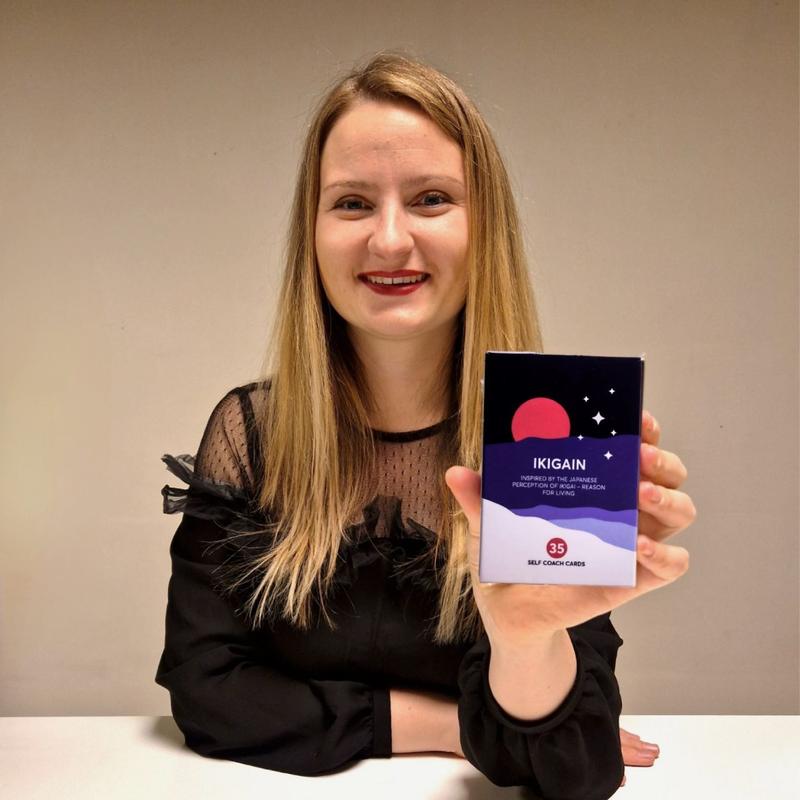
In her published founder story, Sindy describes spending years asking what made her happy and what she wanted from life. Reading about ikigai inspired her to create a hands-on way to explore those questions.
That became the Ikigain cards. Their rhythm is simple: think, write, act. A question gives you something to reflect on, writing makes it concrete, and an action lets you learn from experience.

Karlis brings his experience in eCommerce and brand development to turning Sindy’s ideas into practical products.
The exercise below follows that same rhythm. You can try it with an ordinary notebook.
05 / Think, write, act
How to begin finding your ikigai
Set aside ten quiet minutes to choose one small activity. The purpose of this exercise is to collect something you can learn from, rather than settle the rest of your life.
Think of one moment worth repeating
Recall something specific from the past week. What were you doing? Who was there? What felt absorbing, useful or important? If the week was difficult, look further back.
Write what mattered about it
Separate the activity from the quality you valued. “Helping a colleague” might point to teaching, solving a puzzle, feeling useful or connecting with someone.
Try a small version again
Choose something that fits your time, money and responsibilities. Decide when you will do it and when you will reflect on it. One conversation or a short practice session is enough to begin.
A worked example · illustrative
From “I like helping” to something you can test
- The moment
- I enjoyed helping a colleague understand a spreadsheet.
- The possible pattern
- I like turning something confusing into something clear.
- The next action
- Offer one 20-minute walkthrough this week, within my normal working hours.
- The question afterwards
- Did I enjoy explaining, solving the problem, or simply having time with someone? Would I choose to do it again?
A different answer is useful too. You can adapt the activity instead of making an immediate career decision.
Afterwards, record what gave you energy, what took effort and what you would change. Repetition can help you distinguish an appealing idea from an activity you want in your everyday life.
06 / Read the evidence carefully
What does research say about ikigai?
Researchers have examined whether reporting a sense of ikigai is associated with health and well-being. Those studies ask a different question from whether a career worksheet or an online test improves someone’s life.
The Ohsaki Study
Sone and colleagues followed 43,391 Japanese adults for seven years. Those who reported no ikigai had a higher adjusted mortality hazard than those who reported ikigai: a hazard ratio of 1.5. This is an association from an observational study, not proof that finding ikigai extends life. Read the study reference.
Health and well-being in later life
Okuzono and colleagues studied Japanese adults aged 65 and over. Reported ikigai was associated with several subsequent health and well-being outcomes over three years. These findings also do not establish that an ikigai exercise prevents disease. Read the study reference.
Self-report, the population studied and other influences on health all matter when interpreting these results. Neither study validates Ikigain’s assessment or its personality labels.
Where does an ikigai test fit?
A structured set of questions can make reflection easier to begin. Ikigain’s free ikigai test organizes your responses into themes you can compare with your own experience.
Treat your result as a starting point for exploration. Your answers cannot establish a single correct purpose, measure your worth or guarantee that a particular job will suit you.
Turn reflection into a next step
Notice your patterns.
Choose something to try.
Answer 18 questions and explore your free result. If you want more structure afterwards, the optional premium report adds directions to investigate, a practical plan and a decision workbook.
07 / A few common questions
Questions about ikigai
What does ikigai mean in Japanese?
Ikigai is often translated as a reason for living or a sense that life is worth living. The word brings together living and worth. The sources of that feeling can be ordinary and personal: a relationship, an activity, a responsibility or something you look forward to.
How do you pronounce ikigai?
A useful English approximation is “ee-kee-guy,” spoken as four short vowel beats: i-ki-ga-i. English spelling is only an approximation of Japanese pronunciation.
What are the four circles of ikigai?
The familiar diagram asks what you love, what you are good at, what the world needs and what you can be paid for. It is a modern reflection framework associated with ikigai, rather than a complete definition of the Japanese concept.
Does my ikigai have to be my job?
No. Work can be one source of meaning, and it can also support a life with meaning elsewhere. Relationships, caring for others, learning and creative interests can matter deeply without becoming a source of income.
Can I have more than one ikigai?
You can have several sources of meaning at once. Their importance may shift as your relationships, responsibilities and circumstances change. You do not need to force them into one permanent label.
How do I find my ikigai if nothing feels clear?
Begin with one recent moment that felt absorbing, useful or worth repeating. Try a small related activity, then reflect on the experience. A conversation with someone who knows you may help you notice patterns you overlook.
Can an ikigai test tell me my purpose?
A test can organize your answers and suggest themes to explore. It cannot establish a single correct purpose, diagnose your mental health or guarantee a career match. Compare any result with your lived experience and practical needs.
Sources and further reading
Sources are linked beside the claims they support. The practical exercise is an Ikigain reflection prompt; the worked example is illustrative.
- Government of Japan · Ikigai: The Japanese Secret to a Joyful Life
An introduction to the word and its everyday uses, published in 2022.
- Marc Winn · Ikigai
The creator’s account of combining the purpose diagram with the word ikigai in 2014.
- Sone and colleagues · Ohsaki Study, 2008
A seven-year observational study of 43,391 Japanese adults, published in Psychosomatic Medicine.
- Okuzono and colleagues · Ikigai and subsequent health and wellbeing, 2022
A longitudinal study of older Japanese adults, published in The Lancet Regional Health – Western Pacific.