
You can have the title, the salary, and the LinkedIn profile that turns heads, yet still drag yourself to work every Monday feeling hollow. That disconnect is not a personal failure. It is what happens when your career and your core values are pulling in opposite directions. Many professionals achieve traditional success yet feel unfulfilled if their work clashes with what they care about most. This article breaks down what values alignment actually means, why it matters more than most career advice acknowledges, and how you can start closing the gap between where you are and where you genuinely want to be.
Table of Contents
- What does it mean to align career with values?
- Why does aligning career with values matter?
- How to identify your core values
- Common signs your career and values are misaligned
- Examples of careers that align with different values
- Practical steps to realign your career with your values
- Discover your Ikigai for lasting career purpose
- Frequently asked questions
Key Takeaways
| Point | Details |
|---|---|
| Values alignment unlocks fulfillment | Professionals who align their work with core values experience higher satisfaction and meaning. |
| Self-awareness is essential | Identifying your true values provides a foundation for smarter, more rewarding career choices. |
| Signs of misalignment matter | Persistent stress or disengagement often signal underlying values conflicts. |
| Small steps create big change | You can start building a values-aligned career through small, purposeful changes without quitting your job. |
| Use tools for clarity | Personality frameworks and guided self-reflection can support your alignment journey. |
What does it mean to align career with values?
Values alignment is not the same as liking your job. You can enjoy your coworkers, appreciate your paycheck, and still feel like something important is missing. Aligning your career with your values means making choices that reflect what matters most to you, not just what looks good on paper or pays the bills.
Think of your values as an internal compass. When your work points in the same direction as that compass, decisions feel easier, effort feels meaningful, and Monday mornings feel less like a sentence. When they conflict, even a great job can feel draining.
Common core values that shape career satisfaction include:
- Growth: Learning new skills, advancing knowledge, and being challenged regularly
- Service: Contributing to others, solving real problems, and making a visible difference
- Creativity: Expressing original ideas, designing solutions, and working with autonomy
- Stability: Predictable structure, financial security, and long-term reliability
- Freedom: Flexible schedules, independent work, and control over your own direction
Misalignment shows up in subtle ways before it becomes obvious. You might notice a creeping sense of boredom, frustration with company decisions, or a feeling that your work does not reflect who you are. Exploring intrinsic values can help you name what is actually driving that discomfort.
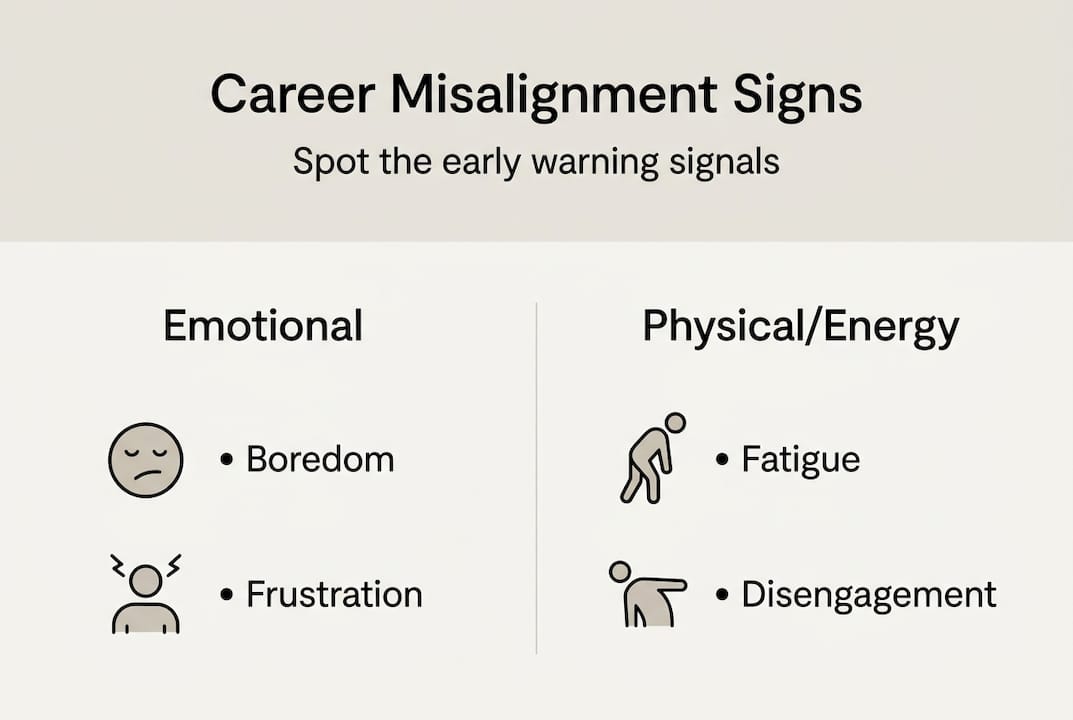
Pro Tip: Most people overlook early signs of misalignment. If you consistently feel drained after work or find yourself disagreeing with your organization’s priorities, that is worth paying attention to before it becomes burnout.
Why does aligning career with values matter?
Understanding what values alignment means, let’s examine why it makes such a dramatic difference for professionals.
The data here is hard to ignore. Professionals who align their work with values are 3X more likely to report high fulfillment compared to those who do not. That is not a marginal improvement. That is a fundamentally different experience of work and life.
“When your work reflects your values, motivation stops being something you have to manufacture. It becomes a natural byproduct of showing up.” This shift is what separates professionals who feel energized by their careers from those who feel perpetually depleted.
Here is why the benefits of career purpose go far beyond feeling good:
- Increased motivation: When your work connects to what you care about, you do not need external pressure to stay engaged. The work itself becomes the reward.
- Enhanced work satisfaction: Value-aligned roles reduce the cognitive friction of doing tasks that feel pointless or ethically uncomfortable.
- Greater resilience to stress: Professionals with strong values alignment recover faster from setbacks because they have a clear reason to keep going.
The research on career fulfillment alignment also shows that value-driven work links to improved health, stronger motivation, and greater resilience over time. This is not just about career success. It is about your overall quality of life.
Statistic to remember: Professionals with high values alignment are 3X more likely to describe their careers as deeply fulfilling. That gap does not close with a promotion.
How to identify your core values
With the benefits clear, let’s turn to the crucial step: figuring out what your personal values actually are.
Discovering your core values is foundational to building a rewarding career, yet most people have never done it deliberately. Here is a practical five-step process:
- Reflect on peak moments: Think of three to five times in your career when you felt genuinely proud or energized. What were you doing? What made it meaningful?
- Review your frustrations: Equally useful are the moments you felt most frustrated or resentful. Those reactions often point directly to a value being violated.
- Use a values list: Start with a broad list of values (autonomy, impact, connection, mastery, security) and circle every one that resonates. Then narrow it to your top five.
- Prioritize ruthlessly: When two values conflict, which one wins? Ranking forces you to get honest about what you actually prioritize versus what you think you should prioritize.
- Test against real choices: Look at a recent career decision. Did it honor your top values? If not, that gap tells you something important.
Tools like personality assessments and finding your Ikigai frameworks can accelerate this process significantly. They surface patterns you might not see on your own. The practice of clarifying intrinsic values is especially useful during career transitions.

Pro Tip: Revisit your values after major life changes, a new role, a move, a loss, or a milestone. What mattered at 28 may not be what drives you at 42.
Common signs your career and values are misaligned
Once you have identified your values, it is also critical to recognize when your current work environment is not a fit.
Persistent stress, ethical dilemmas, and lack of motivation often signal values misalignment at work. The tricky part is that these signs can look like ordinary work stress, so many professionals dismiss them for years.
Watch for these warning signals:
- You feel a sense of dread on Sunday evenings that goes beyond normal tiredness
- Your daily tasks feel disconnected from anything you genuinely care about
- You regularly feel uncomfortable with decisions made above you
- Your energy drops sharply after certain meetings or projects
- You feel like a different person at work than you are outside of it
“I spent six years climbing the ladder in a field that looked impressive from the outside. Inside, I felt like I was slowly disappearing. The moment I named the value conflict, everything became clear.” This kind of experience is far more common than most professionals admit out loud.
The earlier you catch these signs, the more options you have. Waiting until full burnout sets in limits your choices and your energy for making a change. Exploring meaningful work explanation resources can help you put language to what you are experiencing.
Examples of careers that align with different values
To make this concept tangible, let’s look at how different careers embody different values.
People thrive in roles and organizations that are structured around their deeply held values. The table below shows how core values map to career paths and work environments.
| Core value | Example careers | Ideal work environment |
|---|---|---|
| Creativity | Designer, writer, product developer | Flexible, idea-driven, low hierarchy |
| Service | Nurse, social worker, nonprofit leader | Mission-focused, collaborative, community-centered |
| Learning | Researcher, educator, consultant | Intellectually stimulating, growth-oriented |
| Stability | Accountant, operations manager, engineer | Structured, predictable, process-driven |
| Freedom | Entrepreneur, freelancer, remote strategist | Autonomous, self-directed, flexible |
Use this as a screening tool, not just a reflection exercise. When evaluating a new role or employer, look for:
- How the company describes its culture and mission in job postings
- What current and former employees say about day-to-day decision-making
- Whether leadership publicly models the values they claim to hold
- How much autonomy or structure the role actually offers versus what is advertised
Ikigai career insights offer a particularly useful lens here, connecting your values to the kind of contribution that feels most natural to you.
Practical steps to realign your career with your values
Now let’s see how you can apply these insights and begin making changes, large or small, toward a more values-driven path.
Even small shifts toward values-driven work dramatically boost motivation and well-being. You do not need to quit your job tomorrow. You need a plan.
- Audit your current work: For one week, note which tasks energize you and which drain you. Look for the pattern.
- Identify the mismatches: Compare your top values against your daily reality. Where is the gap largest?
- Seek values-congruent projects: Volunteer for assignments that connect to what you care about. This builds evidence and momentum.
- Network with aligned professionals: Spend time with people whose careers reflect your values. Their paths show you what is possible.
- Consider role or career changes: If the gap is structural, a larger pivot may be necessary. Clarity on values fuels more confident career decisions at every stage.
Pro Tip: Start with one project or responsibility that better reflects your values before overhauling everything. Small wins build the confidence and clarity needed for bigger moves.
The career clarity guide framework is especially useful here. When you know what you value, you stop second-guessing every opportunity and start filtering for what actually fits.
Discover your Ikigai for lasting career purpose
Ready to go deeper than surface-level career advice? The tools and frameworks at Ikigain.org are built specifically for professionals who want to move from vague dissatisfaction to genuine clarity.

The Ikigai test helps you identify your unique value drivers and how they connect to the kind of work that brings you alive. You can also explore Ikigai personality types to understand how your natural strengths and values intersect with different career paths. If you are just starting out, the life purpose questions offer a structured way to begin the reflection process. These are not generic quizzes. They are purpose-built tools grounded in Japanese philosophy and modern self-discovery research, designed to give you actionable insight, not just interesting results.
Frequently asked questions
How do I know if my career aligns with my values?
Pay attention to your daily energy levels and whether you feel proud of or disconnected from your work. Persistent stress and lack of motivation are reliable early signals of values misalignment.
What are the risks of not aligning career and values?
You risk burnout, chronic disengagement, and a growing sense of meaninglessness that no salary increase can fix. Value misalignment directly impacts both motivation and long-term well-being.
Can I realign my career without quitting my job?
Absolutely. Start by shifting toward projects or responsibilities that better reflect your values before considering a full career change. Small shifts toward values-driven work can meaningfully boost your motivation and satisfaction.
How do I identify my top values if I feel unsure?
Reflect on moments when you felt genuinely proud or deeply frustrated at work and look for repeating themes. Discovering your core values through structured reflection is the most reliable starting point.