You wake up, go through the motions, and somewhere between your morning coffee and your afternoon meeting, a quiet question surfaces: What is this all for? That feeling of drifting without direction is more common than you think, and it carries real weight. Japanese philosophy offers a structured answer through the concept of ikigai (pronounced ee-kee-guy), which translates roughly to “reason for being.” Research even links a strong sense of purpose to a 40% reduced mortality risk in older adults. This guide walks you through a proven, phase-by-phase method to uncover, test, and clarify your unique ikigai.
Table of Contents
- Why discover purpose? Science and tradition meet
- Preparing for your purpose journey
- The multi-phase method: Discovering your purpose step by step
- The five pillars: Japanese principles for lasting fulfillment
- Common roadblocks and how to overcome them
- Measuring your progress and next steps
- Take the next step: Purpose tools and resources
- Frequently asked questions
Key Takeaways
| Point | Details |
|---|---|
| Structured process matters | Breaking purpose discovery into phases makes it approachable and effective. |
| Embrace imperfection | It’s normal not to fit all four circles; even meaningful intersections boost fulfillment. |
| Japanese insights | Daily rituals and the five pillars provide practical ways to build lasting purpose. |
| Longevity link | Research shows clear health and happiness benefits from a strong sense of purpose. |
| Support and evolve | Purpose discovery is ongoing; keep reflecting, experimenting, and utilizing community resources. |
Why discover purpose? Science and tradition meet
Before you begin the process, it is crucial to understand what purpose can actually do for your life. This is not about finding a motivational poster quote. It is about measurable, real-world change.
Research consistently shows that people with a clear sense of purpose experience better physical health, stronger emotional resilience, and deeper satisfaction in their relationships. In Japan, ikigai boosts life satisfaction in elderly populations and is closely tied to the legendary longevity of Okinawans. The difference between ikigai and Western goal-setting is subtle but important: ikigai is not about achieving a destination. It is about finding meaning in the everyday.
Here is what purpose discovery can bring into your life:
- Sustained motivation that does not depend on external rewards
- Meaning during adversity, so setbacks feel like detours rather than dead ends
- Improved relationships because you show up more fully when you know why you are there
- Increased energy from doing work and activities that align with your values
- Greater clarity when making decisions about career, time, and relationships
“Those with a strong sense of purpose are 40% less likely to die in the coming years compared to those who feel their lives lack direction.” This is not philosophy. It is data.
If you have been finding answers with ikigai elusive, know that the science is firmly on the side of the search itself being worthwhile.
Preparing for your purpose journey
With the why established, you will want to prime yourself for a practical, exploratory process. Jumping in without preparation is like starting a road trip without checking your fuel.
Ikigai sits at the intersection of four overlapping circles: what you love, what you are good at, what the world needs, and what you can be paid for. Most people assume you need a perfect four-way overlap before you have found your ikigai. You do not. In fact, most find fulfillment in 2-3 circles, and the discovery process is meant to be iterative, not instant.

Here is a simple preparation checklist before you begin:
| Preparation item | Why it matters |
|---|---|
| A dedicated journal or notebook | Tracks patterns over weeks and months |
| Honest self-reflection time | Purpose work requires real answers, not ideal ones |
| A trusted friend or mentor | External feedback reveals blind spots |
| An energy-tracking habit | Noticing what drains vs. energizes you is core data |
| Openness to changing direction | Your first answer is rarely your final one |
| A quiet, consistent space | Reflection needs low-distraction conditions |
Key mindset shifts to adopt before you start:
- Embrace imperfection. Your ikigai does not need to be poetic or grand.
- Accept normal struggle. Confusion early in the process is a sign you are asking real questions.
- Expect growth. Who you are at the start of this process will not be who you are at the end.
The step-by-step process works best when you approach it with curiosity rather than pressure. For practical ikigai guidance on where to begin, start by simply noticing what activities make time feel irrelevant.
Pro Tip: Many people feel stuck because they are waiting for all four circles to light up at once. Focus on the intersections you can see right now. Progress through two or three circles is real progress.
The multi-phase method: Discovering your purpose step by step
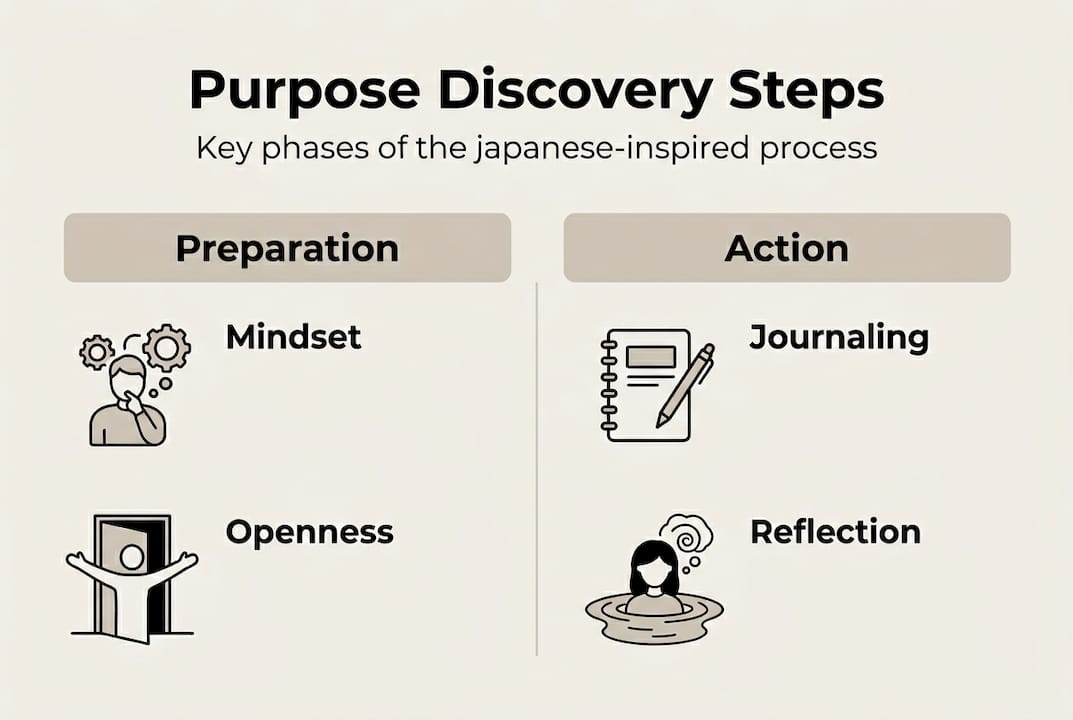
Now that you are ready, here is how to move systematically from questioning to clarity. The structure below follows a multi-month reflection process that moves through three distinct phases.
-
Phase 1: Exploration (Months 1 to 3). Use daily journaling prompts to map what energizes you, what you naturally gravitate toward, and what problems you care about solving. Track your energy levels after different activities. Ask yourself: When do I lose track of time? and What would I do even if no one paid me?
-
Phase 2: Pattern recognition (Months 4 to 6). Share your journal findings with a trusted friend or mentor and ask for honest feedback. Experiment with small new roles or side projects that test your emerging hypotheses. Look for recurring themes across your entries.
-
Phase 3: Synthesis (Month 7 onward). Write a draft ikigai statement in one or two sentences. Build a “purpose portfolio” of activities, roles, and projects that collectively express your reason for being. Revisit and refine it regularly.
Here is how different reflection approaches compare:
| Approach | Pros | Cons |
|---|---|---|
| Solo journaling | Private, flexible, low barrier | Can reinforce blind spots |
| Group feedback sessions | Diverse perspectives, accountability | Requires vulnerability and trust |
| Coaching or guided workshops | Structured, expert-led, faster clarity | Higher time and financial investment |
| Digital self-assessments | Accessible, data-driven, repeatable | Less nuanced than human dialogue |
When discovering ikigai, combining at least two of these approaches tends to produce richer results than relying on any single method. Explore ikigai questions designed to prompt deeper reflection across all four circles.
Pro Tip: Set a recurring weekly calendar reminder for your “Ikigai Audit.” Spend 10 minutes tracking moments of harmony, joy, and flow from the past seven days. Patterns emerge faster than you expect.
The five pillars: Japanese principles for lasting fulfillment
These practical steps are grounded in core Japanese values. Neuroscientist and author Ken Mogi identified five pillars of ikigai that form the authentic cultural backbone of this practice.
- Starting small. Big purpose is built from tiny, consistent actions. You do not need a grand plan on day one.
- Releasing yourself. Let go of the need to perform or impress. Authenticity is the starting point, not the reward.
- Harmony and sustainability. Your ikigai should fit your life, not consume it. Balance is not a compromise; it is the goal.
- The joy of small things. A perfectly brewed cup of tea, a conversation that goes deep, a walk that clears your head. These are not distractions from purpose. They are purpose.
- Being here and now. Presence is the practice. Purpose is not something you find in the future. It is something you notice in the present.
These pillars are not abstract ideals. They are weekly practices. Each Sunday, spend five minutes rating yourself on each pillar from one to five. Where are you thriving? Where are you coasting? That simple check-in keeps your purpose work grounded in real life rather than theory.
Okinawans with strong ikigai regularly live past 100, and researchers point to this daily sense of meaning, not just diet or genetics, as a central factor.
Explore more Japanese concepts for meaning that complement the five pillars and deepen your understanding of this philosophy in practice.
Common roadblocks and how to overcome them
Even with a step-by-step process, challenges can arise. Let us address how to navigate them before they stall your momentum.
Common obstacles people face during purpose discovery:
- Feeling stuck after the initial excitement fades
- Self-doubt about whether your passions are “valid” or practical
- Burnout from over-analyzing instead of experimenting
- No perfect four-circle overlap, which can feel like failure
- Comparison to others whose purpose seems clearer or more impressive
The most effective troubleshooting strategy is to shrink the question. Instead of asking “What is my life’s purpose?”, ask “What felt meaningful this week?” Small, specific questions generate actionable answers. Test tiny shifts: volunteer for one new project, try one new creative outlet, have one honest conversation about what you value.
“Purpose is a practice, not a finish line. Most people revisit and update their ikigai regularly as their life circumstances and values evolve.”
A portfolio approach to fulfillment means accepting that two or three overlapping circles is a completely legitimate place to operate from. You do not need all four to feel alive and directed. Use the ikigai direction guide to reorient when you feel lost, and revisit what your purpose in life might look like from a fresh angle.
Measuring your progress and next steps
After engaging with the process and troubleshooting, it is time to recognize your achievements and plan forward. Progress in purpose work is real, even when it feels invisible.
Here are four ways to self-check your progress:
- Energy audit. Are you ending more days feeling spent-but-satisfied rather than just depleted? That shift is significant.
- Fulfillment reflection. Look back at your journal from month one. Do your answers feel more specific, more honest, more yours than they did before?
- Feedback from trusted others. Have people close to you noticed a change in your engagement, enthusiasm, or clarity? Outside perspective is often more accurate than self-assessment.
- Sense of meaning in routines. Even mundane tasks can carry purpose when they connect to something larger. Are more of your daily actions feeling intentional?
Purpose discovery is ongoing, and progress shows up as increased vitality, joy, and alignment between your roles and your values. Natural next steps include expanding your practice, revisiting your journal monthly, connecting with communities of like-minded people, and considering group workshops or formal guidance when you want to accelerate.
For continued reflection, explore discovering your purpose through guided questions that evolve with you.
Pro Tip: Set a calendar reminder every quarter to review and possibly update your personal purpose portfolio. Life changes. Your ikigai is allowed to change with it.
Take the next step: Purpose tools and resources
You have learned the framework. Now it is time to put it into motion with tools built specifically for this journey.

At Ikigain.org, the ikigai type test gives you a structured, personalized starting point based on your unique combination of passions, strengths, and values. It is not a generic quiz. It is a self-assessment designed to surface the intersections that matter most to you. If you want to go deeper into the cultural roots of this practice, the Japanese philosophy section offers rich context that makes the method feel alive rather than academic. And when you are ready to keep reflecting, the full library of purpose questions gives you fresh prompts at every stage of your journey. Your ikigai is already there. These tools help you see it more clearly.
Frequently asked questions
How long does it take to discover your purpose using the step-by-step method?
Purpose discovery typically spans several months, moving through exploration, pattern recognition, and synthesis. The multi-month structured process suggests at least six to nine months for meaningful clarity to emerge.
What if my purpose changes or I can’t find a perfect fit?
That is completely normal. Ikigai evolves over time, and most people find genuine fulfillment by working within two or three of the four circles rather than requiring a perfect overlap.
Can purpose discovery really improve health?
Yes. Research links strong purpose or ikigai to a 40% reduced mortality risk, particularly in older adults, along with better mental and physical health outcomes overall.
What are the core Japanese principles behind this method?
Ken Mogi’s five pillars of ikigai include starting small, releasing yourself, harmony and sustainability, finding joy in small things, and being fully present in the moment.