TL;DR:
- Self-assessment tools boost motivation and self-awareness when paired with feedback and action.
- Japanese frameworks like Ikigai and Naikan emphasize purpose and relational reflection over traits.
- Effective self-discovery requires ongoing practice and response, not just taking assessments.
You probably think you know yourself pretty well. The gap between how you see yourself and how you actually behave is usually much wider than you'd expect. Research on self-assessment shows that structured tools do help—they shift things measurably when they're designed right and you actually do something with what you learn. But they're not magic. This article looks at why some assessment approaches work better than others, where they hit a wall, and what Japanese practices like Ikigai and Naikan bring to the table that most Western tools don't. If you've felt the distance between who you think you are and who you're trying to become, you're not alone in that.
Table of Contents
- Why assessment tools matter for self-discovery
- Types of assessment tools and their impacts
- Limitations and pitfalls: What to watch out for
- How Japanese assessment philosophies deepen self-knowledge
- A deeper truth about self-discovery and assessment
- Begin your journey with purpose-driven assessment
- Frequently asked questions
Key Takeaways
| Point | Details |
|---|---|
| Self-discovery needs action | Assessment tools work best when their results spark real-life steps and feedback loops. |
| Choose tools wisely | Validated, performance-oriented assessments give deeper insights and minimize bias. |
| Japanese methods offer depth | Frameworks like Ikigai and Naikan add purpose and relational focus to self-discovery. |
| Awareness is just a start | Labels and scores are useful, but lasting growth comes from ongoing reflection and adaptation. |
Why assessment tools matter for self-discovery
Your gut feeling about yourself is shaped by memory, emotion, and social comparison. None of those filters are neutral. We tend to remember our successes more vividly than our failures, and we often rate ourselves by intentions rather than outcomes. That gap between internal self-judgment and actual behavior is exactly where structured assessment tools become useful.
The empirical case for using these tools is solid. Self-assessment boosts motivation with an effect size of g=0.66, which is a meaningful gain in a field where many interventions barely register. But motivation alone is not the whole story. The real value comes when a tool is paired with feedback and deliberate action.
Experts in the field are clear on this point: tools foster self-awareness best when combined with training, honest feedback, and a commitment to act on what you learn. A personality profile sitting in your inbox, unread and unexamined, changes nothing. It is the reflection and response that create growth.
Here is what well-used assessment tools can realistically offer:
- Clearer self-knowledge: A structured tool surfaces patterns you might not notice on your own.
- Motivation boost: Seeing your strengths named and validated can energize your next steps.
- Domain-specific insight: Tools calibrated to career, relationships, or values give targeted, actionable data.
- A starting point for dialogue: Assessments open conversations with coaches, mentors, or trusted friends.
"Assessment won't show you everything about yourself. It's more like a flashlight—it picks out the corners you've been ignoring."
Think of ikigai-based self-discovery as a practical example of this principle. Rather than asking who you are in the abstract, it asks what you love, what you are good at, what the world needs, and what you can be paid for. That shift from identity to function is powerful. It is also worth noting that reducing anxiety through self-discovery is a documented benefit when the process is structured and purposeful rather than open-ended and overwhelming.
Assessment tools are catalysts, not conclusions. Treat them that way and they become genuinely useful.
Types of assessment tools and their impacts
Not all assessment tools are built the same. Understanding the differences helps you choose the right one for your goal and interpret results with appropriate skepticism.
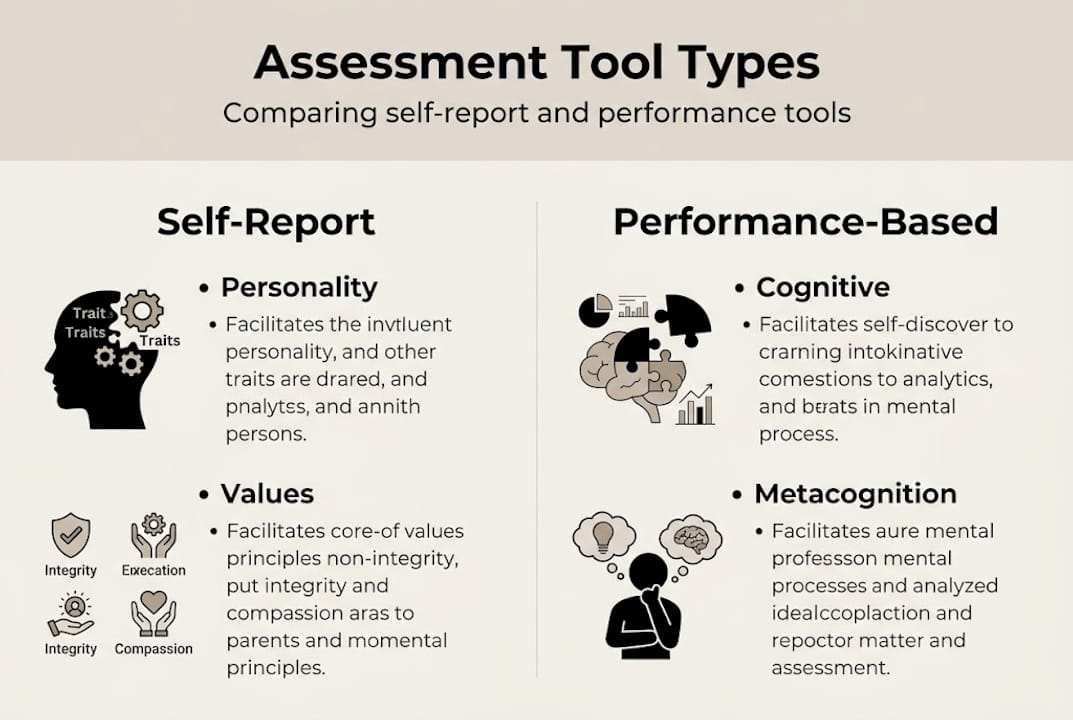
The three main categories you will encounter are personality and self-report inventories, values inventories, and performance-based tasks. Each has a distinct logic and a distinct set of trade-offs.
Performance-based tests are better predictors of metacognition, while self-reports are more vulnerable to faking and confirmation bias. That does not make self-reports useless, but it does mean you should interpret them as one data point, not a verdict.

| Tool type | Strengths | Weaknesses | Best-fit scenario |
|---|---|---|---|
| Self-report personality (e.g., Big Five) | Fast, accessible, good for general awareness | Prone to social desirability bias | Early-stage self-exploration |
| Values inventory | Surfaces priorities you may not consciously recognize | Can reflect aspirations more than reality | Career and life direction decisions |
| Performance-based task | More objective, harder to fake | Time-intensive, requires trained interpretation | Deep self-knowledge, coaching contexts |
Here is a practical sequence for getting useful results from any tool:
- Choose a validated tool: Look for assessments backed by peer-reviewed research, not just popular appeal.
- Take it honestly: Resist the urge to answer how you wish you were. Answer how you actually behave.
- Request external feedback: Share your results with someone who knows you well and ask if they ring true.
- Identify one action: Every assessment should end with a concrete next step, not just a label.
Pro Tip: If a tool gives you a personality type but no guidance on what to do with it, that is a red flag. The best assessments are designed to prompt action, not just categorization.
If you are working on discovering your true self, combining a values inventory with a structured purpose framework tends to produce richer insight than relying on a single personality test alone.
Limitations and pitfalls: What to watch out for
Even the best tools have blind spots. Knowing them in advance keeps you from over-investing in a label that may not fully represent you.
The most common pitfalls include:
- Faking: In high-stakes settings, people answer strategically. Faking in high-stakes settings attenuates validity significantly, making results less reliable exactly when accuracy matters most.
- Self-perception bias: We rate ourselves through the lens of who we want to be, not always who we are.
- Label lock-in: Once you receive a type or category, it can start to feel permanent. It is not.
- Over-reliance: Using one tool as a definitive answer closes off curiosity rather than opening it.
"Assessments are fine. What kills you is using one as an excuse to stop asking yourself hard questions."
Research confirms that tools can constrain via labels and must be combined with real-world action to generate lasting change. A label without behavior change is just vocabulary.
To spot a validated, actionable tool, look for these markers: published reliability and validity data, a clear theoretical framework, and guidance on how to use results practically. Avoid tools that promise dramatic insight with no scientific backing.
Pro Tip: After taking any assessment, write down three ways the results match your lived experience and one way they do not. That friction point is often where the most useful self-knowledge lives.
For a broader view on how purpose-driven frameworks handle these trade-offs, the comparison between ikigai vs. kaizen is worth exploring. Both are Japanese frameworks, but they operate on different timescales and mechanisms, which makes them complementary rather than competing.
How Japanese assessment philosophies deepen self-knowledge
Western assessment tools tend to focus on traits and categories. Japanese philosophical frameworks take a different angle: they ask about purpose, relationships, and contribution. That shift changes what you discover.
Ikigai is structured around four overlapping circles: what you love, what you are good at, what the world needs, and what you can be paid for. The intersection of all four is your ikigai, your reason for being. It is not a personality type. It is a dynamic map that evolves as your life does.
Naikan, developed by Yoshimoto Ishin, uses three core self-reflection questions: What have I received from others? What have I given to others? What troubles and difficulties have I caused others? These questions deliberately redirect attention from self-focused grievance to relational gratitude and accountability.
| Framework | Focus | Method | Best use case |
|---|---|---|---|
| Ikigai | Purpose and contribution | Four-circle mapping | Career direction, life meaning |
| Naikan | Relational reflection | Three structured questions | Repairing relationships, reducing self-centeredness |
Here is how to try both in a single sitting:
- Ikigai exercise: Write one answer in each of the four circles. Look for overlap. Note where circles are empty.
- Naikan reflection: Spend ten minutes answering the three Naikan questions about a specific relationship or period of your life.
- Compare notes: Where do your ikigai circles and your Naikan reflections align? That intersection often reveals something Western tools miss entirely.
Japanese philosophy uniquely links self-understanding with community. You are not discovered in isolation. You are discovered in relation to others and to the world you want to serve. The ikigai and anxiety reduction connection is partly explained by this shift: when purpose is relational, it feels more stable than when it is purely internal.
For a guided starting point, the ikigai method for purpose offers structured questions that walk you through the framework step by step.
A deeper truth about self-discovery and assessment
Here is what most articles on this topic will not tell you: the tool is almost irrelevant. What matters is what you do after you take it.
We have seen people take every validated assessment available and remain stuck, because they were looking for certainty rather than direction. They wanted a label that would explain them, not a question that would challenge them. Japanese philosophy, particularly embracing ikigai for growth, teaches something different: self-knowledge is not a destination you arrive at. It is a practice you return to.
The uncomfortable truth is that real transformation requires discomfort. It requires sitting with feedback that contradicts your self-image. It requires acting on insights before you feel ready. Tools are useful precisely because they surface that discomfort in a structured way. But the growth happens in the response, not the reading.
Stop asking which tool is best. Start asking what you will do with what you already know.
Begin your journey with purpose-driven assessment
Reading about self-discovery won't rewire your life. Sitting with the uncomfortable questions will.
The Ikigai test here draws from Japanese philosophy and actual research on how people land on what matters. If you're tired of thinking in circles, take the test and get a real map of your strengths, values, and direction. You can dig into concepts like Naikan and Wabi-sabi too—they're not filler, they shift how you see things. Or start with our life purpose questions if you need something concrete to work with. Whatever you pick, it doesn't have to be a major pivot. It just has to be honest.
Frequently asked questions
Do assessment tools really improve self-understanding?
Well-designed tools paired with action show a moderate positive effect on self-knowledge, according to meta-analyses, though the impact depends heavily on how you engage with the results.
How can I avoid the pitfalls of self-assessment?
Use validated assessments with feedback, combine multiple approaches, and treat results as a starting point rather than a final answer.
What makes Japanese assessment tools unique for self-discovery?
Frameworks like Ikigai and Naikan integrate purpose and relational reflection, connecting personal growth to community and meaning in ways that purely trait-based tools do not.
Are self-assessment tools accurate?
Performance-based tools outperform self-reports on accuracy, especially for metacognition, but combining both types with external feedback produces the most reliable picture.