Choosing the right self-discovery method can feel overwhelming when you’re seeking genuine personal growth. With countless approaches promising transformation, how do you identify which practices will truly serve your journey toward purpose and fulfillment? This article outlines five evidence-based methods rooted in Japanese philosophy and modern psychology, helping you evaluate and select approaches that align with your unique path to self-knowledge.
Table of Contents
- How To Choose Effective Self-Discovery Methods: Criteria And Framework
- Journaling: Uncover Your Inner Landscape Through Writing
- Mindfulness And Meditation: Quiet The Mind For Clarity And Openness
- Wabi-Sabi: Embrace Imperfection For Self-Acceptance
- Personality Assessments And Life Experiments: Tools For Actionable Self-Knowledge
- Explore Ikigai And Deepen Your Self-Discovery Journey
- Frequently Asked Questions
Key takeaways
| Point | Details |
|---|---|
| Five distinct methods | Journaling, mindfulness, wabi-sabi, personality assessments, and life experiments each offer unique pathways to self-knowledge. |
| Japanese philosophy enriches growth | Accepting imperfection through wabi-sabi reduces anxiety and fosters self-compassion. |
| Evidence supports mindfulness | Mindfulness practice improves self-concept clarity and reduces negative self-objectification. |
| Assessments provide actionable insights | Personality tests reveal strengths and growth areas that guide purposeful decisions. |
| Experimentation builds resilience | Small weekly life experiments develop mastery and self-efficacy through direct experience. |
How to choose effective self-discovery methods: criteria and framework
Selecting a self-discovery method requires evaluating how well it aligns with your emotional needs, lifestyle, and growth objectives. The most effective approaches share common characteristics: they promote emotional safety, deliver clear insights, and integrate smoothly into your daily routine. Research shows that methods offering both structure and flexibility tend to produce lasting results.
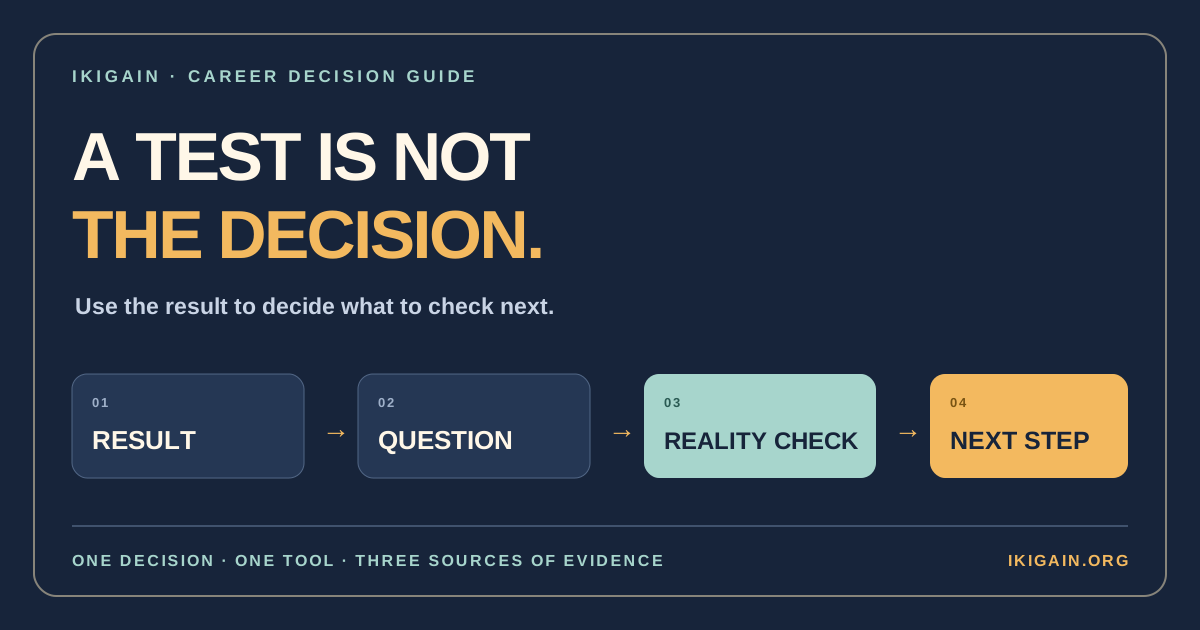
Consider a reflect-decide-act-adjust framework when evaluating options. First, reflect on your current emotional state and readiness for introspection. Next, decide which method matches your comfort level with either traditional wisdom or scientific approaches. Then, act by committing to consistent practice for at least three weeks. Finally, adjust based on what you observe about your progress and well-being.
Your criteria should include practical factors like time commitment, accessibility, and whether the method emphasizes solitary reflection or guided structure. Some people thrive with the open-ended nature of journaling, while others prefer the concrete feedback from personality assessments. Understanding the advantages of self-discovery for purpose wellness helps you recognize which benefits matter most to your journey.
Key evaluation criteria include:
- Emotional safety and your capacity to process difficult feelings
- Clarity of insights the method typically produces
- Ease of integration into your existing schedule
- Alignment with your preference for tradition versus empirical science
- Support available when challenges arise
Pro Tip: Test one method thoroughly for 30 days before adding another, allowing you to accurately assess its impact on your self-awareness and well-being.
Journaling: uncover your inner landscape through writing
Journal writing creates a private space where your unfiltered thoughts can surface, revealing patterns in your emotions, values, and behaviors. The practice works through expressive writing, which improves mental health by enabling emotion processing and helping you make sense of complex feelings. By committing words to paper, you externalize internal experiences and gain perspective on recurring themes in your life.

The most effective journaling approach involves freewriting for 10 minutes without editing or censoring yourself. Let your pen move continuously, capturing whatever emerges without judgment. This technique bypasses your inner critic and accesses deeper layers of consciousness where authentic insights reside. Over time, you’ll notice patterns that point toward your core values and unmet needs.
Using targeted prompts can guide your exploration when freewriting feels too open-ended. Questions like “What makes me feel truly alive?” or “When do I feel most like myself?” direct your attention toward purpose and authenticity. The 50 powerful journal prompts self discovery clarity purpose resource offers structured starting points for meaningful reflection.
Be prepared for journaling to surface painful memories or difficult emotions. This isn’t a flaw in the method but rather evidence of its power to access buried experiences. If you encounter overwhelming feelings, consider working with a therapist who can provide professional support as you process what emerges. Your self-exploration journey psychology benefits from both independent practice and expert guidance when needed.
Benefits you can expect from consistent journaling:
- Increased awareness of emotional triggers and behavioral patterns
- Greater clarity about your authentic values versus adopted beliefs
- Improved ability to articulate your needs and boundaries
- Enhanced problem-solving through written reflection
- Documented growth that you can review periodically
Pro Tip: Schedule a monthly review session where you read past entries and highlight recurring themes, transforming raw observations into actionable self-knowledge.
Mindfulness and meditation: quiet the mind for clarity and openness
Mindfulness practice cultivates non-judgmental awareness of your present moment experience, creating mental space between stimulus and response. Through daily meditation involving breath observation or body scans, you develop the capacity to witness your thoughts and feelings without immediately reacting to them. This decentering allows you to see thoughts as transient mental events rather than absolute truths about yourself or your circumstances.
Research demonstrates that mindfulness improves self-concept clarity and openness, reducing the tendency toward negative self-objectification. When you observe your inner experience without harsh judgment, you naturally develop more compassionate self-understanding. The practice also enhances mental flexibility, helping you consider alternative perspectives on challenging situations.
Japanese philosophy has long recognized mindfulness as essential to well-being and purpose. The concept of “ma” or mindful pause creates intentional space in daily life for reflection and presence. This integration of contemplative practice with purposeful living forms a cornerstone of ikigai, where Japanese mindfulness ikigai boosts wellbeing through sustained attention to what matters most.
Starting a mindfulness practice requires minimal resources but consistent commitment. Begin with five minutes daily, gradually extending as the practice becomes habitual. Sit comfortably, close your eyes, and focus on your natural breath. When your mind wanders, gently return attention to breathing without self-criticism. This simple act trains your awareness and builds the foundation for deeper self-discovery.
Key elements of effective mindfulness practice:
- Daily consistency matters more than session length
- Non-judgmental observation of thoughts and sensations
- Gentle redirection of attention when mind wanders
- Body scan techniques to develop somatic awareness
- Integration of mindful moments throughout your day
“Mindfulness serves as the foundation for all other self-discovery work. Without the ability to observe yourself clearly, you cannot accurately identify what needs to change or what deserves celebration.” This perspective from the guide to self-discovery mindfulness emphasizes why contemplative practice underpins lasting personal growth.
Wabi-sabi: embrace imperfection for self-acceptance
Wabi-sabi represents a Japanese aesthetic and philosophical tradition that finds beauty in imperfection, impermanence, and incompleteness. As a self-discovery method, it offers a gentle counterbalance to perfectionism by encouraging you to accept your flaws as integral parts of your authentic self. Rather than striving to eliminate weaknesses, wabi-sabi invites you to appreciate how your imperfections contribute to your unique character and life story.
The core practice involves cultivating self-compassion and acknowledging the transient nature of all experiences, including your current limitations. Studies show that self-compassion practices reduce anxiety and depression by promoting acceptance of flaws rather than harsh self-judgment. When you treat yourself with the same kindness you’d offer a struggling friend, you create psychological safety for honest self-examination.
Wabi-sabi integrates seamlessly with other self-discovery methods like journaling or mindfulness. You might journal about moments when your imperfections led to unexpected growth, or practice mindful observation of self-critical thoughts without believing them. This philosophical framework doesn’t require formal practice sessions but rather a gradual shift in how you interpret your experiences and perceived shortcomings.
The mental health benefits of wabi-sabi extend beyond reduced anxiety to include greater life satisfaction and resilience. By accepting that incompleteness is natural and even beautiful, you release the exhausting pursuit of an impossible ideal. This freed energy can redirect toward purposeful activities aligned with your values, as explored in Japanese concepts philosophy meaningful life.
Ways to integrate wabi-sabi into daily life:
- Notice and appreciate small imperfections in your environment
- Reframe mistakes as evidence of courage and growth
- Practice self-kindness when you fall short of expectations
- Celebrate progress over perfection in your endeavors
- Acknowledge the temporary nature of current struggles
Pro Tip: Each evening, identify one moment when your imperfection led to learning, connection, or unexpected beauty, gradually rewiring your brain to see flaws as growth opportunities.
Personality assessments and life experiments: tools for actionable self-knowledge
Personality assessments provide structured frameworks for understanding your characteristic patterns of thinking, feeling, and behaving. Common tools like the Myers-Briggs Type Indicator and Big Five model offer language for articulating your tendencies and preferences. While no test captures your full complexity, these assessments serve as useful mirrors that reflect aspects of yourself you might not consciously recognize.
The real value emerges when you combine assessment insights with life experiments, small deliberate actions designed to test assumptions about yourself. For example, if a personality test suggests you’re highly introverted, you might experiment with one social event weekly to distinguish between genuine preference and limiting belief. Research indicates that personality feedback increases self-efficacy, with mastery experiences proving most impactful for building confidence.
Life experiments follow a reflect-decide-act-adjust cycle that optimizes learning. You reflect on a hypothesis about yourself, decide on a specific experiment to test it, act by implementing the experiment for a defined period, then adjust based on observed results. This scientific approach to self-discovery grounds insights in direct experience rather than abstract theorizing.
Consider weekly experiments like abstaining from social media, waking an hour earlier, or saying yes to invitations you’d normally decline. Each experiment generates data about what energizes versus depletes you, revealing authentic preferences beneath habitual patterns. The personality assessment purpose potential guide explains how formal assessments complement this experimental approach.
Comparison of self-discovery methods:
| Method | Emotional Impact | Time Commitment | Growth Potential | Best For |
|---|---|---|---|---|
| Journaling | Moderate to high | 10-20 min daily | High for emotional awareness | Processing feelings, identifying patterns |
| Mindfulness | Low to moderate | 5-30 min daily | High for mental clarity | Reducing reactivity, building presence |
| Wabi-sabi | Low | Ongoing mindset | Moderate for self-acceptance | Overcoming perfectionism |
| Assessments | Low | 30-60 min once | Moderate for self-knowledge | Understanding traits, setting goals |
| Life experiments | Variable | 1-7 days per test | High for behavioral change | Testing assumptions, building confidence |
Steps to conduct an effective life experiment:
- Identify a specific assumption or question about yourself you want to test
- Design a small, measurable action you can complete within one week
- Commit to the experiment publicly or in your journal to increase accountability
- Track your observations and emotional responses throughout the experiment
- Evaluate results objectively, noting what surprised you or confirmed expectations
- Adjust your self-understanding based on evidence rather than preconceptions
Mastery experiences built through successful experiments significantly boost self-efficacy and resilience. Each time you complete a challenge outside your comfort zone, you expand your sense of capability. The journey of self-discovery accelerates when you combine reflective practices with action-oriented experiments, as detailed in this self-exploration journey with personality resource.
Explore ikigai and deepen your self-discovery journey
You’ve explored five powerful methods for self-discovery, each offering unique pathways to understanding your authentic self. Now you can take your journey further by integrating Japanese philosophy with personalized insights designed specifically for purpose-driven growth. The ikigai type test provides a comprehensive assessment that reveals your core passions, values, and strengths through the lens of this transformative philosophy.

Once you complete the assessment, explore the detailed ikigai personality types guide to understand how your unique configuration of traits influences your path to fulfillment. This resource translates abstract self-knowledge into concrete strategies for career decisions, relationship dynamics, and daily practices that honor your authentic nature. Deepen your understanding further by studying Japanese concepts philosophy meaningful life, where you’ll discover how principles like wabi-sabi, kaizen, and ma can enrich every aspect of your growth journey.
Frequently asked questions
What are the most effective self-discovery methods?
Effective methods vary by individual, but journaling and mindfulness have the strongest research backing for improving self-awareness and mental health. Wabi-sabi philosophy supports emotional well-being through acceptance, making it ideal for those struggling with perfectionism. Personality assessments offer actionable knowledge that guides goal setting and decision making. Life experiments build resilience and self-efficacy but should be paced appropriately to avoid overwhelm. Most people achieve the best results by combining multiple complementary approaches rather than relying on a single method.
How does journaling differ from mindfulness in self-discovery?
Journaling involves active writing to process emotions and identify patterns through verbal expression. Mindfulness focuses on non-judgmental observation of present moment experience without analysis or interpretation. Both cultivate self-awareness but through distinct cognitive pathways, with journaling engaging analytical thinking and mindfulness developing observational capacity. The methods complement each other beautifully when used together.
Can wabi-sabi philosophy be practiced alongside other methods?
Yes, wabi-sabi enriches other self-discovery practices by fostering self-compassion and acceptance of imperfection. It pairs especially well with journaling, where you can reflect on how flaws contribute to growth, and mindfulness, where you observe self-critical thoughts without believing them. Integrating wabi-sabi creates psychological safety that allows deeper exploration through any method. Learn more about how these Japanese concepts philosophy meaningful life work together synergistically.
What is the role of personality assessments in personal growth?
Assessments provide clarity on your characteristic strengths and growth areas, enhancing confidence in your abilities and potential. They serve as a foundation for setting realistic, purpose-aligned goals based on your natural tendencies rather than external expectations. Studies confirm that personality feedback significantly boosts self-efficacy and guides mastery experiences that build competence. Understanding your personality assessment purpose potential transforms abstract traits into actionable strategies for development.