Feeling lost or unfulfilled despite success in certain areas of life is a common struggle many face today. You may have career achievements or daily routines that lack genuine meaning and joy. This guide offers a practical approach using the philosophy of Ikigai, a Japanese concept centered on finding purpose in everyday living. You will learn how to discover purpose and engage fully in daily living and work, moving beyond surface goals toward lasting fulfillment.
Table of Contents
- Understanding Ikigai: The Authentic Japanese Philosophy
- How Ikigai Supports Meaningful Life Direction And Work Engagement
- Steps To Discover And Cultivate Your Ikigai For A Meaningful Life
- Common Challenges And How To Keep Your Ikigai Thriving
- Explore Ikigain Tools To Deepen Your Ikigai Journey
Key takeaways
| Point | Details |
|---|---|
| Ikigai connects deeply with work engagement and daily fulfillment | Research shows Ikigai positively impacts work engagement, leading to better job satisfaction and wellbeing. |
| Western Ikigai models differ from traditional Japanese views | Western interpretations focus on career and income, while authentic Ikigai centers on everyday joys and community. |
| Passion often develops through mastery, not before | Mastery leads to passion rather than the reverse, so focus on skill development first. |
| Practical application of Ikigai supports career and personal growth | Using Ikigai principles can improve career fulfillment and reduce burnout in demanding professions. |
Understanding Ikigai: the authentic Japanese philosophy
Ikigai translates to ‘life’s worth’ and fundamentally focuses on daily pleasures rather than career alone. Traditional Ikigai emphasizes community connections and small joys over individual success metrics. Ikigai is not a purpose-finding blueprint but a feeling rooted in daily joys, making it more accessible than grand life missions.
Western popularizations often use a four-circle diagram focusing on pay and passion, which differs significantly from Japanese roots. The Western Ikigai four-circle Venn diagram misrepresents the true Japanese concept by overemphasizing career monetization. Authentic Ikigai relates to ‘seikatsu,’ meaning everyday life, not lofty goals.
Mieko Kamiya’s foundational work illustrates Ikigai as joy in simple routines like gardening, tea preparation, or morning walks. These activities provide meaning through regular practice and presence. Understanding this authentic foundation helps you avoid chasing the wrong definition of purpose.
Pro Tip: Start noticing small moments that bring you genuine joy each day, like a morning coffee ritual or an evening walk. These are your Ikigai seeds waiting to grow.
Key distinctions to remember:
- Ikigai centers on daily joy, not just career fulfillment
- Community and relationships play central roles in authentic Ikigai
- Western models often oversimplify into career and financial metrics
- Traditional Ikigai values present moment awareness over future goals
For a deeper exploration of these concepts, check out our comprehensive guide to Ikigai to understand how this philosophy can transform your approach to purposeful living.
How Ikigai supports meaningful life direction and work engagement
Research confirms Ikigai demonstrated a unique positive association with work engagement, showing a correlation coefficient of 0.24 among nursing trainees. This connection matters because work engagement is linked to greater wellbeing, job satisfaction, enhanced performance, and reduced intent to leave.
Ikigai serves as a personal resource comparable with other job resources like supervisor support and growth opportunities. Development of Ikigai can enhance career fulfillment and retention in demanding professions where burnout rates typically run high. Supporting Ikigai development may complement strategies promoting engagement in professional nursing and other high-stress fields.
“Ikigai development represents a sustainable approach to work engagement that goes beyond external motivators, tapping into intrinsic meaning and daily purpose.”
Ikigai acts as a supportive framework in career counseling and education, providing tools for professionals seeking alignment between their work and personal values. This framework helps individuals identify activities that bring both joy and contribution. Understanding Ikigai’s career insights can guide you toward roles that naturally energize rather than drain you.
Key benefits of developing Ikigai:
- Increases intrinsic motivation independent of external rewards
- Reduces burnout risk by connecting work to daily meaning
- Improves job satisfaction through value alignment
- Enhances retention by fostering genuine engagement
- Supports wellbeing through purposeful daily activities
These outcomes demonstrate that Ikigai extends beyond personal philosophy into practical career and life management. You can apply these principles regardless of your current profession or life stage.

Steps to discover and cultivate your Ikigai for a meaningful life
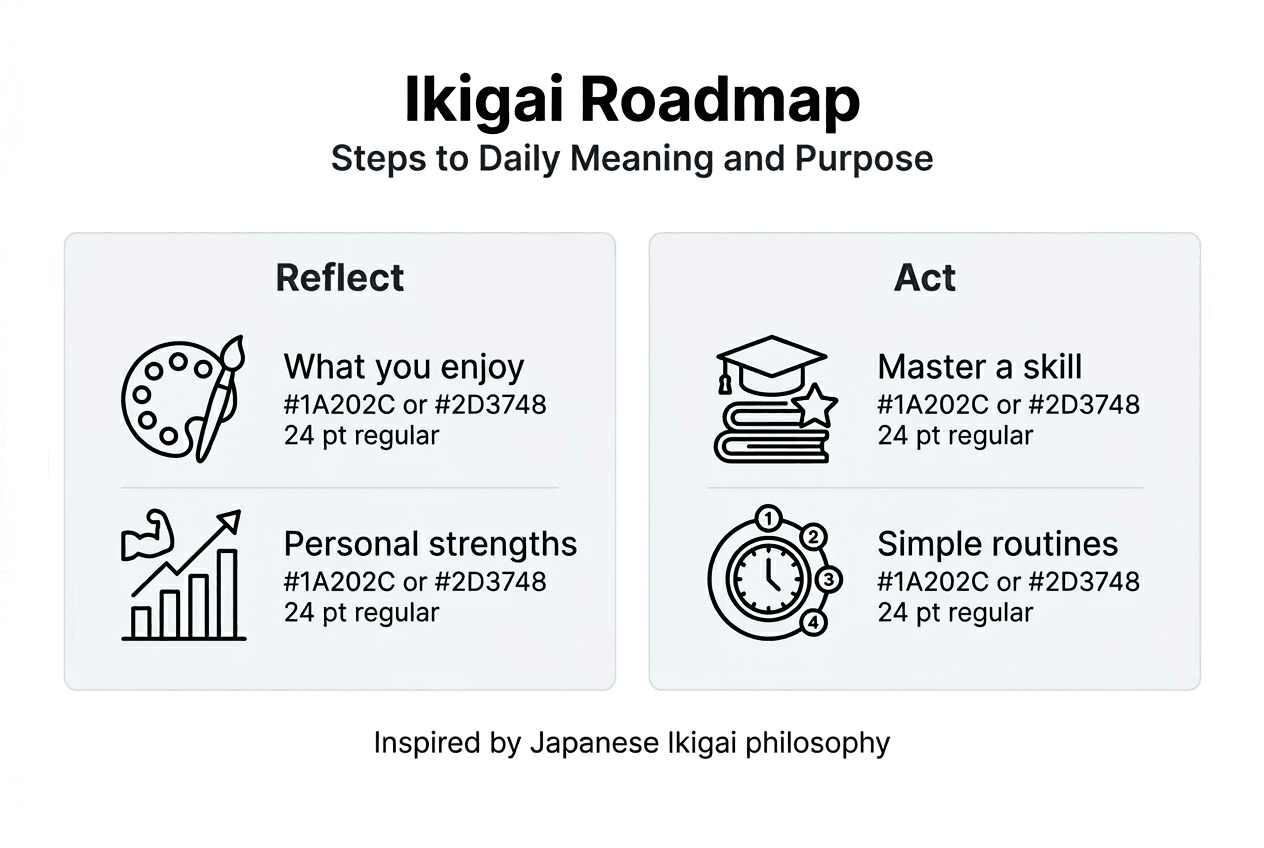
Begin by reflecting on what brings you joy and everyday meaning rather than what you think should bring fulfillment. Engage in mindful practices to connect with daily experiences without judgment. Notice which activities make time pass quickly or leave you feeling energized.
Recognize that passion often follows mastery rather than preceding it, so focus on skill development in areas that interest you. This reverses common advice to “follow your passion” and instead suggests building passion through competence. As you become skilled, natural enjoyment and engagement follow.
Pro Tip: Keep a daily joy journal for two weeks, noting three moments that brought you genuine pleasure each day. Patterns will emerge showing your Ikigai themes.
Follow these steps to discover your Ikigai:
- Identify activities that bring you natural joy without external validation
- Practice mindfulness to notice which tasks engage you fully
- Develop skills in areas where you show curiosity and interest
- Connect your strengths to contributions that benefit others
- Balance personal pleasure with community involvement
- Regularly reassess and adjust as your Ikigai evolves
Use Ikigai personality types to align strengths with life activities through structured self-discovery. Balance personal pleasure with contributions to others and community, ensuring your Ikigai includes both receiving and giving.
| Ikigai Element | Discovery Questions | Action Steps |
|---|---|---|
| Daily Joy | What activities make you lose track of time? | Schedule 30 minutes daily for these activities |
| Natural Strengths | What comes easily that others find difficult? | Seek opportunities to use these strengths |
| Community Value | How can your skills benefit others? | Volunteer or mentor in areas of competence |
| Growth Areas | What skills would enhance your joy? | Commit to deliberate practice weekly |
Explore how to practice Ikigai daily through simple routines that reinforce your sense of purpose and meaning. Consistent small actions compound into lasting fulfillment over time.
Common challenges and how to keep your Ikigai thriving
Avoid mistaking Ikigai for just career or financial success, which represents a common Western misinterpretation. Don’t expect passion to appear before skill mastery, as this expectation creates frustration and abandonment of promising paths. Be wary of losing sight of everyday joys by focusing only on end goals.
Use mindfulness to reconnect with your purpose regularly through meditation, journaling, or reflective walks. Allow your Ikigai to evolve and adapt over time as your life circumstances, skills, and interests naturally shift. Rigid adherence to an outdated Ikigai creates the same emptiness as having no purpose.
Western interpretations can dilute Ikigai’s essence by overemphasizing career and payment aspects at the expense of daily joy. Simplification risks losing joy found in interconnectedness of life’s small moments when reduced to a career optimization formula.
Common pitfalls to avoid:
- Treating Ikigai as a one-time discovery rather than ongoing practice
- Ignoring community and relationship elements for solo pursuits
- Expecting immediate clarity instead of gradual emergence
- Abandoning activities before reaching competence levels
- Measuring success only through external achievements
- Neglecting physical and mental health in pursuit of purpose
Regular check-ins help maintain authentic Ikigai alignment. Monthly reflection on whether your daily activities still bring genuine joy prevents drift into obligation-based living. Learn about mindfulness and Ikigai to strengthen your awareness of present moment meaning.
Sustaining Ikigai requires patience, self-compassion, and willingness to adjust course when activities no longer serve your growth. You are not locked into any single expression of purpose.
Explore Ikigain tools to deepen your Ikigai journey
Finding your authentic Ikigai becomes clearer with structured guidance and self-discovery tools designed specifically for this purpose. Ikigain offers comprehensive resources to support your journey toward purposeful living and personal growth.

Take the Ikigai type test to identify your unique Ikigai type and receive personalized insights aligned with your core passions, values, and strengths. Use Ikigai self-discovery cards to reinforce daily Ikigai practices through guided reflection prompts and exercises. Explore our Ikigai personality types guide to understand how different types approach purpose and fulfillment.
These tools provide structured support for your purposeful living journey, helping you move from theory to practical application. They integrate Japanese cultural principles with modern self-discovery techniques, making ancient wisdom accessible for contemporary life challenges.
FAQ
What is Ikigai and how is it different from Western purpose frameworks?
Ikigai means ‘life’s worth’ in Japanese and focuses on finding joy in daily activities rather than grand career missions. Traditional Ikigai emphasizes community connections, small pleasures, and present moment awareness. Western purpose frameworks often reduce Ikigai to a four-circle diagram focused on career monetization and individual achievement, missing the essence of everyday fulfillment. Our complete guide to Ikigai explores these distinctions in depth, helping you understand authentic approaches to purposeful living.
How can I start applying Ikigai principles in my daily life?
Begin by incorporating mindfulness practices to notice small pleasures throughout your day like morning routines, meal preparation, or conversations with loved ones. Focus on activities that bring you joy and a sense of meaning without requiring external validation or rewards. Build habits that reflect your unique strengths and interests through consistent small actions. Learn practical techniques to practice Ikigai daily and naturally integrate purpose into routine activities.
Can Ikigai help me find more satisfaction in my career?
Research demonstrates Ikigai contributes positively to work engagement and job satisfaction, particularly in high-stress professions. Using Ikigai principles can reduce burnout risk by connecting your work to intrinsic meaning beyond paychecks or titles. Ikigai provides a personal resource alongside other career development tools, helping you identify roles and activities that naturally energize you. Discover more about Ikigai and career satisfaction to apply these concepts to your professional life.
Does finding my Ikigai mean I need to change careers?
Not necessarily, as Ikigai focuses on everyday meaning rather than just career fulfillment. You can cultivate Ikigai within your current role by shifting how you approach tasks, building new skills, or emphasizing aspects that align with your values. Sometimes small adjustments in daily activities create significant satisfaction without dramatic career changes. Ikigai development often reveals opportunities for growth and meaning you overlooked in familiar environments.
How long does it take to discover my Ikigai?
Ikigai discovery unfolds gradually through consistent practice and reflection rather than appearing in a single revelation. Most people notice emerging patterns within weeks of intentional observation and experimentation with different activities. The process continues evolving throughout life as your skills, interests, and circumstances change. Approach Ikigai as an ongoing journey of self-discovery rather than a destination to reach, allowing patience and curiosity to guide your exploration.