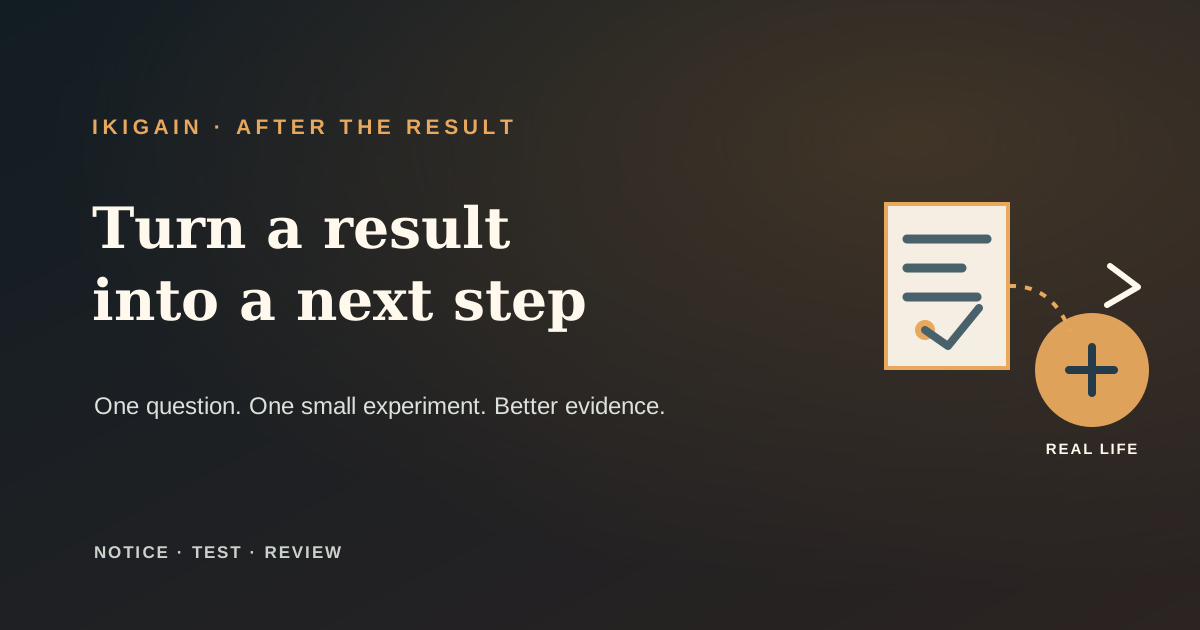
After an Ikigai test, save your result and choose one question to investigate before taking another test or making a major life decision. Write down the part that feels familiar, the part that feels too broad, and one small activity, conversation, or change of conditions that could give you evidence.
An Ikigai result can help you notice themes around interest, contribution, capability, and practical fit. It cannot see your complete history, your responsibilities, your health, or the actual conditions of a job. The useful next step is therefore not to defend the result. It is to test one part of it in ordinary life.
The short version
Use this sequence after you finish:
- Save the result and your first reaction. Do this before reading ten more explanations.
- Separate a theme from a prediction. “I may enjoy helping people understand difficult ideas” is a theme. “I should become a teacher” is a prediction.
- Write one question. Make it specific enough that an observation or conversation could answer it.
- Choose a small experiment. Try a representative task, speak with someone who does it, or change one condition in your current routine.
- Review the evidence. Ask what became clearer, what became less attractive, and what you still need to learn.
This is the same reason we describe assessments as prompts rather than verdicts. If you need help choosing a different lens later, the guide to which Ikigain test to take first matches tests to questions instead of encouraging a pile of labels.
Start with your reaction, not the score
Two people can receive a similar result and need completely different next steps. One may feel relieved because the description gives language to something they have already observed. Another may feel doubtful because the result sounds flattering but does not resemble an ordinary week.
Before interpreting the result, write three short notes:
| Prompt | What to record |
|---|---|
| Familiar | Which sentence describes something I already notice in my life? |
| Unclear | Which sentence sounds attractive but too general to use? |
| Tension | Which part conflicts with my recent behaviour or practical limits? |
Do not grade yourself for having the “right” reaction. A result that makes you curious is useful. A result that makes you argue with it is also useful. Both reactions give you a question to investigate.
Turn a result into a question you can test
Assessment language often sounds more certain than the evidence allows. A result may say that you are creative, people-oriented, analytical, or motivated by contribution. Those words are broad enough to fit many lives.
Translate the broad phrase into an observable question:
| Broad result | Better question |
|---|---|
| “You enjoy helping others.” | Do I prefer explaining, listening, organising support, or solving a practical problem for someone? |
| “You are creative.” | Which kind of making keeps my attention when the first version is disappointing? |
| “You value independence.” | Which decisions do I need to own, and where would collaboration still help? |
| “You seek meaningful work.” | Which contribution would I want to keep making when the task becomes repetitive? |
The better question has a verb, a setting, and some friction. It does not only ask whether you like an idea. It asks what you actually do when time, skill, money, feedback, or other people enter the picture.
Use a five-column post-test worksheet
Copy the strongest sentence from your result into the first column. Then complete the rest without trying to make the result sound impressive.
| Result language | Possible meaning | Evidence I already have | Small test | What would change my mind? |
|---|---|---|---|---|
| “You may be energised by guiding others.” | I might enjoy helping someone move from confusion to a next step. | I have done this informally twice, but both conversations were short. | Offer a 30-minute explanation or mentoring session and ask what was useful. | If I spend the whole time wanting to solve the task myself, I need a different interpretation. |
The point is not to prove the result. It is to make the claim more precise. You may discover that you like the outcome but not the process, or that the activity works only with a certain pace or amount of autonomy.
A composite example: from “creative” to a useful experiment
Illustrative example: the person and situation are fictional.
Imagine a person we will call Priya. Her result highlights creativity and contribution. She has been considering a move into design because the description feels exciting.
Instead of treating that as a career instruction, Priya writes three questions:
- Do I enjoy generating possibilities, refining a visual detail, or explaining a solution to another person?
- Can I stay with a task when a client, colleague, or user rejects the first version?
- What working conditions would let me do this without giving up the stability I currently need?
Her first experiment is not to resign or enrol in a long course. She asks a designer she knows to explain one current project, completes a small brief with a clear deadline, and records what she enjoyed and what drained her. She then compares the result with the conditions she needs to protect.
The experiment may support a design direction. It may instead show that Priya likes collaborative problem-solving but not visual production. Both outcomes are progress because they replace an appealing label with evidence about tasks and conditions.
Choose the right kind of experiment
Different questions need different evidence. Choose the smallest experiment that can reduce your uncertainty.
If you are unsure about the activity
Try a representative task. Do not choose only the fun first five minutes. Include the ordinary part: preparation, repetition, revision, or explaining your work.
If you are unsure about the environment
Have a specific conversation with someone who works in that setting. Ask how time is divided, what gets measured, what becomes tiring, and which part surprises newcomers.
If you are unsure about your work conditions
List the conditions you need to protect: income, schedule, autonomy, social contact, quiet, learning, accessibility, or recovery time. The Work Values Test can help you name trade-offs, but the result still needs to be compared with a real role.
If you are unsure what kinds of activities attract you
Use the Career Interests Test as another lens, then compare its suggestions with tasks you have actually tried. Interest in a subject is not identical to wanting its everyday work.
Give the experiment a boundary
A small experiment is useful only when you know what you are testing. Write down:
- The hypothesis: “I may enjoy making complex information easier to use.”
- The action: “I will redesign one confusing internal guide and ask two readers where they hesitate.”
- The time limit: “I will spend two focused hours on it this week.”
- The evidence: “I will record my attention, frustration, questions, and the readers’ feedback.”
- The next decision: “I will choose whether to repeat, adjust, or stop this type of task.”
The time limit protects the experiment from becoming a vague new identity. It also protects you from treating one difficult attempt as a final verdict. A task can be worth repeating after better instructions, support, or conditions.
What to record while you are testing
Do not record only whether you enjoyed the activity. Enjoyment is one signal, and it changes with sleep, confidence, novelty, and the people around you.
Notice:
- What part made you want to continue?
- What part did you avoid or postpone?
- What kind of difficulty felt satisfying rather than merely exhausting?
- What feedback helped you improve?
- Which condition made the task easier or harder to sustain?
- Would you want to repeat the task after the novelty disappeared?
This gives you richer information than “I liked it” or “I was bad at it.” Early awkwardness may mean you are learning. Repeated dread may mean the task or its conditions are a poor fit. Neither conclusion should be drawn from one short session alone.
Do not turn one result into a new identity
Self-discovery tests can be tempting because labels are easier to remember than observations. A label can also become a permission slip: “I am not a people person,” “I am creative, so routine is beneath me,” or “I am analytical, so I should avoid uncertain work.”
Keep the language provisional. Try:
- “This result gives me a reason to notice… ”
- “I want to test whether I enjoy… ”
- “This may fit me when the conditions include… ”
- “I have evidence for this in one setting, not every setting.”
The goal is not to make your identity less meaningful. It is to keep it flexible enough to learn from experience.
When to take another test
Take another assessment only when it answers a different unresolved question. A second test is not automatically a better answer.
For example, an Ikigai result may help you think about direction, while a work-values result may help you compare the conditions that make a direction sustainable. A personality result may add a language for patterns, but it should not replace information about tasks, training, opportunities, or the people involved.
If you are taking tests because each result creates a new question but no action, pause. Choose one question and run one experiment before collecting another score.
What if the result feels completely wrong?
Do not force yourself to accept it. First check the basics:
- Did you understand the questions in the way the test intended?
- Were you answering about your usual behaviour or an ideal version of yourself?
- Were you rushed, distracted, unusually stressed, or answering in a language that made nuance difficult?
- Does the result conflict with repeated examples, or only with your self-image?
- Is the test designed for the question you are asking?
If the mismatch remains, record it as evidence. A tool can be useful for showing which description does not fit, even when it does not give you a replacement identity.
The APA overview of psychological testing and assessment is a useful reminder that assessment quality depends on the purpose, interpretation, and context of a test. A short online self-discovery result should not be treated as a clinical evaluation, employment classification, or complete account of a person.
A 15-minute review you can do tonight
If you already have a result, set a timer for fifteen minutes:
- Copy one sentence that caught your attention.
- Rewrite it as a question about an observable task or condition.
- List one example from the last month that supports it and one that complicates it.
- Choose a conversation or small task that could give you more evidence.
- Write what you will protect while experimenting: time, money, energy, privacy, or an existing responsibility.
When the timer ends, stop. You do not need a perfect interpretation before you can take a careful next step.
FAQ: what to do after an Ikigai test
Should I take another test immediately after an Ikigai test?
Usually not. First turn the result into one question and one small experiment. Take another assessment only when it addresses a different uncertainty, such as work conditions or career-interest areas.
Can an Ikigai result tell me which career to choose?
No. It can organise reflection around possible interests, contribution, strengths, and practical fit. A career decision also needs information about tasks, training, opportunities, conditions, finances, and your lived experience.
What should I write down after receiving my result?
Record what feels familiar, what feels too broad, what conflicts with your experience, and what question you want to test. Keep the original result so you can compare it with later observations rather than relying on memory.
What if I do not agree with my result?
Treat the disagreement as useful information. Check how you interpreted the questions and whether the result conflicts with repeated behaviour or only with an expectation about yourself. You do not have to accept a description that does not fit.
How long should a post-test experiment last?
Use a short, realistic boundary—often one task, one conversation, or one week of observations. Extend it only if the first experiment produces a clear question that needs more evidence. A small experiment should remain reversible and proportionate to the decision.