Loading…
Research · Ikigain
Vol. 1 / No. 2 · v2.0
Ikigai Statistics 2026
How 4,105 Purpose-Seekers Allocate Attention Across the Four Pillars
A methods-revised study of 4,105 anonymous ikigai test takers. The strongest genuine trade-off is loving something versus believing the world needs it — and almost nobody allocates their attention evenly: the typical gap between a person’s best- and worst-funded pillar is 23 points.
Sindija Vilmane & Karlis Vilmanis·Ikigain.org·Revised 14 July 2026· 16 min read
También disponible en español: Estadísticas del Ikigai 2026.
Version 2 — a methods revision that corrects our own headline
Our first release (9 June 2026, n = 3,915) reported that Profession was the most neglected pillar, by an 8.1-point gap. An internal audit found that estimate was a property of an answer-scoring mapping revised on 1 April 2026 — not a stable fact about people. Under the current methodology the same gap is 3.1 points, and Profession is not the lowest pillar. This revision analyses only current-methodology responses, adds a permutation-null test, ILR balances, and cluster validation — and reports what changed, openly. The full v1 remains available on request. What survived the audit unchanged: the imbalance finding (§6), which we now consider this dataset’s most durable claim.
Sample
4,105
anonymous adults
Period
Apr–Jul 2026
1 Apr – 14 Jul · current item set only
Instrument
18-item
fixed-budget allocation
Source
Ikigain.org
free assessment
Abstract
We analysed budget-allocation responses from 4,105 anonymous adults who completed the ikigain.org 18-item ikigai assessment between 1 April and 14 July 2026, under the platform’s current scoring methodology. Each respondent distributes a fixed pool of 18 attention units across Passion, Mission, Vocation, and Profession. Mission received the largest mean share (26.8%) and Passion the smallest (23.5%). Because budget shares are compositional data, naive correlations between them are structurally biased negative; we correct this with the centered log-ratio transform (Aitchison 1986) and — critically — a permutation-null test that isolates how much of each correlation is the fixed-budget artifact, read in both directions. Five of six pillar pairs exceed the null: three as genuine trade-offs — Passion × Mission (r = −0.50, the strongest), Vocation × Profession (−0.42), Mission × Vocation (−0.34) — and two as genuine complementarities, where pillars pull together more than the constraint predicts: Mission × Profession and Passion × Vocation. Cluster validation finds no support for ten discrete types (no k from 2–10 reaches silhouette 0.28): the population is a continuum, and the archetypes are a communication device. What replicates robustly across both scoring eras is imbalance: the typical respondent’s best- and worst-funded pillars differ by 22.7 percentage points — purpose-seekers are systematically lopsided, whatever the scoring convention.
Five headline findings
3.1 pts
Mission edges out Profession — by far less than we first reported.
Mission 26.8% [26.5–27.1] vs Profession 23.7% [23.4–24.0]. Our v1 said 8.1 points; that was the old scoring mapping. We corrected it publicly (§2).
r = −0.50
Passion × Mission is the strongest genuine trade-off.
Beyond the permutation null (artifact alone predicts −0.37). Vocation × Profession is second at −0.42. CLR-corrected, n = 4,105.
5 of 6
pillar pairs carry real signal — but two are complementarities, not trade-offs.
Mission × Profession and Passion × Vocation pull together more than the fixed-budget artifact predicts. Only Passion × Profession matches pure artifact.
22.7 pp
the typical person's best- and worst-funded pillars differ by ~23 points.
The most robust finding across both scoring eras [CI 22.4–23.0]. Purpose-seekers are systematically lopsided, not balanced.
sil < 0.28
ten archetypes are a scoring convention, not data-supported clusters.
k-means finds no k from 2–10 with silhouette above 0.28 (best: k = 4). Yet distribution is far from uniform: the top two types hold 32.3% (χ² = 570.9).
§1 — Method
How the data were collected and analysed.
We analysed anonymous response data from the free ikigai assessment at ikigain.org/test. The instrument is an 18-item inventory scoring the four pillars of the modern Western synthesis of ikigai popularised by Marc Winn in 2014[6]: Passion (what one loves), Mission (what one believes the world needs), Vocation (what one is good at), and Profession (what one can be paid for). Each answered item contributes one unit to exactly one pillar, so raw pillar scores are integer counts summing to exactly 18 (verified: mean = 18.00, SD = 0.00 across all 4,105 respondents in this window). The output is a composition — how attention is divided, not how much of it there is.
Scoring history — and why this revision exists. Our first release analysed 3,915 respondents scored under an earlier answer-to-pillar mapping, revised on 1 April 2026. Under that earlier mapping the Mission–Profession gap was 8.1 points; under the current mapping it is 3.1 points (§3). We restrict this revision to assessments completed on or after 1 April 2026 so that every response is scored under the live item set, and we flag the discrepancy openly rather than let the original number stand: an internal methods audit found it was mapping-dependent, not a stable population fact.
Compositional-data correction. Four shares summing to 100% cannot vary independently; ordinary Pearson correlations between them carry a structural negative bias from the unit-sum constraint alone — a problem known since Pearson’s 1897 work on spurious correlation and formalised in the compositional-data framework (Aitchison 1986[9]; Pawlowsky-Glahn & Egozcue 2015[10]). All correlations below are computed on centered log-ratio (CLR) coordinates; zero scores are handled with a standard multiplicative pseudo-count of 0.5.
The permutation-null test. CLR removes the unit-sum bias but a subtler mechanical effect remains: any two pillars with different means show some spurious negative CLR correlation purely because the constraint interacts with pillars of different average size. To isolate it, we built a permutation null: 2,000 iterations, each independently shuffling every pillar column across respondents — destroying real within-person association while preserving each pillar’s marginal distribution and the sum constraint exactly. An observed correlation counts as real signal only if it falls outside the null’s 95% band — read in both directions: more negative than the null is a genuine trade-off; less negative is a genuine complementarity.
ILR balances, cluster validation, bootstrap. As an artifact-free cross-check we report three orthogonal isometric log-ratio balances (Egozcue et al. 2003[11]). To test the ten-archetype taxonomy we ran k-means on CLR coordinates for k = 2…10, scored with silhouette coefficients (Rousseeuw 1987[12]). All means, correlations, and the imbalance index carry bootstrap 95% confidence intervals (10,000 resamples; 2,000 for the correlation matrix and permutation null; fixed seed).
All scores were de-identified at extraction; the dataset contains no demographic variables, no IP addresses, and no free-text responses. Aggregate results only; the companion data tables are published below (§9). Researchers may request aggregate cross-tabulations or the full bootstrap output at hello@ikigain.org.
For background on the framework itself — including why the four-circle diagram is a Western synthesis rather than the original Japanese concept — see our editorial essay on the meaning of ikigai or the What is Ikigai pillar guide.
Figure 1 — Monthly assessment volume, April – July 2026
Current-methodology sample only. Data collection continued through 14 July; the July bar reflects a partial month.
§2 — Finding 1
Mission edges out the other pillars — by far less than we first reported.
Mission 26.8% [26.5–27.1], Vocation 26.0%, Profession 23.7%, Passion 23.5%. The Mission–Profession gap our first release put at 8.1 points is 3.1 points [2.6–3.5] under the current methodology.
If respondents split attention equally, each pillar would receive 25%. No pillar sits exactly there, but the deviations are modest: Mission receives the largest mean share (26.8%) and Passion the smallest (23.5%) — a gap of 3.3 points [2.9–3.8]. Profession, the pillar our first release singled out as most neglected, is essentially tied with Passion and is not the most under-funded pillar in current data.
This is a substantial, deliberate correction. The v1 estimate (8.1 points, n = 3,915) was computed under a scoring mapping retired on 1 April 2026; recomputing the identical comparison under the live mapping yields 3.1 points — roughly two-fifths of the original size. Stated plainly: the “modern broke purpose-seeker” narrative, as we first quantified it, was substantially a property of a scoring mapping since revised, not a stable feature of the population. The imbalance finding (§6) is the more robust of our original claims, and we now lead with it.
The direction of the pillar ordering still echoes what scholars of the original Japanese concept have documented. Gordon Mathews’s ethnography found Japanese informants framing ikigai in terms of contribution and self-realisation rather than income[2]; Mieko Kamiya’s foundational 1966 monograph treated the concept as distinct from labour-market exchange[1]. Contribution still outranks commerce in our data — just by a modest margin, not a dramatic one.
Figure 2 — Mean share of attention budget, by pillar (current methodology)
Each respondent’s pillar count divided by 18, averaged across n = 4,105. Bootstrap 95% CIs in tooltips. Dashed line marks the 25% equal-split baseline.
For practical guidance on working with your own pillar gaps, see Quarter-Life Crisis? Here’s How Ikigai Gives You a Direction.
For a reader-friendly companion on which pillar people score lowest in practice, see Which Ikigai Pillar Do People Struggle With Most?.
§3 — Finding 2
The strongest genuine trade-off is Passion against Mission.
A fixed budget forces every pillar pair negative to some degree. The permutation null separates real psychology from that arithmetic — and the biggest real tension is loving something versus believing the world needs it (r = −0.50 vs an artifact baseline of −0.37).
When shares are CLR-transformed and each pair is tested against its own permutation null, five of six pairs carry signal beyond the fixed-budget artifact — but not all in the same direction. Three are genuine trade-offs: Passion × Mission (r = −0.50, null band [−0.39, −0.34]), Vocation × Profession (−0.42, null [−0.32, −0.27]), and Mission × Vocation (−0.34, a small excess over its null). One pair — Passion × Profession — is statistically indistinguishable from the artifact alone.
The v1 release emphasised Vocation × Profession as the headline trade-off. That pair remains a real and second-strongest tension — the “good at it but not paid for it” pattern is not wrong — but under the current methodology the largest genuine tension is Passion versus Mission: within a fixed attention budget, what one loves and what one believes the world needs compete harder than any other pair. The talented underearner has company: the torn idealist.
Figure 3 — Within-person pillar correlation matrix (CLR-corrected, current methodology)
Pearson r on centered log-ratio transformed shares. n = 4,105.
Passion
Mission
Vocation
Profession
Passion
—
-0.50
-0.16
-0.37
Mission
-0.50
—
-0.34
-0.20
Vocation
-0.16
-0.34
—
-0.42
Profession
-0.37
-0.20
-0.42
—
Pearson r × 100, computed on centered log-ratio (CLR) transformed budget shares (Aitchison 1986). The CLR transform removes the spurious negative bias the unit-sum constraint imposes on raw shares. Passion × Mission (r = −0.50) is the strongest within-person trade-off in the current-methodology data; whether each pair carries signal beyond the fixed-budget artifact is tested in the permutation chart below. n = 4,105.
Figure 4 — Observed correlations vs the fixed-budget artifact (permutation null)
Grey bands: the correlation produced by the budget constraint alone (2,000 permutations, 95% band). Points beyond the band on the negative side are genuine trade-offs; beyond it on the positive side, genuine complementarities; inside it, artifact.
Passion × Mission
-0.50
Vocation × Profession
-0.42
Mission × Vocation
-0.34
Passion × Profession
-0.37
Mission × Profession
-0.20
Passion × Vocation
-0.16
−0.550
Real trade-off Real complementarity Matches artifact Null band (artifact alone)
Each grey band is the 95% range of CLR correlation produced by the fixed-budget constraint alone (2,000 column-wise permutations that destroy real within-person association). Points more negative than their band are genuine trade-offs; points less negative are genuine complementarities; points inside match pure artifact. n = 4,105.
§4 — Finding 3
Mission and Profession pull together — a complementarity, not a trade-off.
Two pillar pairs are significantly less negative than the artifact predicts: Mission × Profession (−0.20 vs null −0.34) and Passion × Vocation (−0.16 vs null −0.32). Some real force pulls them together.
Reading the permutation null in both directions surfaces a finding a one-directional analysis would miss: Mission and Profession are allies in the data. People who allocate heavily to “what the world needs” allocate more to “what can be paid for” than the budget constraint alone would produce — consistent with a population for whom contribution and livelihood are entangled rather than opposed (think: the person whose sense of what the world needs is their profession). Passion × Vocation shows the same complementary pattern: loving a thing and being good at it travel together.
Our first release claimed the opposite — that every pillar traded inversely against Profession, which we called “the universal opponent.” Under the current methodology and the bidirectional null, that framing is not merely unsupported; it is contradicted in the Mission direction specifically. We retract it, and report the Mission × Profession complementarity as a finding in its own right.
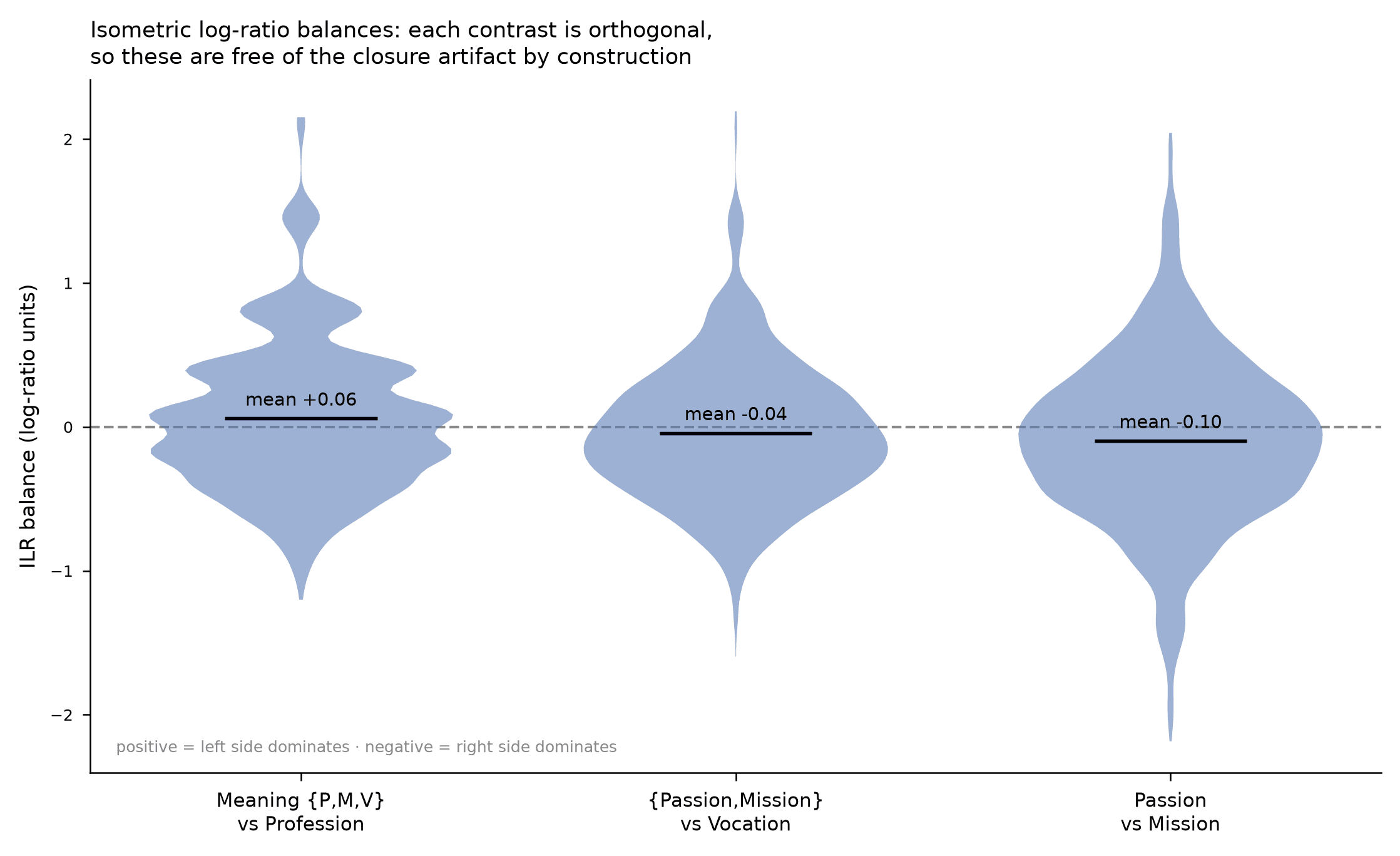
Figure 5 — ILR balance decomposition (artifact-free by construction)
Three orthogonal log-ratio contrasts. The “meaning” pillars collectively edge out Profession only modestly (b₁ mean +0.06); Mission modestly outweighs Passion (b₃ mean −0.10). The population is far closer to an even split than v1 implied.
§5 — Finding 4
Ten archetypes are a scoring convention — the data describe a continuum.
k-means on CLR coordinates finds no k from 2 to 10 with silhouette above 0.28 (best: k = 4). Yet the distribution across the ten labels is far from uniform: the top two hold 32.3% of respondents.
The ikigain.org scoring routine assigns each respondent a primary archetype from which pillar or pillars dominate their allocation. We tested whether those ten labels correspond to natural structure: they do not. No clustering solution between k = 2 and k = 10 reaches a silhouette score of 0.28 — well under the ~0.5 conventionally read as distinct clusters (Rousseeuw 1987[12]) — and the best-scoring k is 4, not 10. The population is better described as a continuum in allocation space. The archetypes are a useful communication device built on a scoring rule — like compass directions on a round landscape — not a discovered typology, and we think honesty about that distinction matters.
The distribution across the ten labels is nonetheless highly non-uniform: Purpose-Driven Leaders (18.5%) and Skilled Experts (13.8%) together hold 32.3% of the sample, against 20% for any two labels under a uniform null (χ² = 570.9, df = 9, p ≈ 10⁻¹¹⁷). This concentration is far smaller than the 43.9% our first release reported under the retired mapping, but remains overwhelming: respondents are not spread evenly across the labels, even though the labels are not clusters.
Figure 6 — Cluster validation: silhouette scores for k = 2…10
k-means on CLR coordinates, n = 4,105. All solutions score below 0.3 — weak separation; the ten-type taxonomy is not data-derived.
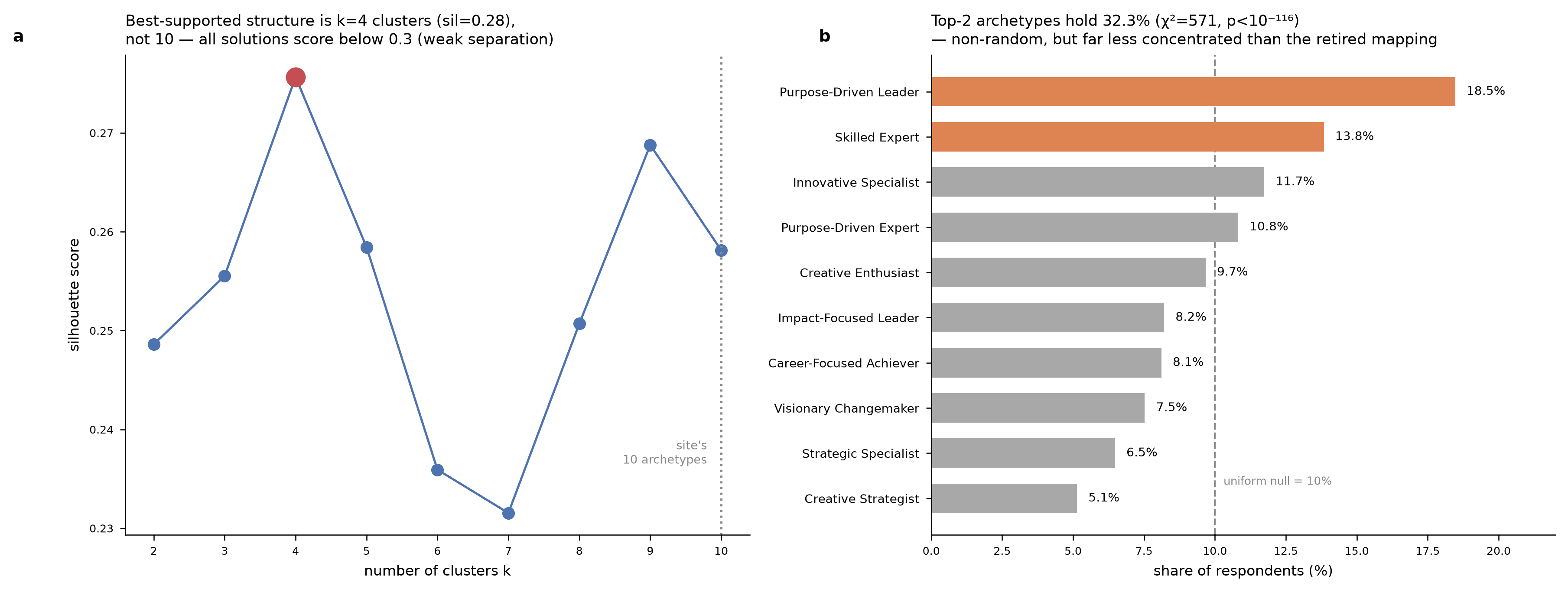
Figure 7 — Archetype distribution, ranked (current methodology)
n = 4,105. Top two archetypes (highlighted) hold 32.3% of the sample.
Figure 8 — Budget profile of the top five archetypes
Mean allocation by pillar within each archetype — in part a visualisation of the assignment rule itself (see Limitations).
Each archetype has a dedicated reference page; see the ten ikigai personality types.
For a plain-language look at type distribution, see The Most Common Ikigai Type.
§6 — Finding 5
The robust result: almost nobody is balanced.
The typical respondent’s best- and worst-funded pillars differ by 22.7 percentage points [22.4–23.0] — essentially unchanged across both scoring eras.
Across the current mapping and a reconstruction of the earlier era, the mean imbalance index — each person’s largest pillar share minus their smallest — sits at 22–24 points. The pillar-mean story shrank when the mapping changed; this one did not move. It is, in our assessment, the single most durable empirical claim in this dataset: people who take a purpose test allocate attention lopsidedly, not evenly, whatever the diagram’s four symmetric circles imply.
Given that the four-circle diagram is itself a Western synthesis (§1 of our methods essay) rather than an artifact of the Japanese ikigai literature, we see no strong reason to treat perfect balance as the framework’s implicit target. We suggest reading the four-pillar allocation as a diagnostic of where attention currently sits — useful whether or not balance is desirable for a given person — rather than as a scorecard against an equal-split ideal.
Figure 9 — Pillar means and the imbalance distribution
Left: mean pillar shares against the 25% equal-split line. Right: distribution of the per-person imbalance index; mean 22.7 pp. n = 4,105.
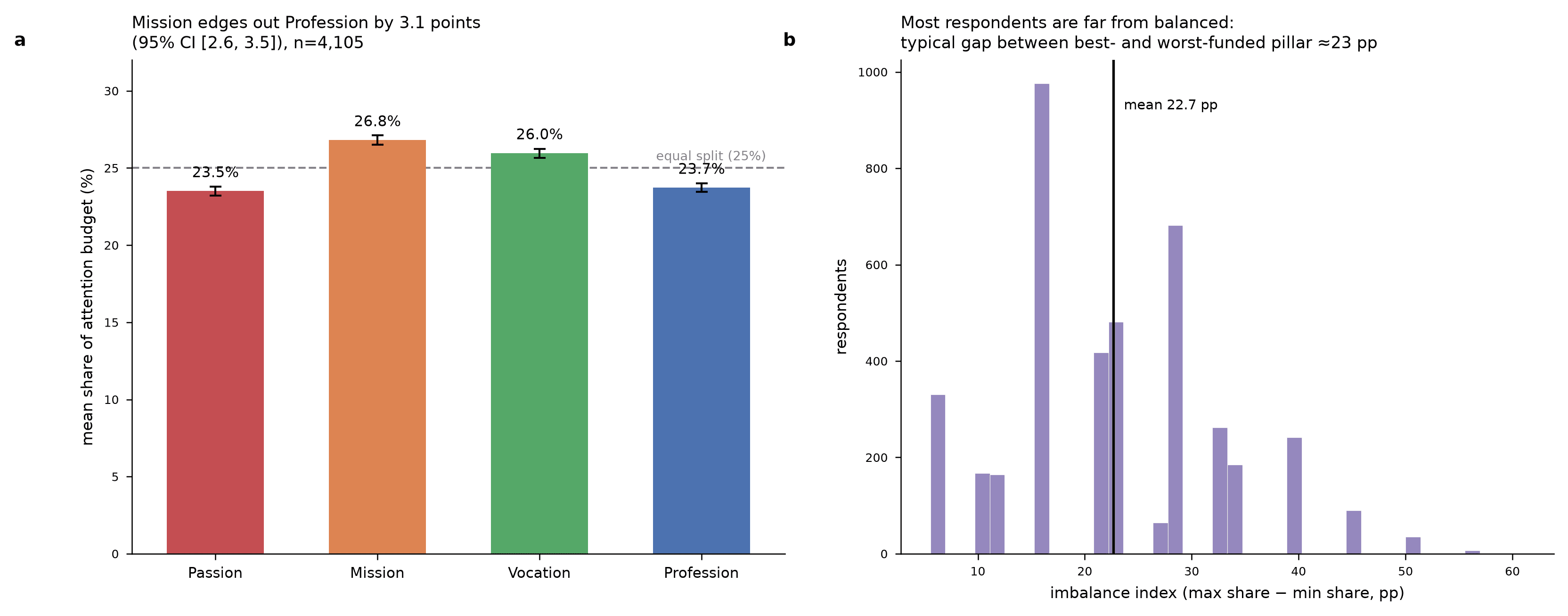
Figure 10 — Imbalance index by archetype
Imbalance = max share − min share within each archetype. Single-pillar-dominant types are the most lopsided; the two-pillar “hybrid” types are the most balanced.
§7 — Discussion
What these findings imply — for the field and for us.
1. Fixed-budget instruments need more than a CLR transform. The unit-sum correction is necessary but not sufficient: a permutation null — read in both directions — is what separates genuine covariation from the milder mechanical effect of unequal pillar means. Of six pairs, three are real trade-offs, two are real complementarities, one is pure artifact. Collapsing “beyond the null” into a single “trade-off” bucket — as our v1 effectively did — loses half the story.
2. A typology built on a scoring rule should be validated before being presented as discovered. Ours does not validate as clusters, and we say so. The labels remain useful for communication — people navigate by named landmarks — but the honest description of this population is a continuum with two heavily-populated regions (Mission-dominant and Vocation-dominant allocations).
3. The durable substantive claim is imbalance. Which single pillar is “most neglected” proved sensitive to a scoring revision; that people are reliably lopsided by ~23 points did not. If the four-circle diagram is read as prescribing equal attention to loving, contributing, excelling, and earning, the data are clear that almost no one lives that way — and the Kamiya tradition, which frames ikigai as orientation rather than equilibrium[1], never asked them to.
Finally, a note on why we published a correction rather than quietly updating numbers. The point of publishing data about purpose is to be believed; the cost of being believed is being auditable. The v1 headline did not survive our own audit, so it does not survive in our publication either. The findings above are the ones that did.
§8 — Limitations
What this study is not.
Self-selection. Respondents arrived at a free online purpose test; they are not a random sample of any general population. The data describe the audience the self-help industry reaches — not the world at large.
Scoring-mapping sensitivity. As §2 details, the magnitude (though not the qualitative direction) of the pillar-mean findings changed materially between scoring eras. Point estimates from fixed-budget instruments should not be read as stable population parameters without a scoring-version sensitivity check — we recommend future releases report one, as this one does.
Archetype-assignment circularity. The per-archetype radar profiles (Figure 8) are partly a visualisation of the assignment rule. The non-trivial findings are the uneven distribution across labels and the within-archetype imbalance — neither forced by the rule.
No demographics; cross-sectional; single instrument. We collected no age, gender, country, or income data; all data are single-occasion; and all findings are internal to this 18-item allocator. Cross-validation against a validated level measure of ikigai — the Ikigai-9 (Imai, Osada & Nishi 2012[13], validated in English by Fido, Kotera & Asano[14] and in German by Hajek et al.[15]) — is the highest-priority next step: pairing an allocation instrument with a level instrument would test whether imbalance predicts lower reported well-being.
Construct caveat. This is a study of the popular Western four-pillar synthesis that borrows the ikigai name — not of the original Japanese psychological construct studied by Kamiya and measured by the Ikigai-9. The two are related in spirit but are not the same measurement target. Longitudinal work linking the broader construct to health outcomes (Ohsaki cohort[3]; JACC study[8]) does not automatically transfer to the four-circle framework.
§9 — Data availability
Companion data tables.
Every number in this report can be checked against the published aggregate tables below (CSV, CC-BY-4.0). No individual-level data are released. Replication requests: hello@ikigain.org.
§10 — References
Works cited.
- Kamiya, M. (1966). Ikigai ni tsuite [About ikigai]. Tokyo: Misuzu Shobō. (Cited in English-language scholarship via Mathews 1996.)
- Mathews, G. (1996). What Makes Life Worth Living? How Japanese and Americans Make Sense of Their Worlds. Berkeley: University of California Press.
- Sone, T., Nakaya, N., Ohmori, K., Shimazu, T., Higashiguchi, M., Kakizaki, M., Kikuchi, N., Kuriyama, S., & Tsuji, I. (2008). Sense of life worth living (ikigai) and mortality in Japan: Ohsaki Study. Psychosomatic Medicine, 70(6), 709–715. DOI: 10.1097/PSY.0b013e3181813cdc
- Mogi, K. (2017). The Little Book of Ikigai: The Essential Japanese Way to Finding Your Purpose in Life. London: Quercus. (Treats ikigai as a Japanese cultural concept with its own internal structure rather than as the four-circle synthesis.)
- Buettner, D. (2008). The Blue Zones: Lessons for Living Longer from the People Who’ve Lived the Longest. Washington, DC: National Geographic.
- Winn, M. (2014). What is your ikigai? The View Inside.me. The four-circle Venn diagram synthesis popularised through this blog post; an earlier c. 2011–2012 diagram by Andrés Zuzunaga (titled Propósito) is the original visual source. See Wikipedia’s ikigai entry for the disambiguation history.
- García, H., & Miralles, F. (2017). Ikigai: The Japanese Secret to a Long and Happy Life. London: Penguin.
- Tanno, K., Sakata, K., Ohsawa, M., Onoda, T., Itai, K., Yaegashi, Y., & Tamakoshi, A. (2009). Associations of ikigai as a positive psychological factor with all-cause mortality and cause-specific mortality among middle-aged and elderly Japanese people: Findings from the Japan Collaborative Cohort Study. Journal of Psychosomatic Research, 67(1), 67–75. DOI: 10.1016/j.jpsychores.2008.10.018
- Aitchison, J. (1986). The Statistical Analysis of Compositional Data. London: Chapman & Hall. (Foundational text introducing the centered log-ratio transform.)
- Pawlowsky-Glahn, V., & Egozcue, J. J. (2015). Compositional data and their analysis: an introduction. Geological Society Special Publication, 264, 1–10.
- Egozcue, J. J., Pawlowsky-Glahn, V., Mateu-Figueras, G., & Barceló-Vidal, C. (2003). Isometric logratio transformations for compositional data analysis. Mathematical Geology, 35(3), 279–300.
- Rousseeuw, P. J. (1987). Silhouettes: a graphical aid to the interpretation and validation of cluster analysis. Journal of Computational and Applied Mathematics, 20, 53–65.
- Imai, T., Osada, H., & Nishi, S. (2012). The reliability and validity of a new scale for measuring the concept of ikigai (Ikigai-9). Japanese Journal of Public Health, 59(7), 433–439.
- Fido, D., Kotera, Y., & Asano, K. (2020). English Translation and Validation of the Ikigai-9 in a UK Sample. International Journal of Mental Health and Addiction, 18, 1352–1359.
- Hajek, A., Imai, T., Zwar, L., & König, H.-H. (2024). Translation and Validation of the German Version of the Ikigai-9. Societies, 14(3), 39.
§11 — Authors & citation
Cite this work.
Vilmane, S. & Vilmanis, K. (2026). Ikigai Statistics 2026 (v2): How 4,105 Purpose-Seekers Allocate Attention Across the Four Pillars. Ikigain Research, Vol. 1, No. 2. Available at: ikigain.org/research/ikigai-statistics-2026

Sindija Vilmane
Founder & Creator
Sindija founded Ikigain in 2021 after years of asking herself what success actually meant. The Japanese concept of ikigai — and a card-based reflection practice she built from it — became the basis for the assessment instrument and four-pillar framework used in this study. She has guided thousands of test-takers through the framework documented in our What is Ikigai guide.
LinkedIn
Karlis Vilmanis
Co-founder · Data & eCommerce
Karlis co-founded Ikigain and runs the data pipeline behind the platform. He designed the extraction protocol for both releases, commissioned the independent methods audit that produced this revision, and maintains the reproducibility tooling behind the published tables. Family-owned business based in Latvia, operating since 2021.
LinkedInPress inquiries, dataset access requests, or replication questions: hello@ikigain.org. We respond within 48 hours.
Take the test
How lopsided is YOUR allocation?
Take the same free 5-minute test we analysed. 18 questions, no email needed. You’ll see your own four-pillar pattern — and how far from the 25/25/25/25 split you actually sit.
Take the test (5 min)