TL;DR:
- The quarter-life crisis is a real psychological phase, typically hitting between ages 24 and 32. It feels like being lost despite doing everything right.
- The standard advice — "follow your passion," "trust your gut," "just take a year off" — fails because it's vague.
- The Japanese concept of ikigai gives you something concrete to do: identify the intersection of what you love, what you're good at, what the world needs, and what you can be paid for.
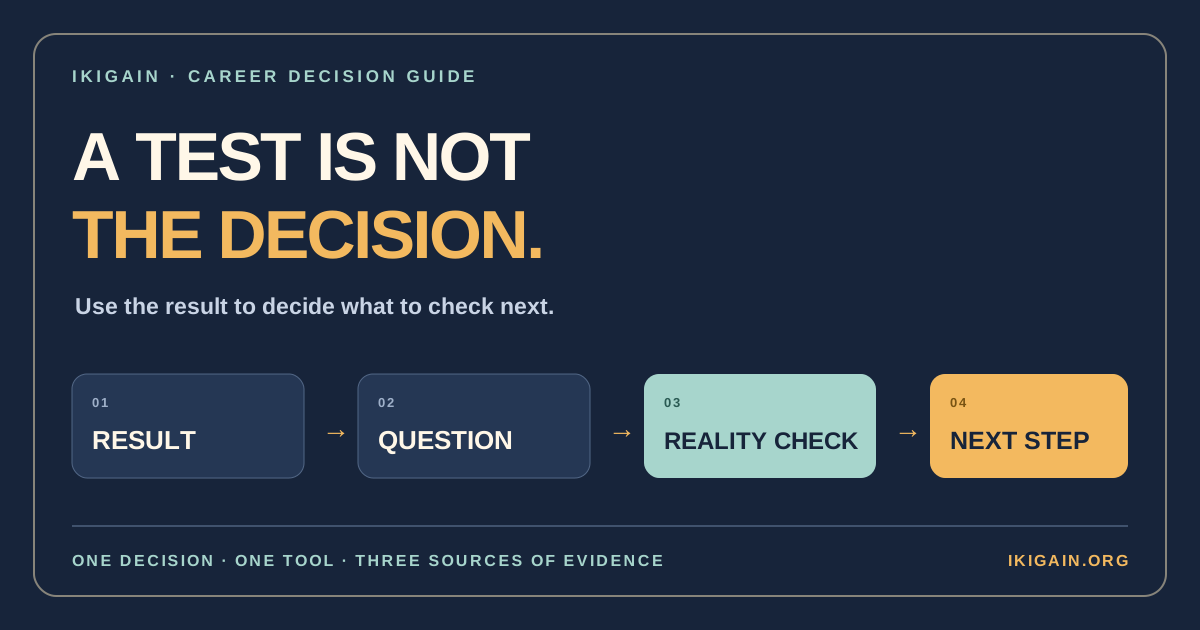
- A free 5-minute ikigai test will give you a direction. Not the answer. A direction.
You're not having a breakdown. You're having a chapter break.
The quarter-life crisis has a script. It usually goes like this:
You did the things. You finished school, got a job, maybe got a partner. The job pays. The relationship is fine. You should be happy — everyone around you treats this as the success you were supposed to want. But you wake up at 6:43 a.m. and stare at the ceiling and think, is this it?
Or you didn't do the things. You skipped school or quit it. You drifted between jobs. You feel behind, even though no one is keeping score. You watch friends post engagement photos and house keys and you feel like time is passing without you.
Both versions are the quarter-life crisis. Psychologists Oliver Robinson and Alex Fouladi have studied it extensively — they find it typically hits between ages 24 and 32, lasts 6 to 24 months, and usually resolves in one of two ways: a major life pivot, or a slow integration of new values into the existing life.
It is not a breakdown. It is the moment your 20-year-old plan stops fitting your 27-year-old self. That mismatch is actually progress — it means you've changed enough that the old plan no longer fits.
Why "follow your passion" makes the crisis worse
The most common quarter-life crisis advice is the most useless. "Follow your passion." "Trust your gut." "Take a year off and figure it out."
The problem with this advice: if you knew what your passion was, you wouldn't be in a quarter-life crisis. The defining feature of the crisis is that you can't feel your passion clearly. Your gut is full of conflicting signals. A year off without a framework usually produces more confusion, not less — three months of travel and reading, then back to the same paralysis.
What you need is not more permission to drift. You need a diagnostic framework — something that tells you which signals to pay attention to and how to weigh them against each other.
What ikigai actually is (and why it works for this)
Ikigai (生き甲斐) is a Japanese word meaning roughly "a reason for living." It is used in everyday Japanese to describe whatever gets a person out of bed in the morning. In Okinawan culture — where people live unusually long lives — researchers have linked ikigai to longevity and well-being.
The version most useful for the quarter-life crisis is the Western synthesis: a four-circle Venn diagram representing four overlapping dimensions of a meaningful life.
- Passion — what you love: activities, topics, and people you are drawn to without external reward
- Vocation — what you are good at: skills you have, or natural aptitudes you have not yet fully developed
- Mission — what the world needs: problems or contributions that would actually matter
- Profession — what you can be paid for: economic value the market will exchange money for
The four-circle framework is useful in a quarter-life crisis because it does the thing other advice doesn't: it gives you four separate signals to evaluate, instead of one vague "passion" feeling. You can be specific about which pillar you're strong in, which you're weak in, and where the overlaps actually live.
You can read the full ikigai framework here, or take a free 5-minute ikigai test that scores you on all four pillars.
The diagnostic questions that actually move you
If you want to do this without a test, here are the four diagnostic questions that ikigai forces you to answer concretely. Write the answers down. Vague answers don't count.
1. Passion: What activity makes you forget what time it is?
Not "what do you love." Loving something can be passive. The signal is flow state — what activities make you forget time? Coding? Writing? Cooking? Teaching? Solving a logistical puzzle? Notice the verb. Passion lives in the verbs, not the nouns.
2. Vocation: What do people thank you for, without you trying?
What do friends, family, or colleagues spontaneously ask you for help with? Where do they say "you're so good at this"? That's vocation. It's the skill the world is already telling you you have — you just haven't taken it seriously yet.
3. Mission: What problem in the world makes you angry?
Not "what do you want to fix." Anger is more honest than altruism. What injustice, dysfunction, or wastefulness in the world actually pisses you off when you think about it? Healthcare access? Climate inaction? Education inequality? Cities that hate pedestrians? That anger is mission. It's pointing somewhere.
4. Profession: What would you do at half your current pay if you got to choose the work?
Not "what would make you rich." Money is the constraint, not the goal. The signal is: if income dropped 50% but you got to design the work yourself, what would the work be? That points you at the intersection of skill, value, and willingness to take a pay cut — which is roughly where sustainable careers live.
The most common quarter-life crisis patterns (and what ikigai says about each)
Quarter-life crises tend to fall into four patterns. The ikigai framework gives a different prescription for each.
Pattern 1: "I have a stable job but it feels empty"
You probably score high on Vocation and Profession but low on Mission and Passion. The job pays, you're competent, but you don't care about the work. The fix is not to quit. It's to find a Mission or Passion overlay — either inside the current job (different team, different problem) or alongside it (volunteer, side project, evening class).
Pattern 2: "I love what I do but I'm broke"
High Passion, low Profession. You're an artist, musician, teacher, activist — meaningful work, no money. The fix is rarely "stop doing the meaningful thing." It's usually to find the bridge — adjacent work that pays for the central work. The barista-novelist is a cliché because it's a working model.
Pattern 3: "I'm good at something I hate"
High Vocation, low Passion and Mission. You're talented at law, finance, sales, or engineering, and the talent has trapped you. The fix is harder: you usually need to identify a different Mission or Passion that your existing skill can serve. Lawyers who go into nonprofit advocacy. Engineers who join climate startups. The skill stays; the mission shifts.
Pattern 4: "I have no idea what any of this is"
Low scores across the board, or wildly inconsistent. This is the rawest version of the crisis. The fix is not to introspect harder. It's to experiment. Pick one of the four pillars and run a 30-day experiment in it. Volunteer somewhere for Mission. Take a class for Vocation. Spend a weekend on something purely for Passion. The data you generate is more useful than the data you can imagine.
What a quarter-life crisis is not
It is not depression, even though it can look like depression. If you have lost interest in food, sleep, and connection for more than two weeks, that's clinical and worth talking to a professional about. Ikigai is not a substitute for therapy.
It is not a sign you wasted your twenties. The quarter-life crisis happens precisely because you used your twenties to grow — you outgrew the version of yourself you planned for at 19. That's a feature, not a bug.
It is not a permanent state. Robinson's research shows the average quarter-life crisis lasts 14 months. The people who come out best are not the ones who waited it out — they are the ones who treated it as a chance to redesign the next chapter, deliberately.
Frequently asked questions
What age does the quarter-life crisis typically start?
Research by Oliver Robinson and Alex Fouladi places it most commonly between ages 24 and 32. Some people experience it earlier (around age 22 after college) or later (early 30s when life decisions feel locked in). It tends to last 6 to 24 months, with the most acute phase around 12 months in.
Is the quarter-life crisis the same as a midlife crisis?
Different ages, similar shape. Both are moments where the life you have stops matching the person you've become. The quarter-life crisis is usually about identity formation ("who am I going to be?"). The midlife crisis is usually about identity revision ("who have I become and is it still me?").
Will ikigai actually help if I don't know what I want?
Ikigai is specifically designed for that situation. The framework doesn't require you to know your passion upfront. It asks four separate diagnostic questions, scores them, and uses the imbalance to point you toward a direction. Most people find the result resonates within seconds of seeing it.
Where can I take a quarter-life crisis test based on ikigai?
The free ikigai personality test on ikigain.org works as a quarter-life-crisis diagnostic. It takes 5 minutes, scores you across all four pillars, places you in one of 15 personality types, and gives you a concrete starting direction. No email required.
One concrete next step
If you are in a quarter-life crisis right now, the most useful thing you can do today is not journal more, talk to more friends, or read another article. It is to generate specific data about yourself, structured around the four pillars.
The free ikigai test does this in five minutes. You'll learn your strongest and weakest pillars, your ikigai personality type, and a clear direction for your next 30 days. It won't give you "the answer." It will give you a place to start.