You chase happiness, yet feel empty. Many confuse fleeting joy with deeper fulfillment. True life satisfaction involves meaning and purpose, not momentary pleasure. This guide reveals what life fulfillment actually means, drawing from Japanese Ikigai philosophy and modern science. You’ll learn practical steps to cultivate lasting satisfaction aligned with your values, strengths, and purpose.
Table of Contents
- Defining Life Fulfillment: Beyond Happiness
- Japanese Philosophy And The Framework Of Ikigai
- Psychological And Health Benefits Of Life Fulfillment
- Common Misconceptions About Life Fulfillment
- Conceptual Framework: The Ikigai Model
- Frameworks And Tools For Discovering Life Fulfillment
- Practical Application: Cultivating Fulfillment Daily
- Discover Your Ikigai And Start Living Purposefully
- Frequently Asked Questions
Key takeaways
| Point | Details |
|---|---|
| Life fulfillment differs from happiness | Fulfillment involves sustained meaning and purpose rather than transient positive emotions or pleasures. |
| Ikigai provides a four-part framework | This Japanese philosophy aligns what you love, excel at, what the world needs, and what provides livelihood. |
| Science confirms fulfillment’s health benefits | Purposeful living correlates with reduced mortality risk and 25% higher life satisfaction scores over one year. |
| Common myths mislead seekers | Wealth and constant happiness are not fulfillment; authentic purpose arises from aligning actions with core values. |
| Daily meaningful habits sustain fulfillment | Consistent engagement in purposeful activities builds lasting satisfaction beyond fleeting achievements. |
Defining life fulfillment: beyond happiness
Life fulfillment represents a subjective state of meaning and satisfaction distinct from happiness. Happiness comes and goes with circumstances. Fulfillment anchors you through challenges because it connects to deeper purpose.
Psychological research distinguishes these experiences clearly. Short-term happiness spikes when you buy something new or enjoy a vacation. These pleasures fade quickly, leaving you searching for the next high. Life fulfillment, however, grows from alignment between your actions and core values.
Why fulfillment matters more than happiness:
- Fulfillment provides resilience during difficult times
- Happiness fluctuates with external events
- Fulfillment correlates with long-term well-being
- Momentary joy often masks deeper dissatisfaction
- Purpose-driven living creates sustainable contentment
Think of happiness as weather and fulfillment as climate. Weather changes daily, but climate defines the environment you live in year-round. Chasing happiness alone feels like constantly checking forecasts, hoping for sunny days. Building fulfillment creates an internal climate that sustains you regardless of external conditions.
“The quality of life is determined by its activities.” This ancient wisdom captures fulfillment’s essence. Your daily choices and engagements shape how meaningful your existence feels, far beyond passing emotions.
Pro Tip: Track your activities for one week. Note which ones leave you energized versus drained. Fulfilling activities restore energy even when challenging, while empty pleasures often exhaust you afterward.
Japanese philosophy and the framework of Ikigai
Ikigai translates roughly as “reason for being.” This comprehensive Japanese philosophy offers a practical framework for discovering life fulfillment. Rather than abstract concepts, Ikigai identifies four concrete elements that intersect to reveal your purpose.
The four pillars of Ikigai create a complete picture:
- What you love: Your passions, interests, and activities that naturally draw you in
- What you’re good at: Your talents, skills, and abilities others recognize
- What the world needs: Problems you can solve, values you can provide
- What you can be paid for: Practical ways to sustain yourself while contributing
When these four elements overlap, you’ve found your Ikigai. This intersection point represents where personal satisfaction meets societal value. You’re not just pursuing selfish desires or sacrificing yourself for others. You’re creating a sustainable balance.

Consider a teacher who loves sharing knowledge, excels at explaining complex ideas, fills society’s need for education, and earns a living doing it. That’s Ikigai in action. The core principles of Ikigai emphasize this harmony between individual fulfillment and community contribution.
Modern life often fragments these elements. You might love painting but work in finance to pay bills. Or you’re skilled at something the market doesn’t value. Ikigai challenges you to seek integration rather than compartmentalization.
“Only staying active will make you want to live a hundred years.” This Japanese proverb encapsulates Ikigai’s emphasis on engaged, purposeful living rather than passive existence.
The beauty of Ikigai lies in its cultural grounding paired with universal applicability. While rooted in Japanese tradition, Ikigai’s impact on fulfillment transcends cultural boundaries. Anyone seeking meaningful direction can apply this framework to clarify their path.
Psychological and health benefits of life fulfillment
Science confirms what philosophy suggests: fulfillment improves both mental and physical health. Research shows purpose-driven individuals face lower mortality risk and better health outcomes across multiple measures. Your brain actually functions differently when engaged in meaningful versus pleasurable activities.
Neuroscience reveals distinct neural pathways for pleasure and purpose. Dopamine surges with immediate rewards, creating addictive cycles. Purpose activates sustained engagement circuits in the prefrontal cortex, building long-term satisfaction. This explains why binge-watching feels empty while completing a challenging project energizes you.
Documented health benefits of life fulfillment:
- Reduced risk of cardiovascular disease
- Lower rates of depression and anxiety
- Improved immune system function
- Better sleep quality and stress management
- Enhanced cognitive function in aging
Longitudinal studies tracking thousands of participants over decades paint a clear picture. People reporting strong life purpose live longer, healthier lives. The daily meaningful engagement increases life satisfaction scores by approximately 25% over one year, according to robust research.
The physical benefits extend beyond mental wellness. Purposeful individuals maintain healthier behaviors not through willpower but intrinsic motivation. When exercise connects to hiking with grandchildren rather than arbitrary fitness goals, consistency improves dramatically.
Life satisfaction score increase: 25%
Research shows daily meaningful activities boost fulfillment scores by one quarter within 12 months.
Your body responds to purpose at cellular levels. Stress hormones decrease, inflammation markers drop, and healing processes accelerate. This isn’t mystical thinking but measurable biological reality. Living with clear purpose literally changes your physiology.
Pro Tip: Notice how your body feels during different activities. Fulfilling work creates focused energy, while empty tasks drain you physically. Your body knows the difference before your mind consciously recognizes it.
Common misconceptions about life fulfillment
Many people chase fulfillment in wrong directions, confused by cultural messaging and superficial markers. Understanding what fulfillment is not helps clarify what it actually is. These misconceptions create barriers preventing authentic purpose discovery.
Widespread myths about fulfillment:
- Fulfillment equals constant happiness: Actually, fulfillment includes difficulty, challenge, and growth that momentarily decrease happiness
- Wealth brings fulfillment: Financial security matters, but research shows income beyond basic needs contributes minimally to life satisfaction
- External achievements create purpose: Recognition feels good temporarily but doesn’t substitute for internal alignment with values
- You find fulfillment once and finish: Purpose evolves throughout life stages, requiring ongoing reflection and adjustment
- Fulfillment requires dramatic life changes: Small daily alignments often create more sustainable fulfillment than radical shifts
Data reveals how common these confusions are. Surveys show 67% of respondents initially define fulfillment through external markers like salary, status, or possessions. Yet longitudinal tracking demonstrates these factors contribute less than 10% to reported life satisfaction.
The constant happiness myth proves particularly damaging. People pursuing fulfillment through their Ikigai often face initial discomfort. Learning new skills feels awkward. Building something meaningful requires patience. If you expect perpetual joy, you’ll abandon purposeful paths when challenges arise.
Understanding why Ikigai matters helps distinguish authentic fulfillment from cultural illusions. The advantages of Japanese philosophy include its resistance to materialistic definitions of success prevalent in Western contexts.
External validation provides temporary satisfaction but unstable foundations. Your boss’s praise feels great until criticism arrives. Social media likes create dopamine hits without substance. Fulfillment rooted in internal values remains steady regardless of external feedback.
Pro Tip: When evaluating life decisions, ask whether they align with your core values rather than others’ expectations. If you feel pressure to justify choices to yourself, you’re likely chasing external markers instead of authentic purpose.
Conceptual framework: the Ikigai model
Visualizing Ikigai as four overlapping circles clarifies how its elements interact. Each circle represents one pillar. Where circles overlap two at a time, you get partial fulfillment states. The center point where all four converge represents your complete Ikigai.
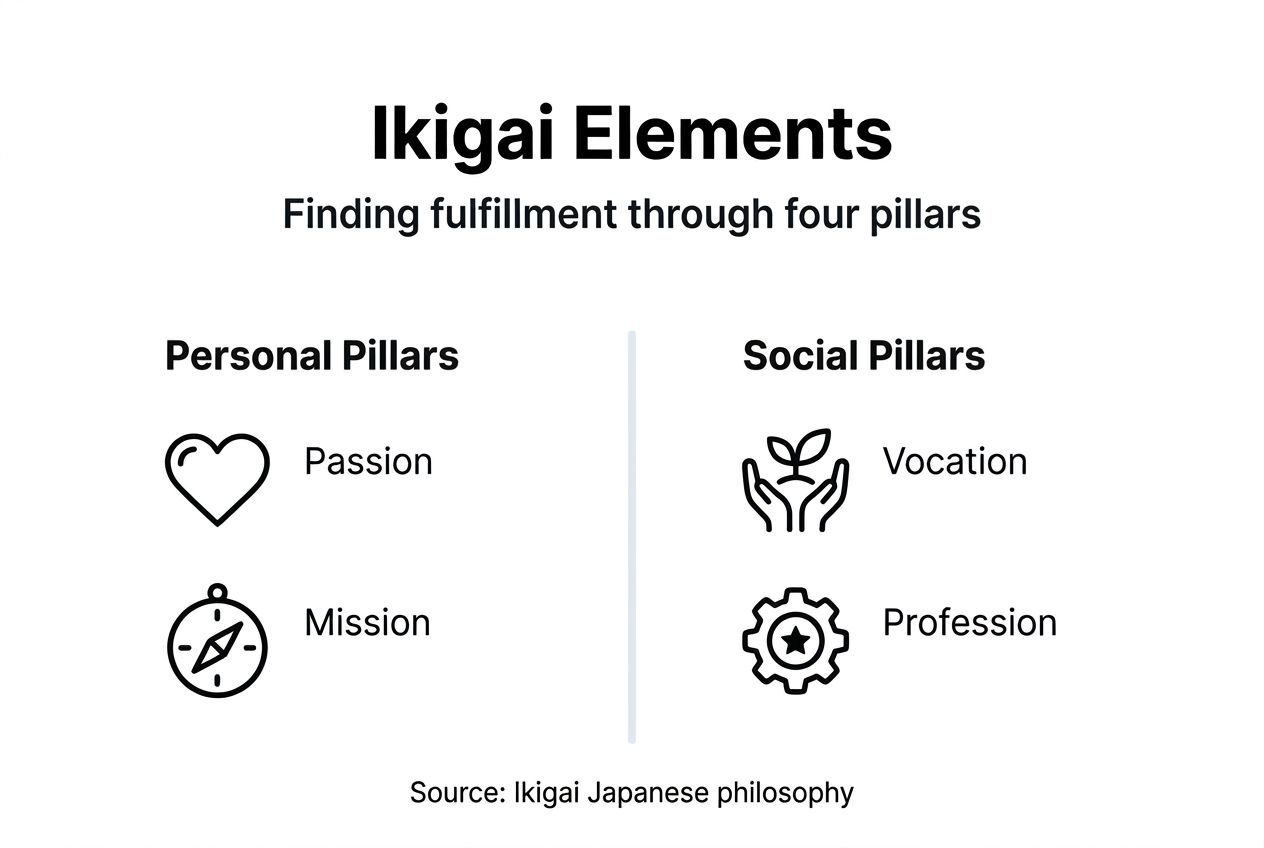
This Venn diagram structure makes abstract concepts tangible. You can literally map your current life position and identify which elements need development. Maybe you’re good at something you hate, creating competence without passion. Or you love activities nobody will pay for, separating joy from practicality.
| Framework | Focus | Limitations | Ikigai Advantage |
|---|---|---|---|
| Ikigai | Passion, skill, value, livelihood balance | Requires integration of all four elements | Comprehensive cultural and practical synthesis |
| Purpose statements | Single defining mission | Often too narrow or abstract | Multiple interconnected components |
| Values alignment | Core beliefs guide decisions | May ignore practical constraints | Balances ideals with real-world needs |
| Strength-based | Build on existing talents | Can neglect passion or societal value | Integrates skill with meaning and market |
The Ikigai framework’s impact comes from refusing false choices. Western career advice often positions passion against practicality: do what you love and starve, or sacrifice happiness for security. Ikigai rejects this dichotomy, insisting you can find integration.
Why this model resonates across cultures:
- Addresses both internal satisfaction and external contribution
- Acknowledges financial realities without making money the sole goal
- Encourages skill development tied to genuine interest
- Connects personal purpose to community needs
- Provides clear diagnostic when life feels unfulfilling
The Ikigai method for lasting fulfillment works because it’s simultaneously idealistic and pragmatic. You’re encouraged to pursue meaning while maintaining practical sustainability. This balance prevents both martyrdom and hedonism.
Mapping your life onto this framework immediately reveals imbalances. Working only for money creates the “profession” circle without passion or mission. Volunteering you’re terrible at provides mission without skill. Ikigai demands honest assessment across all dimensions.
Frameworks and tools for discovering life fulfillment
Knowing Ikigai’s structure means nothing without methods to uncover your personal version. Self-discovery requires structured reflection, not vague soul-searching. These evidence-based tools guide you from abstract philosophy to concrete understanding.
Step-by-step Ikigai discovery process:
- Identify passions: List 10 activities you lose yourself in, where time disappears and energy flows naturally
- Catalog strengths: Note skills others consistently compliment, tasks you accomplish more easily than most people
- Define world needs: Research problems you care about, communities you want to serve, values you can provide
- Map livelihood options: Explore how combinations of your passions and strengths create economic value
- Find intersections: Circle items appearing across multiple categories, revealing potential Ikigai zones
- Test hypotheses: Experiment with activities in your intersection zones through projects, volunteering, or side work
- Refine understanding: Adjust your Ikigai map based on actual experience rather than assumptions
The Ikigai type test provides structured assessment helping you identify patterns across these dimensions. Rather than starting from scratch, you respond to targeted life purpose questions revealing your unique configuration.
Reflection techniques complement formal assessments. Morning pages where you write stream-of-consciousness thoughts often surface hidden passions. Evening reviews noting when you felt most engaged highlight strength areas. Monthly retrospectives tracking which activities created lasting satisfaction versus empty busyness build self-knowledge over time.
Ikigai self-discovery cards offer tactile, interactive exploration. Sorting physical cards representing different values, skills, and contributions engages different cognitive processes than digital assessments. Some people discover insights through hands-on activities they miss in abstract questionnaires.
Pro Tip: Answer discovery questions multiple times over several weeks. Your first responses reflect conscious beliefs, but deeper patterns emerge with repetition. Notice which themes persist across sessions rather than one-time mentions.
Practical application: cultivating fulfillment daily
Discovering your Ikigai means nothing without consistent action. Knowledge without application remains theoretical. Daily practices transform understanding into lived experience, building fulfillment muscle through repetition.
The 25% increase in life satisfaction from daily meaningful engagement happens through accumulated small choices. You don’t need perfect alignment immediately. Each activity moving toward your Ikigai, even 15 minutes daily, compounds over time.
Practical daily fulfillment habits:
- Dedicate first hour after waking to Ikigai-aligned activity before obligations intrude
- Replace one mindless scrolling session with purposeful skill-building in your passion area
- Connect routine tasks to larger purpose through reframing and intention-setting
- Engage in acts serving others that utilize your unique strengths
- Reflect each evening on which moments created energy versus depletion
- Join communities sharing your values and interests for sustained motivation
- Schedule weekly reviews assessing alignment between time spent and stated priorities
Mental contrasting helps set realistic purpose-driven goals. Visualize your ideal Ikigai-aligned life in vivid detail, then identify specific obstacles preventing that reality. This dual focus creates actionable plans rather than wishful thinking. You see both destination and pathway.
Consistency matters more than intensity. Thirty minutes daily pursuing your Ikigai outweighs occasional weekend binges. Your brain builds neural pathways through repetition, making purposeful choices increasingly automatic. Initial effort becomes effortless habit.
The Ikigai method’s sustainability comes from integration rather than addition. You’re not adding fulfillment tasks to an already-packed schedule. You’re gradually replacing empty activities with meaningful ones, often discovering more energy results from the exchange.
Pro Tip: Don’t wait for perfect conditions or complete clarity. Start with your current best understanding and adjust based on experience. Your Ikigai reveals itself through action, not prolonged contemplation.
Progress tracking maintains momentum. Simple journaling noting daily Ikigai-aligned activities and resulting satisfaction levels provides data showing growth over months. When motivation wanes, reviewing your trajectory reminds you how far you’ve come.
Discover your Ikigai and start living purposefully
You now understand life fulfillment’s true nature and Ikigai’s comprehensive framework. Theory becomes reality through application. Ikigain’s Ikigai Test provides personalized insights into your unique purpose configuration, revealing specific intersections between your passions, talents, and the world’s needs.

Our comprehensive guides to Ikigai personality types explain how different individuals express purpose through varied approaches. You’re not searching for a one-size-fits-all answer but discovering your distinctive path. The Ikigai self-discovery cards offer hands-on tools for ongoing exploration as your purpose evolves through life stages. Start your purposeful living journey today with resources designed to transform philosophical understanding into practical daily fulfillment.
Frequently asked questions
What is the difference between happiness and life fulfillment?
Happiness represents short-term positive emotions triggered by pleasant experiences or circumstances. Life fulfillment involves sustained sense of meaning, purpose, and satisfaction that persists regardless of momentary mood. Fulfillment provides deeper stability because it connects to your core values and contribution rather than external conditions.
How can Ikigai help me find my life purpose?
Ikigai provides a structured framework aligning what you love, excel at, what society needs, and what generates income. Using Ikigai-based tools clarifies these four elements and reveals where they intersect. This intersection point represents your unique purpose zone, making abstract life direction concrete and actionable.
What daily habits improve life fulfillment?
Engaging daily in meaningful activities aligned with your values and purpose enhances fulfillment substantially. Practices like morning reflection, purposeful skill-building, service utilizing your strengths, and evening reviews support sustained satisfaction. Mental contrasting helps set realistic goals while consistent small actions compound into significant life satisfaction increases over time.