
Career clarity feels elusive for most people. Research shows that aligned careers boost life satisfaction by 2.6 times, yet many struggle with confusion about their path. The advice to simply follow your passion oversimplifies a complex journey. True clarity requires purpose, self-awareness, and alignment with your values and strengths. This guide explores how frameworks like Ikigai and intentional self-reflection help you discover meaningful career direction through personal growth and Japanese philosophy.
Table of Contents
- Key takeaways
- What is career clarity and why does it matter?
- Ikigai: a Japanese philosophy for discovering career clarity
- Common challenges and nuances in finding career clarity
- Practical steps to achieve career clarity using Ikigai and reflection
- Explore Ikigai tools and resources for your career journey
- What is career clarity?
Key Takeaways
| Point | Details |
|---|---|
| Career clarity benefits | Aligned careers boost life satisfaction and productivity compared with unclear paths. |
| Ikigai four elements | Ikigai blends passion, mission, vocation, and profession to guide meaningful work. |
| Clarity is a process | Gaining clarity involves self reflection, exploration, and gradual growth. |
| Burnout avoidance | Lack of clarity drives burnout while clear direction reduces indecision and builds confidence. |
What is career clarity and why does it matter?
Career clarity means understanding what you want from your work, why it matters to you, and how to align your daily activities with your core values and natural abilities. This goes beyond choosing a job title. It involves recognizing your motivations, identifying your strengths, and connecting your efforts to meaningful outcomes.
The impact of clarity on your life extends far beyond professional success. People with aligned careers boost life satisfaction by 2.6 times and increase productivity by 1.6 times compared to those working without purpose. Yet most professionals operate without structured career plans. This gap leads to widespread disengagement and burnout.
Consider these realities about career confusion:
- Most people change careers multiple times without clear direction
- Burnout rates climb when work feels disconnected from personal values
- Indecision paralyzes progress and erodes confidence over time
- Lack of clarity creates reactive rather than proactive career management
When you gain career clarity, several benefits emerge immediately. You make decisions faster because you understand your priorities. You feel more confident taking risks that align with your purpose. You manage your energy better by focusing on work that energizes rather than drains you. Your long-term planning improves because you can evaluate opportunities against clear criteria.
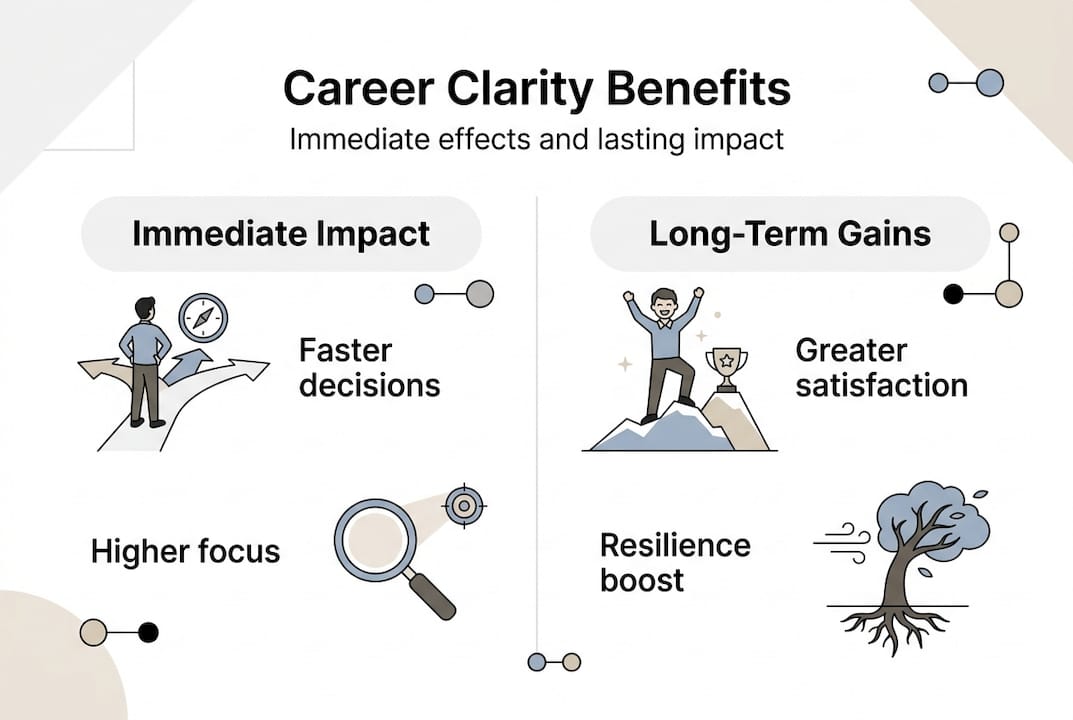
Clarity also transforms how you experience daily work. Tasks feel meaningful when connected to larger goals. Challenges become growth opportunities rather than obstacles. You develop resilience because purpose provides motivation during difficult periods. This foundation supports sustainable career fulfillment and purpose-driven alignment throughout your professional life.

The absence of clarity creates a different reality. You might chase external markers of success without internal satisfaction. You could feel stuck despite having options. You may experience anxiety about whether you are on the right path. These struggles often stem not from lack of opportunity but from lack of self-knowledge and intentional direction.
Ikigai: a Japanese philosophy for discovering career clarity
Ikigai translates to reason for being in Japanese. This philosophy offers a structured approach to discovering career clarity by examining four intersecting elements. Ikigai involves intersecting what you love, are good at, the world’s needs, and what you can be paid for. Each circle represents a critical dimension of fulfilling work.
The four circles create distinct zones where two elements overlap:
- Passion: what you love meets what you are good at
- Mission: what you love intersects with what the world needs
- Vocation: what the world needs aligns with what you can be paid for
- Profession: what you can be paid for matches what you are good at
True Ikigai sits at the center where all four circles converge. This sweet spot represents work that energizes you, utilizes your strengths, serves others, and provides financial sustainability. Finding this intersection requires honest self-assessment and willingness to explore multiple paths.
The Ikigai approach contrasts sharply with Western career advice that emphasizes following your passion. Consider these differences:
| Western approach | Ikigai approach |
|---|---|
| Passion exists innately and must be discovered | Passion develops gradually through mastery and daily joy |
| Career clarity arrives as sudden epiphany | Clarity emerges through iterative exploration and reflection |
| Single calling defines your purpose | Multiple purposes can coexist and evolve over time |
| Linear career progression toward one goal | Nonlinear paths with room for experimentation and growth |
This Japanese philosophy recognizes that purpose develops over time rather than appearing fully formed. You cultivate passion by engaging deeply with activities and building competence. Small daily joys compound into lasting fulfillment. This perspective removes pressure to identify perfect answers immediately.
Pro Tip: Use Ikigai as a dynamic tool rather than a static assessment. Your circles will shift as you gain experience, develop new skills, and encounter changing life circumstances. Revisit your Ikigai framework quarterly to track evolution and maintain alignment.
The holistic nature of Ikigai prevents common career mistakes. Pursuing only passion without considering market needs leads to financial struggle. Focusing solely on skills without love for the work creates burnout. Prioritizing income without meaning produces emptiness despite material success. Understanding career insights through value and Japanese Ikigai philosophy helps you balance these competing demands.
Many people discover they already possess elements of Ikigai in their current work. The framework helps you recognize and amplify these aspects while addressing gaps. This approach feels more accessible than completely reinventing your career. You can make incremental shifts that gradually increase alignment and satisfaction.
The iterative nature of Ikigai supports sustainable career development. You test hypotheses through small experiments rather than making dramatic changes based on limited information. Each exploration provides data that refines your understanding of the four circles. This process builds confidence while reducing risk. Learning why to choose the Ikigai method reveals how this framework supports both immediate clarity and long-term growth.
Common challenges and nuances in finding career clarity
The path to career clarity involves navigating several predictable obstacles. Understanding these challenges helps you maintain realistic expectations and develop strategies for progress.
Perfect alignment rarely exists in practice. Perfect alignment is rare as passion often develops through mastery, not innate talent, and cultural factors influence career clarity. Most people experience partial alignment across the four Ikigai circles rather than complete convergence. This reality does not indicate failure. It reflects the complex nature of modern work and human psychology.
Many individuals discover they have multiple Ikigai operating simultaneously. Your reason for being might include creative expression, financial security, family support, and community contribution. These purposes do not always align neatly with a single career path. Accepting this multiplicity reduces frustration and opens possibilities for portfolio careers or sequential focus areas.
Fear frequently disguises itself as uncertainty about career direction. You might believe you lack clarity when actually you fear the implications of acting on what you already know. Recognizing this distinction proves crucial. Ask yourself whether you truly do not know your next step or whether you hesitate to take it.
Cognitive overload also blocks progress toward clarity. The abundance of career options, combined with pressure to optimize every decision, creates analysis paralysis. You consume endless information without moving forward. This pattern feels productive but prevents the experimentation necessary for genuine learning.
Cultural context shapes how you approach career clarity:
- Western cultures emphasize individual achievement and passion pursuit
- Eastern philosophies prioritize daily joy and gradual mastery
- Some cultures value family expectations over personal preference
- Different societies attach varying status to career types
These cultural factors influence both what clarity means to you and how you pursue it. Awareness of these influences helps you separate authentic desires from internalized expectations. You can honor cultural values while still developing personal clarity.
Pro Tip: Break clarity work into manageable steps rather than demanding immediate comprehensive answers. Focus on one Ikigai circle at a time. Explore what you love this month, assess your skills next month, research market needs the following month. This sequential approach reduces overwhelm while building momentum.
The nonlinear nature of career development challenges people seeking clear roadmaps. Your path will likely include detours, experiments that fail, and periods of uncertainty. These experiences provide valuable information rather than representing wasted time. Each exploration eliminates options and refines your understanding of fit.
Many struggle with the gap between current reality and ideal Ikigai. You might clearly see where you want to be but feel overwhelmed by the distance. This challenge requires patience and incremental progress. Small shifts compound over time into significant transformation. Understanding how to find Ikigai and discover purpose provides frameworks for bridging this gap systematically.
External pressures create additional complexity. Family expectations, financial obligations, and social comparison all influence career decisions. These factors do not disappear when you gain clarity. Instead, you develop better strategies for navigating them while staying true to your purpose. Learning to align passions with career using Ikigai helps balance competing demands.
Practical steps to achieve career clarity using Ikigai and reflection
Gaining career clarity requires structured exploration combined with honest self-reflection. This seven-step process provides a roadmap for discovering and refining your Ikigai.
-
Assess your current state across all four Ikigai circles. Document what you genuinely love doing, your developed skills, needs you observe in the world, and activities people pay you for currently. Be specific rather than general.
-
Identify gaps between your current reality and potential Ikigai. Which circles feel underdeveloped? Where do you see the largest misalignment? These gaps indicate areas for focused exploration.
-
Research careers and roles that might bridge your gaps. Look beyond job titles to understand daily activities, required skills, and typical career trajectories. Informational interviews provide valuable insights.
-
Conduct small experiments to test hypotheses about fit. Volunteer, take courses, start side projects, or shadow professionals. These low-risk explorations generate data about what energizes versus drains you.
-
Reflect systematically on your experiments. Journal about what you learned, how you felt, and what surprised you. Look for patterns across multiple experiences rather than judging single events.
-
Seek feedback from trusted peers and mentors. Others often see your strengths and blind spots more clearly than you do. Ask specific questions about where they see you thriving.
-
Create an iterative action plan with quarterly milestones. Define concrete next steps while remaining flexible as you gain new information. Review and revise your plan regularly.
Structured career planning and clarity reduce disengagement and burnout while supporting confident decision-making. This process differs from instant-choice models by acknowledging that clarity develops over time through accumulated experience and reflection.
Pro Tip: Use the Ikigai test to identify your dominant personality types. Understanding whether you lean toward harmony, growth, freedom, or authenticity helps you tailor your clarity journey to your natural tendencies and values.
Your emotional experience provides important signals during this process. Track how different activities and environments affect your energy and mood:
| Career clarity stage | Common emotions | Typical behaviors |
|---|---|---|
| Confusion | Anxiety, overwhelm, frustration | Excessive research, avoidance, comparison |
| Exploration | Curiosity, hope, uncertainty | Experimentation, networking, learning |
| Emerging clarity | Relief, excitement, cautious optimism | Planning, skill building, focused action |
| Aligned action | Confidence, energy, purpose | Consistent effort, resilience, growth |
Recognize that you will cycle through these stages multiple times. Career clarity is not a destination but an ongoing practice. As you evolve, your Ikigai will shift. Regular reflection keeps you aligned with your current reality rather than outdated assumptions.
The reflection component deserves particular attention. Set aside dedicated time weekly for self-assessment. Ask yourself questions like: What energized me this week? When did I feel most myself? What problems did I enjoy solving? Which activities drained me? What would I do differently with more freedom?
Peer feedback adds external perspective to internal reflection. Share your observations and hypotheses with people who know you well. Ask them to challenge your assumptions and point out patterns you might miss. This dialogue often reveals insights invisible to solo reflection.
Implementing this process requires patience and self-compassion. You will encounter setbacks, false starts, and periods of doubt. These experiences are normal rather than exceptional. The key is maintaining forward momentum through small consistent actions. Understanding how to apply Ikigai at work for fulfillment provides additional strategies for translating clarity into daily practice.
Consider using the Ikigai type test as a starting point for deeper self-understanding. This assessment reveals your core motivations and preferred approaches to purpose. These insights help you design experiments and evaluate opportunities that align with your authentic self.
Explore Ikigai tools and resources for your career journey
Finding career clarity becomes more manageable with structured tools and guided reflection. The Ikigai test offers personalized insights into your unique purpose profile. This assessment identifies your dominant values and natural tendencies, providing a foundation for targeted exploration.
Understanding your specific Ikigai personality types reveals how different individuals approach purpose and fulfillment. Some people prioritize harmony and connection while others seek growth and mastery. Recognizing your type helps you design a clarity journey that works with your nature rather than against it.
Deeper self-reflection emerges through exploring targeted life purpose questions. These prompts guide you beyond surface-level thinking into meaningful examination of your values, strengths, and aspirations. Regular engagement with these questions builds self-awareness over time.
These resources simplify the iterative process introduced earlier. Rather than starting from scratch, you receive frameworks and insights that accelerate your clarity journey. The tools provide structure while leaving room for personal interpretation and application.
What is career clarity?
How long does it take to gain career clarity?
Career clarity develops gradually over months or years rather than appearing suddenly. Most people experience emerging clarity within three to six months of consistent reflection and exploration. However, deepening that clarity and translating it into aligned action continues throughout your career as you evolve and circumstances change.
Can I have career clarity without changing jobs?
Yes, many people gain clarity and increase alignment within their current roles. You might shift your focus to more fulfilling aspects of your job, develop new skills that better match your interests, or reframe how you think about your work’s purpose. Career clarity often leads to internal shifts before external changes.
What if my passion does not align with market needs?
This common challenge requires creative problem solving rather than abandonment of your interests. Look for adjacent fields where your passion provides unique value. Consider how you might serve niche markets or combine your passion with more marketable skills. Understanding how to find Ikigai and discover purpose helps navigate this tension between love and livelihood.
How do I know if I am experiencing genuine uncertainty or fear?
Genuine uncertainty feels like lacking information or experience to make decisions. Fear manifests as knowing your next step but creating reasons to avoid it. Ask yourself: Do I need more data, or am I afraid of what acting on current knowledge requires? Your emotional response to this question often reveals the truth.
Does career clarity guarantee job satisfaction?
Clarity significantly increases the likelihood of satisfaction but does not guarantee it. External factors like workplace culture, leadership quality, and life circumstances also influence your experience. However, clarity helps you make better decisions, set appropriate boundaries, and recognize when situations no longer serve your purpose.