Most people believe that following their passion guarantees career satisfaction, but research reveals this oversimplification can lead to disappointment. True career fulfillment emerges from a deeper alignment integrating your values, skills, and purpose with your work environment. This article explores how career alignment significantly impacts life satisfaction, drawing on the Japanese concept of Ikigai and modern self-discovery techniques. You’ll learn why perfect alignment is rare, how to navigate nonlinear career paths, and practical steps to cultivate purpose-driven work that evolves with you.
Table of Contents
- Understanding Career Alignment: Beyond Passion To Fulfillment
- Ikigai: Integrating Japanese Philosophy With Modern Career Self-Discovery
- Navigating Challenges: Nonlinearity, Cultural Factors, And Evolving Alignments
- Practical Steps To Cultivate Purpose-Driven Career Alignment
- Explore Your Ikigai With Ikigain’s Expert Tools
- Frequently Asked Questions
Key takeaways
| Point | Details |
|---|---|
| Career alignment boosts satisfaction | Matching values and skills to work increases life satisfaction by 2.6 times compared to misaligned roles. |
| Ikigai integrates four dimensions | This Japanese framework blends passion, mission, vocation, and profession to reveal purpose-driven career paths. |
| Perfect alignment is rare | Careers are nonlinear and influenced by cultural factors, requiring adaptability and ongoing job crafting. |
| Passion develops through competence | Growing skills and mastery cultivates passion more reliably than chasing pre-existing interests. |
| Combine Ikigai with self-management | Pairing reflective exercises with iterative job crafting fosters continuous personal and career growth. |
Understanding career alignment: beyond passion to fulfillment
Career alignment refers to the fit between your personal values, skills, passions, and the work environment you inhabit daily. It’s not about finding a single dream job but creating coherence across multiple dimensions of your professional life. When these elements harmonize, you experience greater engagement, resilience, and satisfaction.
Empirical evidence supports this connection. Employees who report 8+ fulfilling attributes including values alignment are 2.6 times more likely to experience high life satisfaction. This dramatic difference underscores that alignment acts as an inner compass, guiding decisions and reducing the cognitive dissonance that drains energy in mismatched roles.
Several attributes enhance this alignment and boost satisfaction:
- Work that leverages your natural strengths and developed skills
- Opportunities to contribute meaningfully to goals you care about
- An organizational culture that reflects your core values
- Autonomy to shape your tasks and approach
- Relationships with colleagues who share your professional ethos
These elements don’t need to be perfect. Even partial alignment creates momentum. The key is recognizing which dimensions matter most to you and actively seeking roles or crafting your current position to strengthen those connections. Understanding career insights from Japanese Ikigai philosophy offers a structured way to map these dimensions and identify gaps.
“Employees with 8+ fulfilling attributes including values alignment are 2.6 times more likely to report life satisfaction.”
This statistic reveals why surface-level career advice often fails. Telling someone to “follow your passion” ignores the complexity of alignment. Passion alone doesn’t pay bills or fit your lifestyle needs. True fulfillment requires integrating what you love with what you’re good at, what the world needs, and what sustains you financially. The Ikigai method benefits emerge from this holistic integration, moving beyond simplistic passion pursuit to a balanced, sustainable approach.
Ikigai: integrating Japanese philosophy with modern career self-discovery
Ikigai, a Japanese concept meaning “reason for being,” provides a framework for discovering career alignment by integrating four overlapping elements. The Western adaptation visualizes these as intersecting circles, each representing a critical dimension of purposeful work.
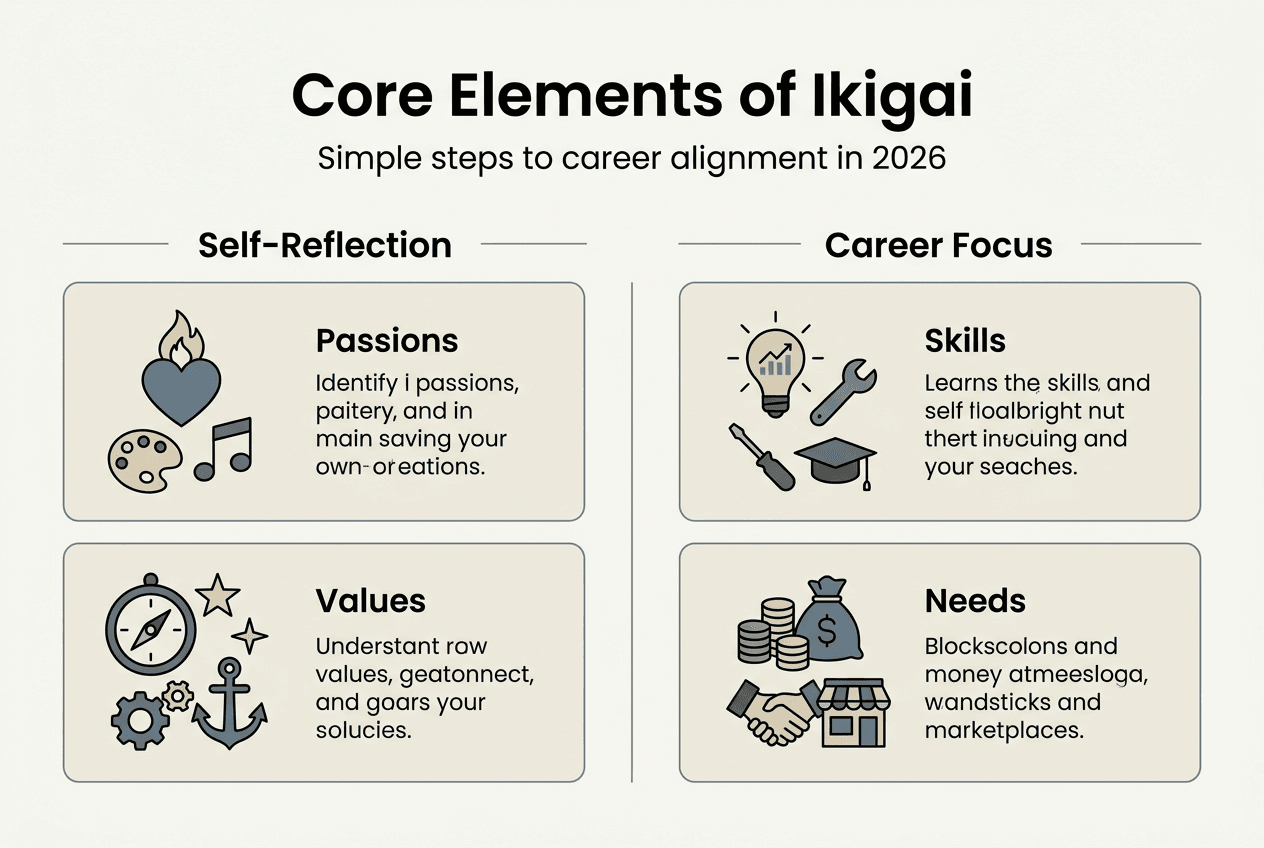
| Ikigai Element | Focus Question | Career Relevance |
|---|---|---|
| What you love | What activities energize you? | Passion and intrinsic motivation |
| What you’re good at | What skills have you mastered? | Competence and confidence |
| What the world needs | What problems matter to you? | Mission and social contribution |
| What you can be paid for | What creates economic value? | Vocation and sustainability |
The sweet spot where all four overlap represents your Ikigai. However, this Western interpretation differs from traditional Japanese understanding. In Japan, Ikigai emphasizes daily joys and gradual passion growth rather than grand career aspirations. Only 31% of Japanese respondents explicitly link career to their Ikigai, focusing instead on small pleasures like morning coffee or time with family.
Using Ikigai as a self-discovery tool involves several steps:
- Conduct reflective exercises exploring each of the four elements separately
- Identify overlaps and gaps between what you love, excel at, and can sustain
- Experiment with roles or projects that test these intersections in real-world contexts
- Iterate based on feedback, adjusting your understanding as you gain experience
- Revisit your Ikigai map quarterly to track evolution and maintain alignment
This process typically unfolds over multiple months of reflection, not a weekend workshop. Rushing leads to superficial answers. The Ikigai self-discovery guide emphasizes patience, allowing insights to emerge gradually as you test hypotheses about what truly fulfills you.
Pro Tip: Combine Ikigai reflection with practical experimentation. Shadow professionals in fields that intrigue you, volunteer for projects outside your comfort zone, or take short courses to validate whether an interest translates into sustained engagement. Theory alone won’t reveal your Ikigai; you need real-world data.
Understanding how to find Ikigai requires recognizing that this isn’t a one-time discovery but an ongoing practice. Your Ikigai evolves as you develop new skills, encounter different challenges, and clarify what matters most at each life stage.
Navigating challenges: nonlinearity, cultural factors, and evolving alignments
Achieving perfect career alignment is rare. Careers unfold nonlinearly, influenced by economic shifts, personal circumstances, and cultural contexts. Recognizing these complexities helps you adapt strategies rather than chase an elusive ideal.

| Challenge | Description | Impact on Alignment |
|---|---|---|
| Nonlinear paths | Careers zigzag rather than follow straight trajectories | Requires flexibility and iterative realignment |
| Stability pressures | Economic needs often conflict with passion pursuits | Demands balancing financial security with fulfillment |
| Generational differences | Gen Z scores lower in fulfilling attributes than older cohorts | Suggests evolving workplace expectations and values |
| Cultural variations | Western emphasis on career differs from Eastern daily joy focus | Influences how you define and pursue Ikigai |
Research shows that perfect overlap of Ikigai elements is uncommon, and careers are shaped by cultural factors beyond individual control. Gen Z workers, for instance, report fewer fulfilling job attributes than previous generations, possibly due to economic uncertainty or shifting workplace norms.
Adaptability becomes crucial. Job crafting, the practice of reshaping your role to better fit your strengths and interests, offers a practical response. Studies confirm that job crafting and cultivating work meaning boost life satisfaction, with intrinsic fulfillment predicting occupational calling mediated by spiritual factors.
Strategies for maintaining alignment over time:
- Regularly assess whether your current role still matches your evolving values and skills
- Proactively reshape tasks, relationships, and perceptions within your existing job
- Seek lateral moves or projects that strengthen underdeveloped Ikigai elements
- Embrace transitions as opportunities to recalibrate rather than failures to avoid
- Build financial buffers that allow exploration without jeopardizing stability
Pro Tip: Embrace descriptive decision models that focus on idea generation, exploration, and choice rather than prescriptive formulas. Career decisions involve uncertainty; iterative testing beats rigid planning.
Understanding how to align passions and career in this context means accepting imperfection. You won’t always love every aspect of your work, and that’s okay. The goal is sufficient alignment to sustain motivation and well-being, not a utopian ideal. Resources on Ikigai anxiety reduction can help manage the stress of navigating these complexities.
Practical steps to cultivate purpose-driven career alignment
Moving from theory to action requires concrete methods that integrate Ikigai reflection with modern self-management techniques. The following steps provide a roadmap for fostering ongoing career and personal growth.
- Complete a comprehensive Ikigai self-assessment, mapping each of the four elements with specific examples from your life.
- Identify the element with the weakest representation in your current work and prioritize strengthening it through targeted actions.
- Design small experiments to test potential career pivots or role adjustments before committing to major changes.
- Establish a quarterly review ritual to reassess your Ikigai map, tracking shifts in values, skills, and interests.
- Engage in deliberate skill development focused on areas where competence will unlock new opportunities aligned with your mission.
- Build a support network of mentors and peers who understand your Ikigai journey and can provide honest feedback.
These steps work best when combined with job crafting practices. Combining Ikigai exercises with job crafting and career strivings self-management enhances iterative alignment and fulfillment. Rather than waiting for the perfect role, you actively shape your current position to better fit your purpose.
Best practices for developing skills and passions iteratively:
- Focus on building competence in areas adjacent to your current strengths, creating natural growth paths
- Seek feedback frequently to accelerate learning and correct course before investing too deeply
- Celebrate small wins that validate alignment, reinforcing motivation during longer journeys
- Document your experiments and reflections to identify patterns and track evolution over time
- Balance exploration with exploitation, dedicating time to both discovering new interests and deepening existing ones
Pro Tip: Focus on descriptive decision models and psychological needs satisfaction for sustained growth. Research shows that passion develops through competence and skill mastery rather than chasing pre-existing interests. Invest in getting good at something meaningful, and passion often follows.
For practical Ikigai guidance, consider how your daily tasks either energize or drain you. Small adjustments, like volunteering for projects that leverage your strengths or delegating tasks that don’t, compound over time. The Ikigai type test can clarify which dimensions need attention, providing a personalized starting point for your alignment journey.
Resources on embracing Ikigai growth emphasize that this is a lifelong practice, not a destination. Your career alignment will shift as you do, requiring ongoing attention and adjustment.
Explore your Ikigai with Ikigain’s expert tools
Deepening your self-discovery and career alignment journey becomes easier with specialized tools designed to clarify your unique purpose areas. Ikigain offers a comprehensive Ikigai type test that identifies where your passions, skills, mission, and vocation intersect, providing personalized insights to guide your next steps.

Once you’ve identified your type, explore the guide to Ikigai personality types to understand your individual strengths and potential blind spots. This resource helps you see how others with similar profiles have navigated career decisions, offering practical examples and strategies.
For those interested in the philosophical foundations, Ikigain’s collection of essential Japanese concepts enriches your Ikigai practice by introducing complementary principles like wabi-sabi, kaizen, and gaman. These concepts deepen your understanding of purpose-driven living beyond career alone.
Pro Tip: Regularly revisit and reflect on your Ikigai profile to maintain alignment. As you grow and circumstances change, your type may evolve, revealing new opportunities for fulfillment.
Frequently asked questions
What is career alignment and why does it matter?
Career alignment is the degree to which your work matches your personal values, skills, passions, and purpose. It matters because aligned careers deliver 2.6 times higher life satisfaction than misaligned ones. When your daily tasks reflect what you care about and leverage what you do well, you experience greater engagement, resilience, and meaning. Understanding what is Ikigai provides a framework for achieving this alignment by integrating multiple dimensions of fulfillment.
How does Ikigai differ from western career advice?
Traditional Japanese Ikigai emphasizes daily joys and gradual passion growth rather than grand career aspirations, with only 31% linking it explicitly to work. Western career advice often oversimplifies by urging people to follow pre-existing passions, ignoring that passion typically develops through competence and skill mastery. The Ikigai growth guide bridges these perspectives, encouraging iterative exploration over instant discovery.
Can career alignment change over time?
Yes, career alignment evolves as you develop new skills, encounter different life stages, and clarify shifting values. What fulfilled you at 25 may not at 45. Job crafting and iterative reflection help maintain alignment by allowing you to reshape your role or pivot to new opportunities as circumstances change. Resources on how to align passions and career emphasize ongoing adjustment rather than one-time optimization.
What are the first steps to discovering my Ikigai?
Start with reflective exercises exploring what you love, what you’re good at, what the world needs, and what you can be paid for. Use tools like the Ikigai type test to clarify your purpose areas with personalized insights. Then experiment with new experiences, side projects, or informational interviews to validate your interests in real-world contexts. Guidance on how to find Ikigai emphasizes patience and iteration over quick fixes.