Many professionals and students feel torn between pursuing what they love and meeting financial or practical career demands. This tension creates dissatisfaction and prevents meaningful work. Ikigai, a Japanese philosophy, offers a holistic framework to align passion, mission, vocation, and profession. This article guides you step by step to discover and apply Ikigai for career fulfillment and purpose-driven living.
Table of Contents
- What Is Ikigai And Why It Matters
- Prerequisites: What You Need Before Starting
- Step 1: Discovering Your Core Passions And Strengths
- Step 2: Mapping Passions To Career Paths Using Ikigai
- Step 3: Creating An Action Plan And Setting Realistic Goals
- Common Mistakes And How To Avoid Them
- Expected Results And Benefits
- Unlock Your Ikigai With Our Tools And Resources
- Frequently Asked Questions
Key takeaways
| Point | Details |
|---|---|
| Ikigai framework | Integrates passion, mission, vocation, and profession for sustainable career alignment. |
| Discovery process | Use personality tests and self-reflection to identify core passions and strengths. |
| Realistic planning | Set achievable goals blending passion with market needs to prevent burnout. |
| Common pitfalls | Avoid ignoring skills development and market realities that cause 40% of failures. |
| Expected benefits | Aligning passions and career improves life satisfaction by up to 60% within one year. |
What is Ikigai and why it matters
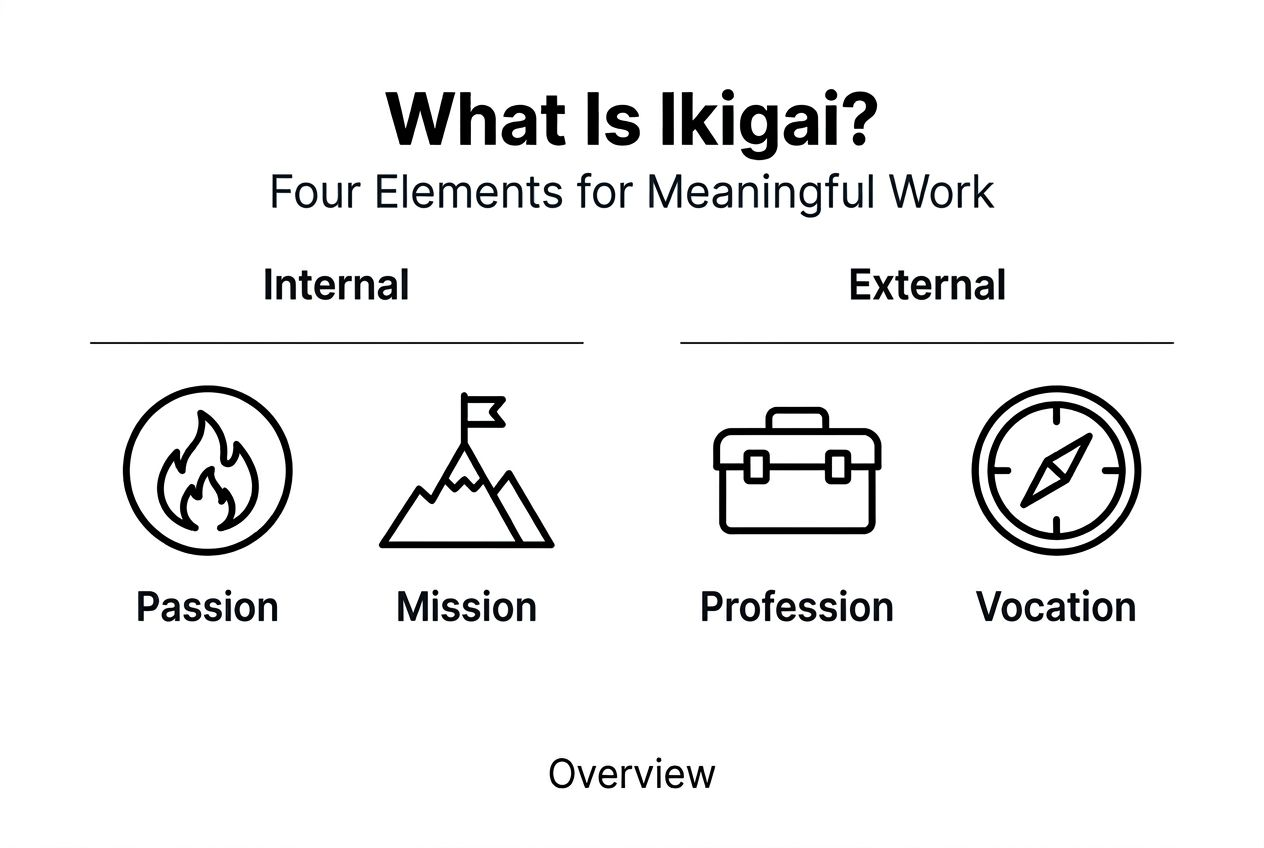
Ikigai represents the intersection of what you love, what you are good at, what the world needs, and what you can be paid for. This Japanese philosophy comprises four elements: passion, mission, vocation, and profession. Each element plays a distinct role in building meaningful work.
The four elements work together:
- Passion: What you love doing naturally and find deeply satisfying
- Mission: What the world needs and how you can contribute meaningfully
- Vocation: What you can be paid for in the current market
- Profession: What you are good at through natural talent and developed skills
Originating in Japanese culture, Ikigai emphasizes balance and sustainability rather than quick success. The philosophy applies universally across cultures and career stages. Unlike other frameworks that focus solely on strengths or market fit, Ikigai creates sustainable, purpose-driven career pathways by integrating personal fulfillment with societal contribution.
When all four elements align, you experience deep satisfaction and resilience against burnout. This balance distinguishes Ikigai from conventional career advice that often prioritizes income or passion alone. The framework acknowledges that sustainable careers require practical skills, market awareness, personal joy, and meaningful impact working in harmony.
Understanding Ikigai gives you a lens to evaluate career decisions holistically. You stop making choices based on single factors like salary or fleeting interests. Instead, you build careers that honor your complete self while meeting real-world demands.
Prerequisites: what you need before starting
Before diving into Ikigai-based career alignment, prepare your mindset and gather essential tools. Success depends on honest self-reflection and willingness to change direction when insights emerge.
Start with these foundational elements:
- Openness mindset: Be ready for honest self-assessment that may challenge current assumptions about your career path
- Assessment tools: Access validated personality tests and passion inventories to increase self-awareness objectively
- Market knowledge: Understand basic job market trends to balance passion with realistic career feasibility
- Digital resources: Use apps or journals to facilitate structured self-reflection and track discoveries
- Patience commitment: Recognize alignment is gradual, requiring consistent effort over months
The process of finding your Ikigai demands more than casual thinking. You need dedicated time for deep reflection about past experiences, current skills, and future aspirations. Block out distraction-free periods weekly to explore these questions thoroughly.
Gather feedback from people who know you well. Friends, family, and colleagues often see strengths and patterns you overlook. Their perspectives add valuable external validation to your self-assessment.
Pro Tip: Create a dedicated Ikigai journal where you record insights, test results, and reflections throughout the discovery process to track patterns and growth over time.
Finally, approach this journey with curiosity rather than pressure. The goal is authentic self-discovery, not forcing yourself into predetermined career boxes. Let insights emerge naturally through exploration.
Step 1: discovering your core passions and strengths
Identifying your deepest passions and natural strengths forms the foundation of career alignment. Use structured assessments and reflection exercises to gain clarity about what truly drives you.
Follow this discovery process:
- Take validated assessments: Complete the Ikigai personality test or similar tools to identify core values, interests, and personality traits scientifically.
- Reflect on peak experiences: List five to ten moments when you felt most alive, engaged, and satisfied in work or personal activities.
- Identify pattern themes: Look for common elements across peak experiences such as creativity, problem-solving, helping others, or building systems.
- Catalog natural strengths: Write down skills and talents that come easily to you, even if you have not formally developed them.
- Seek external input: Ask trusted contacts to describe your top three strengths and when they have seen you most energized.
Research shows validated personality assessments help link personal traits to career satisfaction effectively. These tools provide objective data to complement subjective reflection. They reveal patterns you might miss through casual self-analysis.
Digital journaling enhances this process significantly. Record daily observations about activities that energize or drain you. Over weeks, clear patterns emerge showing your authentic preferences. Small details like enjoying detailed analysis or preferring big-picture strategy become career direction clues.
Discovering your Ikigai requires moving beyond surface interests to uncover core motivations. Ask why you enjoy certain activities. If you love teaching, is it the knowledge sharing, relationship building, or seeing others succeed? The underlying motivation matters more than the activity itself.
Pro Tip: Set a timer for 15 minutes and free-write about a time you lost track of time because you were so engaged in an activity, then analyze what made that experience flow effortlessly.
This foundation of self-knowledge becomes the filter for evaluating all career options. You gain clarity about non-negotiable elements that must be present for satisfaction.

Step 2: mapping passions to career paths using Ikigai
Translate your discovered passions and strengths into realistic career options by integrating market realities with the four Ikigai elements. This step bridges self-knowledge with practical opportunity.
Match your insights to careers systematically:
- Research market demand: Identify industries and roles that value your core strengths and passions currently
- Evaluate each element: Test potential careers against all four Ikigai components to ensure comprehensive fit
- Consider adjacent fields: Explore related industries where your skills transfer but may offer better balance
- Interview professionals: Talk to people in target careers to understand daily realities beyond job descriptions
Balancing passion with practical skills reduces burnout risk significantly. When you ignore vocation or profession elements, initial excitement fades as financial stress or skill gaps create frustration. Sustainable careers require all four Ikigai elements working together.
Compare how Ikigai differs from other frameworks:
| Framework | Focus | Ikigai Advantage |
|---|---|---|
| StrengthsFinder | Natural talents | Ikigai adds market fit and meaning dimensions |
| Myers-Briggs | Personality type | Ikigai includes practical vocation and societal needs |
| Skills assessment | Technical abilities | Ikigai integrates passion and purpose with skills |
| Market analysis | Job opportunities | Ikigai ensures personal fulfillment alongside market fit |
Neglecting balance causes problems quickly. Pursuing passion without developing marketable skills leads to financial stress. Choosing high-paying work that ignores your mission creates emptiness. Studies show burnout typically emerges within 18 to 24 months when these elements remain misaligned.
Applying Ikigai at work means continuously checking decisions against all four elements. Before accepting a role or project, ask if it satisfies what you love, what you are good at, what the world needs, and what provides fair compensation. This filter prevents costly career missteps.
Some careers naturally balance all elements more easily. Others require creativity to find the sweet spot. For example, if you love writing but struggle to monetize it, explore corporate communications, content strategy, or technical writing where strong demand exists.
Life alignment through Ikigai extends beyond career to inform how you structure entire days. The principles guide decisions about side projects, volunteer work, and skill development that collectively build fulfilling lives.
Step 3: creating an action plan and setting realistic goals
Convert your Ikigai insights into concrete actions with achievable goals that maintain momentum without overwhelming you. Strategic planning bridges knowledge and results.
Build your action plan systematically:
- Define short-term goals: Identify three to five actions you can complete in the next 90 days to move toward alignment, such as taking a course or networking in your target field.
- Establish long-term vision: Describe where you want to be in one to three years, ensuring this vision reflects all four Ikigai elements clearly.
- Map skill gaps: List competencies you need to develop to succeed in your target career path realistically.
- Create learning roadmap: Schedule specific times weekly to build necessary skills through courses, practice, or mentorship.
- Set review milestones: Plan monthly check-ins to assess progress, celebrate wins, and adjust goals based on new insights.
Incremental progress prevents the overwhelm that kills career transitions. Breaking big changes into small steps maintains motivation through visible progress. Each completed action builds confidence and momentum toward larger transformation.
Integrate continuous learning into your plan deliberately. Market demands shift constantly, so ongoing skill development keeps you relevant. Dedicate time weekly to reading industry content, practicing new techniques, or connecting with professionals in your target field.
Finding fulfillment with Ikigai requires balancing action with reflection. As you progress, new insights emerge about what truly matters. Stay flexible enough to adjust your plan when deeper self-knowledge suggests better paths.
Accountability accelerates progress significantly. Share your goals with a trusted friend, join a career development group, or hire a coach who understands Ikigai principles. Regular check-ins create healthy pressure to follow through on commitments.
Pro Tip: Use time-blocking to dedicate specific hours each week to your Ikigai action steps, treating these appointments as non-negotiable commitments to your future self.
Track both quantitative and qualitative progress. Note completed courses, networking conversations, and applications submitted. Also record how you feel about your direction, energy levels, and sense of purpose. These emotional indicators often signal alignment better than external metrics.
Realistic goal-setting means accepting that meaningful change takes time. Expecting overnight transformation leads to disappointment. Instead, commit to consistent small actions that compound into significant career shifts over months.
Common mistakes and how to avoid them
Understanding typical pitfalls helps you navigate the Ikigai journey more successfully. Learn from common errors to avoid unnecessary setbacks and frustration.
Watch for these frequent mistakes:
- Ignoring market realities: Pursuing passion without researching demand causes 40% of career transition failures according to labor market studies
- Skipping skill development: Assuming passion alone suffices without building marketable competencies undermines long-term success
- Neglecting balance: Focusing exclusively on what you love while ignoring vocation and profession leads to financial stress
- Rushing the process: Expecting quick clarity creates pressure that blocks authentic self-discovery
- Staying isolated: Attempting alignment alone without feedback or support limits perspective and accountability
The burnout risk deserves special attention. Research confirms that ignoring balance between passion and practicality commonly leads to burnout within 18 to 24 months in passion-driven careers. The initial excitement cannot sustain you when financial stress, skill gaps, or lack of market fit create ongoing problems.
Pursuing what you love without developing marketable skills and understanding market needs creates unsustainable career paths that typically result in burnout between 18 to 24 months after transition.
Avoid these mistakes through proactive strategies. Research market demand thoroughly before committing to a career path. Invest in skill development alongside passion exploration. Seek mentors who have successfully navigated similar transitions. Build financial buffers that allow you to take calculated risks without desperation.
Achieving lasting fulfillment requires patience with the alignment process. Trust that deep self-knowledge and strategic action compound into sustainable career satisfaction. Quick fixes and shortcuts typically backfire, while thoughtful progression builds solid foundations.
Another common error is treating Ikigai as a one-time discovery rather than an ongoing practice. Your passions, skills, and market opportunities evolve over time. Revisit your Ikigai alignment annually to ensure your career still reflects your authentic self and current realities.
Expected results and benefits
Following the Ikigai framework produces measurable improvements in both career satisfaction and overall well-being. Understanding these benefits motivates consistent effort through the alignment process.
Expect these outcomes from Ikigai-based alignment:
- Psychological well-being: Studies show up to 30% improvement in mental health markers within three to six months of beginning purpose-driven career work
- Life satisfaction: 60% of practitioners report significantly higher overall life satisfaction after one year of applying Ikigai principles
- Career clarity: Most people gain clear direction about their professional path within three to six months of dedicated exploration
- Reduced burnout: Proper balance across all four Ikigai elements decreases burnout risk by maintaining sustainable work patterns
- Enhanced resilience: Purpose-driven careers provide motivation to overcome obstacles and adapt to challenges effectively
The timeline for results varies by individual circumstances. Career clarity often emerges within the first three to six months as self-knowledge deepens. Emotional and psychological benefits accrue gradually over six to 12 months as new career patterns become established.
Incremental progress creates compound benefits over time. Small weekly actions toward alignment build momentum that transforms into significant life changes. Each step reinforces your commitment to living purposefully rather than drifting through career decisions reactively.
Discovering your Ikigai creates ripple effects beyond career. The clarity and purpose you develop influence relationships, health choices, and overall life satisfaction. When your work aligns with your deepest values, energy flows into all life areas more freely.
The financial benefits deserve mention too. While Ikigai is not primarily about maximizing income, aligned careers often lead to higher earnings over time. When you excel at work you love using natural strengths, recognition and advancement follow more naturally than in mismatched roles.
Sustainable fulfillment represents the ultimate benefit. Unlike achievement-based satisfaction that fades quickly, purpose-driven career alignment provides ongoing meaning that withstands challenges and setbacks. This deep satisfaction makes daily work feel meaningful rather than obligatory.
Unlock your Ikigai with our tools and resources
Ready to discover your unique Ikigai and align your passions with your career? Our comprehensive Ikigai personality test helps you identify core passions, values, and strengths through a scientifically-designed assessment.
Learn about the four main Ikigai personality types and how each influences your approach to purpose and meaningful work. Understanding your type provides personalized insights for career decisions and personal development strategies.
Our Ikigai self-discovery cards offer hands-on tools to deepen reflection and track progress throughout your journey. These resources support you through every step toward building a fulfilling, purpose-driven career that honors your complete self.
Frequently asked questions
What is Ikigai and how does it help in career alignment?
Ikigai is a Japanese concept that blends passion, mission, vocation, and profession to find life purpose and meaning. This holistic framework supports aligning your career with what brings genuine satisfaction by ensuring all four elements work together rather than prioritizing income or passion alone. The philosophy provides a practical lens for evaluating career decisions against your complete self, not just single factors. Learn more through our comprehensive Ikigai guide that explores cultural origins and modern applications.
How long does it usually take to align my passions with my career using Ikigai?
Most people gain clear career direction within three to six months of dedicated Ikigai exploration and self-reflection. Sustained emotional benefits and tangible career progress typically accumulate over six to 12 months as you implement changes and build new skills. The timeline varies based on your starting point, how much career change is needed, and consistency of effort toward alignment goals.
Can I use Ikigai alongside other career guidance tools?
Yes, Ikigai complements strengths-based assessments like StrengthsFinder, Myers-Briggs, and VIA Character Strengths effectively. The framework adds cultural depth and holistic purpose dimensions often missing in other tools that focus narrowly on personality or skills. Combining multiple methods enriches self-awareness and provides diverse perspectives for making informed career decisions. Explore how Ikigai integrates with other approaches to maximize your self-discovery journey.
What are common pitfalls to watch for when pursuing a passion-driven career?
Avoid neglecting market realities and required skills when following your passions, as this combination causes 40% of career transition failures. Maintain balance between what you love and practical career planning that includes vocation and profession elements. Research shows ignoring this balance typically leads to burnout within 18 to 24 months as financial stress and skill gaps create unsustainable situations despite initial excitement.