Many people feel drained and directionless despite holding decent jobs. Research shows that 77% of workers lack meaningful purpose at work, leading to burnout and dissatisfaction. Ikigai, a Japanese philosophy, offers a balanced framework integrating passion, skills, values, and societal needs to help you discover your reason for being. This guide provides actionable steps to align your life purpose with career fulfillment and mental wellness, transforming how you approach personal growth.
Table of Contents
- Introduction To Ikigai And Life Alignment
- Prerequisites For Starting Your Ikigai Journey
- Step-By-Step Process To Discover Your Ikigai
- Common Mistakes And How To Avoid Them
- Daily Practices To Support Life Alignment
- Expected Results And Timelines
- Alternative Approaches And Tradeoffs
- Discover Your Ikigai With Our Expert Tools
- What Is Ikigai And How Does It Help With Life Alignment?
- How Long Does It Typically Take To Discover And Live Your Ikigai?
- Can Ikigai Help If I’m Unsure About My Career Direction?
- What Daily Habits Support Living Aligned With Ikigai?
Key takeaways
| Point | Details |
|---|---|
| Ikigai intersection | Discover where passion, mission, vocation, and profession converge for authentic fulfillment. |
| Prerequisites matter | Honest self-reflection and structured tools are essential before beginning your journey. |
| Five-step framework | A proven process guides you through discovering and living your Ikigai effectively. |
| Avoid common traps | Don’t equate Ikigai only with career success or ignore mental wellness needs. |
| Realistic timelines | Meaningful alignment takes 3 to 18 months with measurable motivation and wellbeing improvements. |
Introduction to Ikigai and life alignment
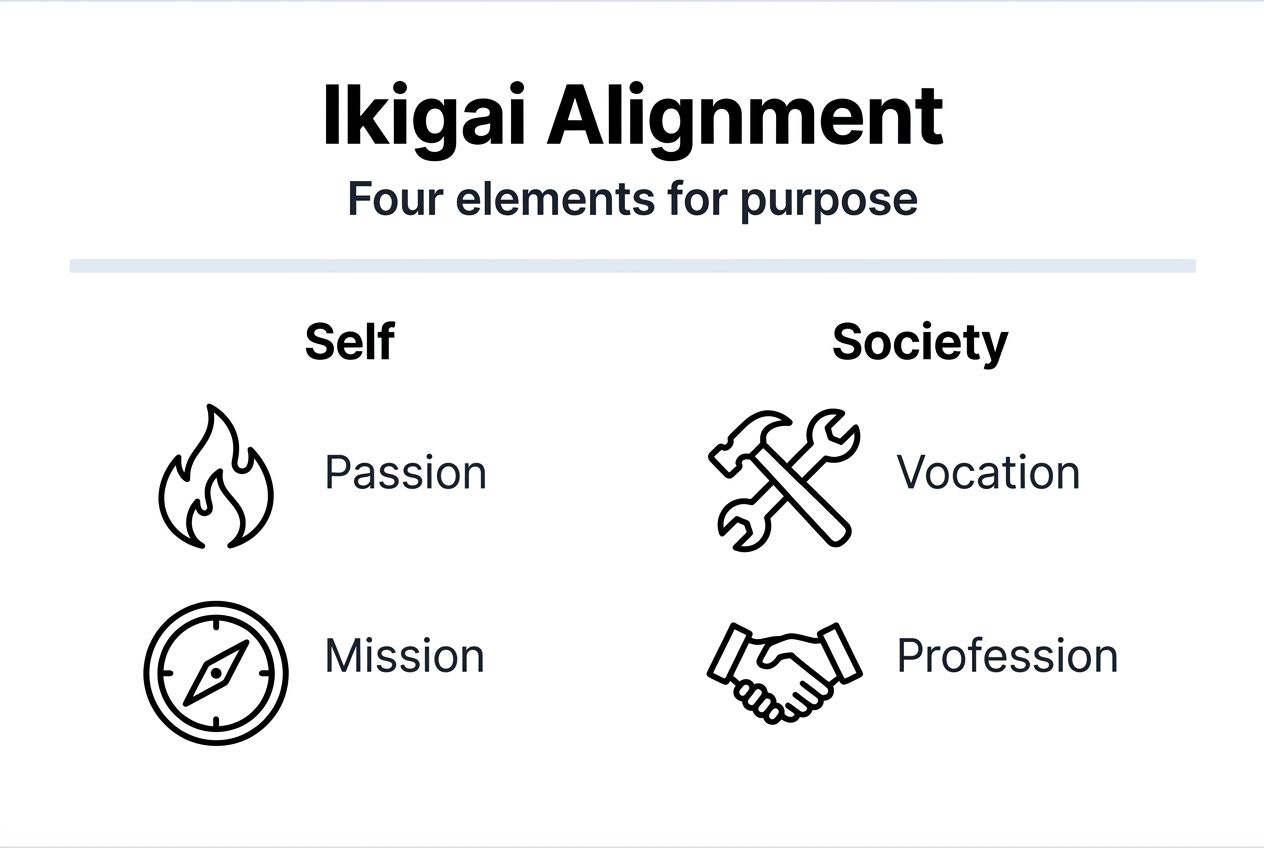
Ikigai translates to ‘reason for being’ in Japanese. It represents the sweet spot where four essential elements meet: what you love, what you’re good at, what the world needs, and what you can be paid for. This ancient philosophy goes far beyond career planning.
The four pillars work together to create balance. Passion fuels your drive. Mission connects you to something larger. Vocation showcases your natural talents. Profession ensures financial stability. When these align, you experience deep satisfaction and purpose.
Japanese culture links Ikigai to longevity and wellbeing. Communities practicing Ikigai principles report lower stress levels and higher life satisfaction. This holistic approach addresses mental wellness alongside career success.
Understanding Ikigai requires recognizing it encompasses all life aspects:
- Personal relationships and community contributions
- Creative pursuits and hobbies that bring joy
- Professional work and financial security
- Physical health and mental wellness practices
- Spiritual growth and personal values alignment
This comprehensive view prevents the trap of reducing life purpose to job titles or income levels. Ikigai invites you to examine how different life areas support your overall sense of meaning.
Prerequisites for starting your Ikigai journey
Successful Ikigai discovery requires specific groundwork. You need honest self-reflection to access authentic passions and skills. Surface-level thinking won’t reveal your true purpose.

Personality assessments provide valuable starting points. The ikigai type test helps identify core patterns in how you approach meaning and fulfillment. These tools offer objective insights that complement personal reflection.
Openness to iterative growth matters tremendously. Your Ikigai evolves as you do. What brought purpose at 25 may shift by 35 as skills deepen and values clarify. Embrace this natural progression rather than seeking one permanent answer.
Key prerequisites include:
- Dedicated time for weekly reflection without distractions
- Journal or digital tool to track insights and patterns
- Willingness to question current life choices honestly
- Support network for accountability and feedback
- Patience with the non-linear discovery process
Pro Tip: Schedule 30-minute reflection sessions every Sunday morning to review the week’s meaningful moments and identify patterns in what energizes versus drains you.
Starting without these foundations leads to superficial answers that don’t withstand life’s challenges. Invest time in proper preparation to ensure lasting results.
Step-by-step process to discover your Ikigai
Discovering your Ikigai follows a structured five-step framework that builds understanding progressively. Each step reveals essential insights about your authentic self and life purpose.
- Reflect on what you love and your genuine passions beyond societal expectations.
- Assess your skills and strengths honestly, including both developed and emerging talents.
- Explore what the world needs and how your unique contributions can address real problems.
- Identify professions or roles that can support you financially while honoring your values.
- Combine these insights to find the intersection where all four elements converge naturally.
This systematic approach helps you discover purpose through concrete actions rather than abstract thinking. Each step builds on the previous one.
| Step | Rationale | Example Activity |
|---|---|---|
| Passion exploration | Reveals intrinsic motivators beyond external rewards | List 10 activities where you lose track of time |
| Skills assessment | Identifies natural strengths and developed competencies | Ask five people what they seek your help for |
| World needs analysis | Connects personal purpose to societal contribution | Research problems in your community or industry |
| Financial viability | Ensures sustainable pursuit of purpose | Analyze market demand for your skill combinations |
| Ikigai synthesis | Integrates all elements into coherent life direction | Map overlaps between the four previous steps |
The intersection point emerges through patient exploration. You might discover your Ikigai involves teaching sustainable practices, creating wellness programs, or designing accessible technology. The key is finding where your authentic self serves real needs.
Pro Tip: Use a dedicated journal to document daily insights about activities that energize you, compliments you receive, and problems you notice others facing to accelerate pattern recognition.
Many people find the synthesis step challenging because it requires holding multiple perspectives simultaneously. Take time to sit with ambiguity rather than forcing premature conclusions. Understanding how to find your purpose requires both analysis and intuition working together.
Common mistakes and how to avoid them
Mistaking Ikigai as only career or job success represents the most frequent error. Your reason for being extends beyond professional identity. Family relationships, creative hobbies, and community service all contribute to authentic fulfillment.
Ignoring non-economic sources of fulfillment creates imbalance. You might earn well while feeling empty because money alone doesn’t satisfy the mission and passion dimensions. Ikigai requires all four pillars working together.
Neglecting mental wellness and self-care undermines the entire journey. Burnout prevents the reflection and energy needed for discovery. Purposeful living includes honoring your physical and emotional needs.
Additional pitfalls to avoid:
- Expecting immediate clarity leads to frustration when the process naturally takes months
- Comparing your timeline to others’ creates unnecessary pressure and anxiety
- Using vague motivational advice instead of taking concrete actionable steps
- Dismissing practical constraints like financial obligations or family responsibilities
- Treating Ikigai as a one-time discovery rather than an evolving journey
The solution involves patience and realistic expectations. Give yourself permission to explore without pressure. Small experiments reveal more than grand commitments at the start.
Recognize that your Ikigai might look different from inspiring social media posts or popular success stories. Authenticity matters more than external validation. Trust your unique path even when it doesn’t match conventional definitions of achievement.
Daily practices to support life alignment
Mindfulness and gratitude exercises deepen awareness of what truly matters. Spend five minutes each morning noting three things you appreciate. This simple practice trains your brain to notice meaning in everyday moments.
Reflecting daily on moments of joy and meaning builds crucial pattern recognition. Ask yourself each evening what energized you today and what felt draining. Over weeks, clear themes emerge about your authentic Ikigai elements.
Adapting mindset to embrace challenges as growth opportunities transforms obstacles into teachers. When facing difficulties, pause to ask what this experience reveals about your values, strengths, or desired contributions.
Sustainable daily habits include:
- Morning pages journaling to process thoughts and identify recurring themes
- Gratitude walks where you notice beauty and connection in your environment
- Weekly reviews comparing your activities against your four Ikigai pillars
- Monthly check-ins to assess alignment between daily life and stated values
- Quarterly goal adjustments based on evolving understanding of your purpose
Pro Tip: Create a morning ritual that incorporates 10 minutes of Ikigai reflection before checking email or social media to maintain steady alignment and prevent reactive living.
These daily practices don’t require major time commitments. Consistency matters more than duration. Even brief daily touchpoints keep your purpose front of mind amid busy schedules.
Integrate Ikigai thinking into existing routines rather than adding separate tasks. Notice during your commute which work projects excite you. Reflect during meals on how today’s actions served something larger than yourself. Small moments compound into significant shifts over time.
Expected results and timelines
Typical timelines for meaningful alignment range from 3 to 18 months depending on engagement depth and life circumstances. Some people experience breakthroughs quickly while others need extended exploration. Both paths are valid.
Outcomes include increased sustained motivation even during challenging periods. When you understand your deeper purpose, temporary setbacks feel less devastating. You maintain perspective about what truly matters.
Measurable mental wellness improvements emerge through clearer purpose and life satisfaction. Studies show people with strong sense of purpose report better sleep, lower anxiety, and greater resilience. These benefits compound as your Ikigai understanding deepens.
| Timeline | Expected Milestone | Success Metric |
|---|---|---|
| 1-3 months | Initial pattern recognition in passions and strengths | Completed self-assessment exercises and identified top three energy sources |
| 3-6 months | Clear understanding of world needs you care about | Defined two to three specific problems you want to address |
| 6-12 months | Testing Ikigai hypotheses through small experiments | Engaged in three pilot projects aligning multiple pillars |
| 12-18 months | Integration of Ikigai into daily life and decisions | 70% of weekly activities align with identified purpose elements |
Progress isn’t always linear. You might experience rapid insights followed by plateau periods requiring patience. Both phases serve the discovery process. Breakthroughs often follow times of apparent stagnation.
Track progress through both objective and subjective measures. Note changes in energy levels, relationship quality, work satisfaction, and overall life contentment. These indicators often shift before external circumstances change.
Alternative approaches and tradeoffs
Ikigai integrates passion, mission, vocation, and profession with cultural authenticity rooted in Japanese longevity research. This holistic framework addresses career and life purpose simultaneously through four interconnected dimensions.
Mindfulness-Based Stress Reduction focuses specifically on stress relief through meditation and body awareness. While effective for immediate anxiety management, it offers less guidance on career alignment or finding life purpose beyond present-moment awareness.
Strength-Based Career Coaching prioritizes professional strengths identification and workplace application. It excels at career transitions but lacks the broader philosophical foundation addressing non-work sources of meaning and cultural wisdom traditions.
| Approach | Key Features | Primary Benefits | Tradeoffs |
|---|---|---|---|
| Ikigai | Four-pillar integration, cultural wisdom, holistic life view | Comprehensive purpose alignment, mental wellness, career guidance | Requires patience, cultural context may feel unfamiliar |
| Mindfulness-Based Stress Reduction | Present-moment focus, meditation practice, body awareness | Immediate stress relief, anxiety management, emotional regulation | Limited career guidance, less purpose structure |
| Strength-Based Career Coaching | Professional assessment, workplace application, skills focus | Quick career clarity, marketable strengths identification | Narrow professional scope, overlooks non-work fulfillment |
Ikigai offers distinct advantages for people seeking comprehensive life alignment rather than isolated career or wellness improvements. The cultural foundation provides time-tested wisdom about sustainable fulfillment spanning centuries.
Choose based on your primary need. If you face acute stress, start with mindfulness practices. If you need immediate career direction, try strength-based coaching. If you seek holistic life purpose integrating all dimensions, Ikigai provides the most complete framework.
Discover your Ikigai with our expert tools
Ready to move from theory to practice? Our specialized assessments help you uncover your personal Ikigai with precision and depth. The ikigai type test identifies your unique approach to purpose and fulfillment through research-backed questions.

Explore detailed ikigai personality types to understand how your natural tendencies shape your path to meaning. Each type offers tailored insights for your specific journey.
Our ikigai self-discovery cards provide ongoing reflection prompts for continued growth. Use them weekly to maintain alignment and deepen understanding as you evolve. Start your purposeful living journey today with tools designed specifically for authentic Ikigai discovery.
What is Ikigai and how does it help with life alignment?
Ikigai is the Japanese concept meaning ‘reason for being’ that combines four essential elements. It brings together what you love, what you’re good at, what the world needs, and what you can be paid for. This creates a comprehensive framework to align personal values with career purpose.
The philosophy helps improve mental wellness by fostering sustained motivation and deeper meaning. When you understand your Ikigai, daily activities feel more purposeful even during challenging times. This clarity reduces burnout and increases life satisfaction across all domains, not just work.
How long does it typically take to discover and live your Ikigai?
Typical duration ranges from 3 to 18 months depending on your engagement level and life circumstances. Some people experience quick breakthroughs while others need extended exploration to uncover authentic patterns. Both timelines are completely normal and valid.
Iterative reflection and growth are essential parts of the process. You won’t find your Ikigai in one sitting. Patient, consistent exploration through journaling, experimentation, and honest self-assessment reveals your purpose over time.
Can Ikigai help if I’m unsure about my career direction?
Yes, Ikigai aids career clarity by integrating passions, skills, and societal needs beyond just job titles. It helps you see how your unique combination of talents can serve real-world problems. This broader perspective often reveals career paths you hadn’t considered.
The framework offers practical steps to discover purpose through concrete actions rather than vague advice. You explore what energizes you, what you excel at, and what the world needs to find sustainable career direction aligned with your authentic self.
What daily habits support living aligned with Ikigai?
Practicing mindfulness, gratitude, and daily reflection on meaningful moments keeps your purpose front of mind. Spend five minutes each morning noting what you appreciate and each evening reviewing what energized you. These small touchpoints maintain steady alignment.
Adapting mindset to see challenges as growth opportunities transforms obstacles into teachers. Ask what difficulties reveal about your values and strengths. Learn how to practice ikigai daily naturally by integrating purpose thinking into existing routines rather than adding separate tasks.