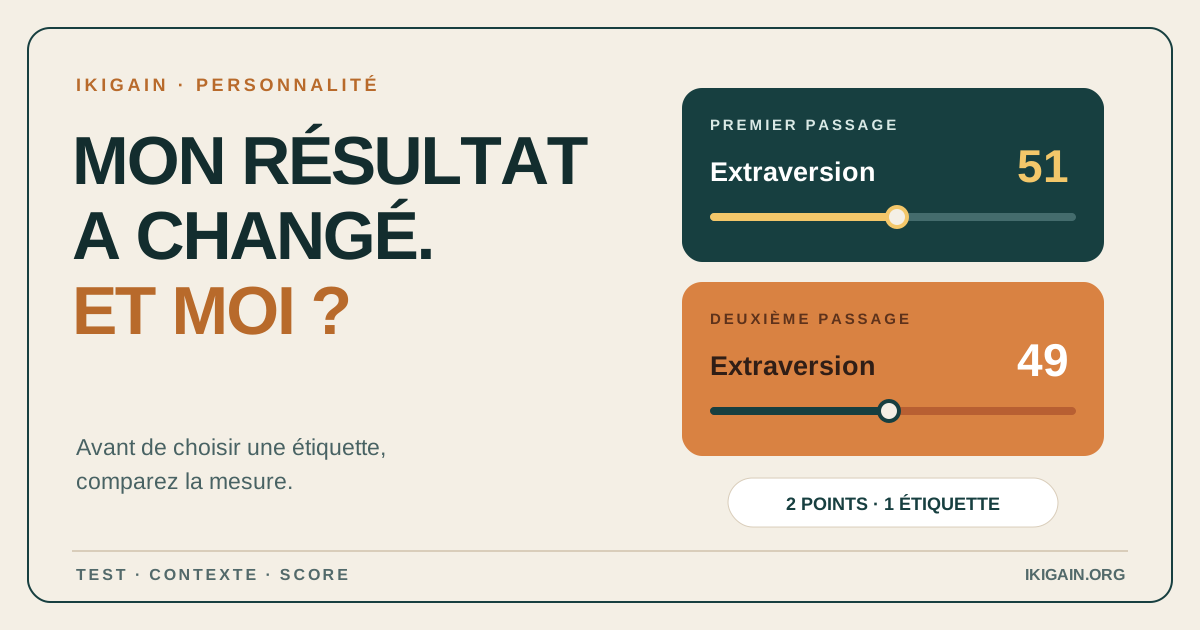
You retake a personality test and the result is different. Maybe your score moved a few points. Maybe a type changed completely. Maybe a description that felt accurate last year now seems strangely distant.
That can be unsettling, especially when the first result felt like an explanation of who you are. But a changed result does not automatically mean that your personality changed overnight, and a matching result does not prove that the test captured your whole identity.
A retest is an opportunity to ask a more useful question: what changed between the two measurements, and what does the evidence actually support?
Quick answer
Personality-test results can change because of:
- different tests, versions, scales, or scoring rules;
- changes in how you interpret the questions;
- the context or time frame you use when answering;
- mood, stress, fatigue, or a recent life event;
- practice, memory, or trying to answer in a preferred way;
- measurement error, especially in short or poorly explained tests; and
- genuine changes in habits, roles, priorities, or personality over time.
The APA definition of retest reliability describes it as the consistency of results when an assessment is given again over time. It is a property of a measurement process, not a promise that every person will receive the same score forever.
A test result is a measurement, not a mirror
When you answer a personality questionnaire, the result is produced by several things working together:
- the construct the test intends to measure;
- the questions selected to represent it;
- your interpretation of those questions;
- the response options and scoring model;
- the comparison group or rules used to interpret the score; and
- the conditions in which you answered.
The result is information about that process. It is not a perfect recording of your entire personality.
This is why “the test says I am 62% agreeable” should not be treated like a laboratory reading. The number may be useful within the test’s method, but it needs context. A different scale, a different norm group, or a slightly different question can produce a different-looking result without revealing a dramatic change in your character.
Reason 1: You took a different test
“Personality test” is a broad category. Two websites may both use the words Big Five, introversion, openness, or 16-type, while asking different questions and applying different scoring rules.
A Big Five inventory may report continuous trait dimensions. A 16-type framework may convert patterns of preferences into a memorable category. A short workplace questionnaire may be designed around a particular job context. These results are not interchangeable just because they use familiar words.
Before comparing two results, check:
- the test name and version;
- the dimensions or categories it measures;
- the number and wording of items;
- the response scale;
- the scoring and norm information; and
- the intended population and purpose.
If those details differ, you are not conducting a clean retest. You are comparing two different instruments.
The Big Five Personality Test and 16-Type Personality Test are different kinds of reflection tools on Ikigain. Their results should not be expected to line up perfectly or to answer the same question.
Reason 2: The questions were interpreted differently
Personality questions often use words such as “usually,” “often,” “social,” “organized,” or “comfortable.” Your interpretation of those words can shift.
Suppose a question asks whether you enjoy meeting new people. The first time, you may think about friends and interesting conversations. The second time, you may think about networking events after a demanding month. Both answers can be honest, but they refer to different experiences.
Other questions may be ambiguous in a different way:
- Are you answering about how you behave, how you would like to behave, or how others expect you to behave?
- Are you thinking about your current role or your behavior across your whole life?
- Does “I like planning” mean detailed schedules, knowing the next step, or having a clear goal?
- Does “I am calm” describe your internal feeling, your outward behavior, or your recovery after stress?
If the instructions do not provide a clear frame of reference, your answers can move as your interpretation moves.
Reason 3: Your context and mood changed
Self-report answers are influenced by the context you bring to the questionnaire. A new job, relationship, study program, health challenge, caregiving responsibility, or period of isolation may change which examples come to mind.
That does not make the answer false. It may describe a real part of your current life. Someone who has spent a year in a highly social role may answer differently from someone who has spent a year working alone. Someone under sustained stress may have less energy for novelty or interaction than they usually do.
Try to distinguish two statements:
- “This is how I have been responding in my current circumstances.”
- “This is the most stable description of me in every circumstance.”
The first may be useful information. The second is a much larger claim.
If you want to compare results over time, record the context: what was happening in your life, which time frame you used, and whether you were answering about your typical self or your current self.
Reason 4: Short tests have less room to balance a single answer
Longer, well-designed measures usually use multiple items to represent a dimension. Short quizzes may rely on only a few questions. One answer can therefore have a larger effect on the final result.
This is not an argument that every long test is good or every short test is bad. It is a reason to be cautious about precision. A score that moves from 54 to 58 may not represent a meaningful change if the test does not report its reliability or uncertainty.
Look for information about:
- how many items contribute to each scale;
- whether the test has been studied with the intended population;
- how consistent scores are across repeated administrations; and
- whether the result is intended for reflection, research, development, or a high-stakes decision.
The APA methodology guide to psychological tests explains that test–retest reliability is one kind of evidence about score consistency. It is not the same as validity, and neither one removes the need to interpret a result for its intended purpose.
Reason 5: You remembered the first result
After taking a test once, you may remember which answers produced a result you liked or disliked. You may answer the second time to confirm it, challenge it, or avoid it.
That is especially likely when a result has become part of your self-story. If you think “I am an introvert,” you may choose answers that protect the label even when your behavior is more mixed. If a result upset you, you may unconsciously answer against it.
Practice can also matter. Repeated exposure to the wording may make you more familiar with the response scale, even if your personality has not changed. In employment testing, retest research has examined practice and retest effects as separate issues from the underlying construct; the same caution is useful when reading online self-assessments.
Do not retake a test repeatedly in a short period to chase a preferred result. That usually creates more noise, not more certainty.
Reason 6: Your personality can develop
Personality is not frozen, even when broad traits show stability. People develop habits, enter new roles, practise new behaviors, and respond to changing environments. A trait can remain recognizable while its expression changes.
For example:
- You may become more comfortable speaking in groups through repeated practice.
- You may become more organized because a role requires new systems.
- You may become more selective about social contact after a period of overload.
- You may become more open to a subject after meeting someone who makes it relevant.
Those changes do not necessarily invalidate an earlier result. They may show that you are a person in development rather than a type in a box.
Longitudinal research on the Big Five generally finds both stability and change. A longitudinal study of Big Five stability and change found that relative ordering can remain moderately stable across adulthood while still leaving room for individual and life-stage differences. The practical lesson is not that a score must stay the same. It is that stability and change can coexist.
How to compare two results responsibly
If you decide that a retest will help, use a simple comparison process.
1. Use the same instrument when possible
If your purpose is to examine change, use the same test version, language, instructions, and scoring method. Comparing a Big Five inventory with a 16-type profile answers a different question.
2. Keep the time frame consistent
Answer both tests about your typical behavior over the same kind of period. If one test asks about the past week and the other asks about your whole life, the scores are not directly comparable.
3. Record the conditions
Note the date, time, device, language, sleep, stress, and any major context. You do not need to create a laboratory environment. You do need to remember what the two measurements were like.
4. Compare patterns before labels
Look for dimensions that stayed similar, items that changed, and areas where you are genuinely uncertain. If a type flips, inspect the underlying answers if the test provides them. A category boundary can make a small difference look like a complete identity change.
5. Ask what decision the result can inform
A retest may help you reflect on a habit or question. It should not be used alone to diagnose a mental-health condition, make a hiring decision, reject yourself from a career, or label someone else.
What to do when your result changes
Instead of asking “Which result is the real me?”, ask:
- Which answers changed?
- What examples was I thinking about each time?
- Did the test, scoring, or language change?
- Is the difference large relative to the test’s reported uncertainty?
- Does the new result match anything I have observed in daily life?
- What practical question would this result help me explore?
Then choose one action:
- Observe: notice the pattern for two weeks without trying to fix it.
- Discuss: ask someone who knows you in a relevant context for specific examples.
- Experiment: change one work or study condition and record what happens.
- Move on: if the result does not answer a useful question, stop retesting.
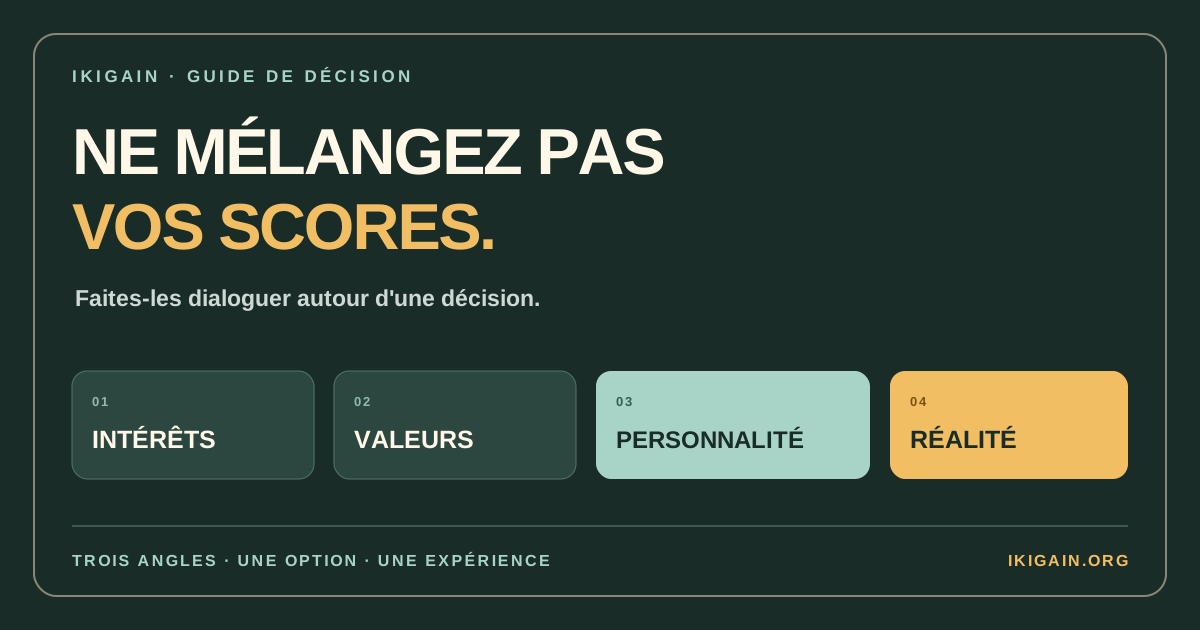
If your question is about career direction, compare a personality result with the Career Interests Test, Work Values Test, and actual descriptions of the work. If your question is about purpose, the first-test guide can help you choose whether another assessment would add information or only another label.
A founder note from Sindy’s search for ikigai
When I was looking for ikigai, I sometimes wanted one result to settle the question. When a result changed, I learned that certainty was not the same as insight. The useful part was noticing which questions kept returning and what I was actually doing in ordinary life.
That is why I prefer to use results as prompts. A score can help you notice a pattern, but your choices, relationships, responsibilities, and experiments add the context that a questionnaire cannot contain.
When a changing result is a reason to pause
Take a break from online testing if:
- you are retaking the same test until the result feels reassuring;
- every score change makes you question your identity;
- you are using tests to delay a conversation or decision you could investigate directly;
- the site makes diagnostic or guaranteed career claims; or
- the result is being used in a high-stakes educational, clinical, or employment decision without appropriate professional guidance.
If a test result raises a serious concern about learning, mental health, work functioning, or an accommodation need, seek a qualified assessment in the relevant setting. An online quiz can help you formulate a question, but it cannot replace an evaluation designed for that question.
FAQ
Does a changed personality-test result mean my personality changed?
Not necessarily. The difference may reflect a new test, different wording, changed context, mood, practice, measurement error, or a genuine change in behavior and priorities. Compare the instruments and circumstances before making a broad conclusion.
How long should I wait before retaking a personality test?
There is no universal waiting period. Follow the test publisher’s guidance and avoid repeated attempts designed to chase a preferred result. If you are studying change, use the same instrument under comparable conditions and allow enough time for the question you are studying to make sense.
Which personality-test result should I trust?
Do not choose only the result that feels flattering or certain. Examine the test’s purpose, method, evidence, context, and limits. A credible result should be interpreted as one source of information alongside your behavior, history, goals, and real-world observations.
Can personality traits really change over time?
Yes, broad traits can show stability while people also develop across life stages and situations. Learning, roles, relationships, health, and environment can change how tendencies are expressed. A changing result is not proof of transformation, but it can invite a useful look at what has changed in your life.
Final takeaway
A retest is not a courtroom deciding which version of you is real. It is another measurement with its own conditions and limitations.
Compare the method, context, questions, and practical evidence before interpreting the difference. If the result helps you notice a useful pattern, turn it into an observation or small experiment. If it only creates more anxiety, you are allowed to stop testing.