A personality score is useful when it helps you notice a pattern and test it in real life. It becomes unhelpful when you start defending the label, comparing every action with it, or using one number to explain your whole identity.
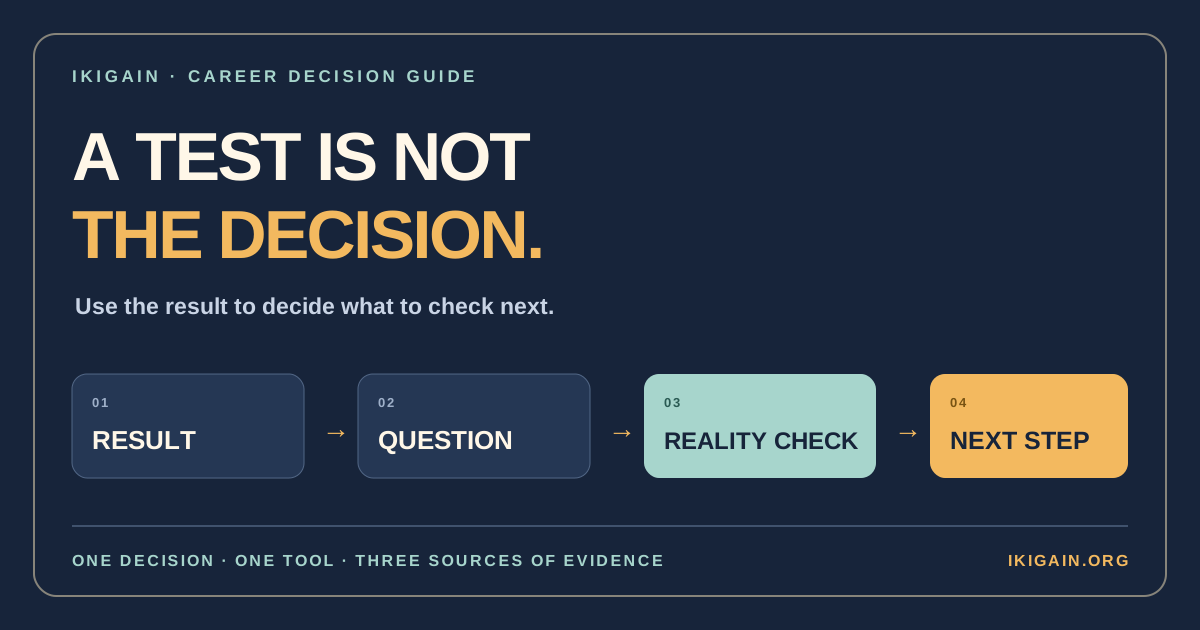
Read the score as a starting point. Ask what the result is describing, when the pattern appears, what changes it, and what small experiment could give you better evidence. A result can suggest a question without becoming an instruction.
The short answer
Use four steps after receiving a personality result:
- Name the scale or category. Write down the exact wording, not the headline summary.
- Translate it into behaviour. What would this look like on an ordinary Tuesday?
- Add context. Where does the pattern appear, and where does it disappear?
- Run one small test. Change a condition and observe your attention, energy, or decisions.
Do not ask, “Am I really this type?” Ask, “When does this description fit, when does it fail, and what can I learn from the difference?” That question keeps the result flexible and close to evidence.
A score describes a tendency, not a command
If a report gives you a high or low score, it is tempting to turn it into a sentence about what you are allowed to do:
- “I am introverted, so I cannot lead meetings.”
- “I am not conscientious, so I will never finish a project.”
- “I am creative, so routine work must be wrong for me.”
- “I am agreeable, so conflict means I am behaving badly.”
Those sentences add a permanent rule that the score itself does not contain. A tendency can influence how an activity feels without deciding what you can learn, practise, or choose.
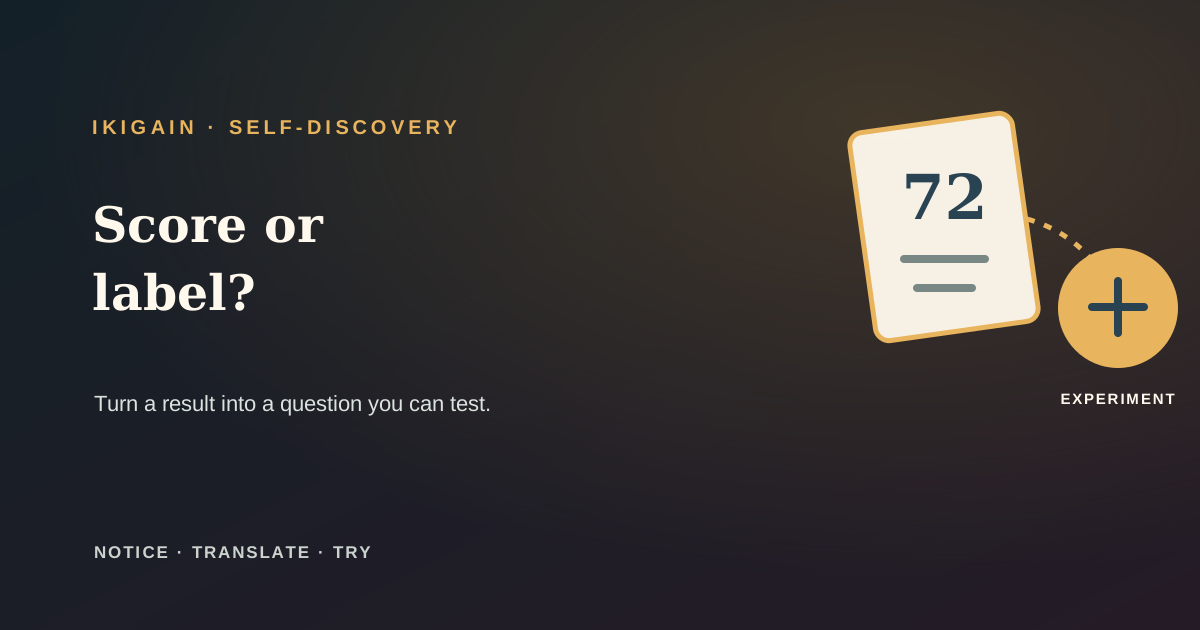
Replace the label with a conditional sentence:
“When [condition], I tend to [observable behaviour]. I work better when [support or adjustment] is available.”
For example: “When I have to switch between many conversations, I tend to lose focus. I work better when I can prepare the purpose of each conversation and protect a quiet block afterwards.” This statement is more useful than “I am bad with people.”
Start with the exact score wording
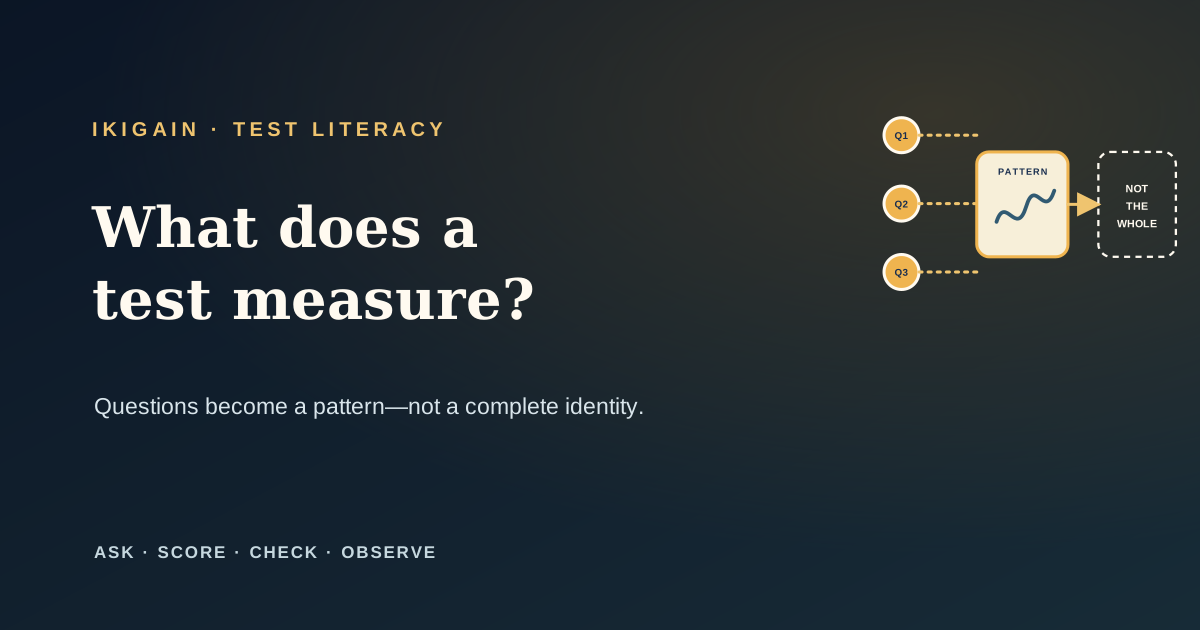
Reports compress information. A page may say “high openness”, “socially reserved”, “structured thinker”, or “people-oriented”. Those phrases can hide several meanings.
Copy the original result into your notes and underline the verbs. Does it say you prefer, tend to, report, enjoy, notice, or are? These verbs do not make the same claim.
Then ask:
- Is this a continuous score or a category?
- What questions produced it?
- Does the result describe a preference, a self-image, or a repeated behaviour?
- Was a specific time frame mentioned?
- Does the report explain what a high and low score mean?
The International Personality Item Pool is one example of a public resource that shows how personality items and scales can be documented. You do not need to become a psychometrician to use a score responsibly, but you should know what kind of claim the tool is making.
Turn the label into ordinary examples
Pick one result that feels accurate, inaccurate, or emotionally charged. Complete these sentences:
- In an ordinary week, this might look like…
- A recent example that supports it is…
- A recent example that complicates it is…
- The people or settings where it changes are…
- The condition that makes the pattern easier to manage is…
Avoid impressive examples. A small scene is better: “I asked for the agenda before the meeting,” “I left a task until the deadline,” or “I kept editing the message because I wanted everyone to be comfortable.” These details let you test the description instead of admiring it.
Separate preference from ability
Personality language often gets confused with competence. Not enjoying a type of activity does not prove that you cannot perform it. Enjoying an activity does not prove that you have developed the skills it requires.
| Result interpretation | More careful question |
|---|---|
| “I am not a detail person” | Which details lose my attention, and what system helps me catch them? |
| “I am highly social” | Which kinds of interaction restore my energy, and which leave me tired? |
| “I am too sensitive for feedback” | What form, timing, and relationship make feedback easier to use? |
| “I am very organized” | Which planning habits work, and where do they become rigidity? |
| “I am not creative” | Which kinds of making, problem-solving, or variation have I actually tried? |
This distinction protects you from two mistakes. You do not have to turn a preference into a limit, and you do not have to deny a real difficulty just because a label sounds positive.
Look for the situation behind the score
The same person can appear different across environments. You may speak easily with a familiar team and hesitate in a room where status is unclear. You may plan carefully when rested and improvise when overloaded. You may enjoy helping one person and avoid a crowded service setting.
Ask what the situation contributes:
- How much choice do I have?
- How clear is the goal?
- Am I alone, with a familiar group, or being evaluated?
- Is the pace steady or interrupted?
- What happens if I make a mistake?
- Does the task use a skill I have practised?
Context does not make a result meaningless. It tells you where to look for the conditions that support or disrupt the pattern.
A composite example: “low conscientiousness”
Illustrative example: the person and situation are fictional.
Consider Maya, who receives a low conscientiousness score and immediately thinks, “I cannot be trusted with important work.” She checks three recent situations.
In the first, she missed a deadline because the project had no clear owner and priorities changed every day. In the second, she completed a volunteer event plan early because the roles, milestones, and handover were visible. In the third, she kept postponing a personal course because the next action was vague.
The score may have touched a real difficulty with self-structuring, but the label hid the conditions. Maya does not need to decide whether she is or is not a conscientious person. She can test whether a visible next action, a weekly review, and a clear owner change her follow-through.
That experiment may confirm a useful habit, expose a skill she wants to practise, or show that the score was too broad for her question. Each outcome is more informative than repeating the label.
Use a score to improve a condition
Choose one place where the result might matter: a meeting, a study block, a project handover, a job search, or a relationship conversation. Change one condition for seven days.
| If you notice… | Try changing… | Record… |
|---|---|---|
| You lose focus during interruptions | A protected 30-minute block | What you finished and how quickly you returned |
| You avoid starting an unclear task | The first action and a visible stopping point | Whether clarity changed your willingness to begin |
| You over-prepare for social situations | A short purpose statement and one question | What happened without extra rehearsal |
| You agree before checking your capacity | A pause before answering | Which commitments you kept or revised |
| You get bored with repeated work | A learning or improvement target | Whether variation changed your engagement |
The experiment is not a scientific validation of the test. It is a practical way to discover whether a condition helps you work with a tendency rather than obeying it.
Do not chase a better-looking result
Retaking tests until the description feels flattering can turn self-discovery into score shopping. A result that sounds positive is not automatically more accurate, and a result that feels uncomfortable is not automatically false.
If you retake a test, write down the reason first. Are you checking a stable question with the same instrument, exploring a different construct, or trying to resolve an emotional reaction? The article about changing personality-test results can help you compare context, wording, practice, and measurement differences before deciding what a change means.
Sometimes the better next step is not another personality test. If your question concerns activities, use a career interests test. If it concerns the conditions you need at work, use a work values test. If it concerns meaning and contribution, use the Ikigain test. These tools ask different questions; they should not be averaged into one identity score.
A 15-minute score review
Set a timer and write:
- The exact scale or category I received.
- The behaviour the report seems to describe.
- One situation where it fits.
- One situation where it does not fit.
- The condition that changes the pattern.
- The skill I might practise, if I want more choice here.
- One small experiment for the next seven days.
Finish with two sentences:
This result gives me a question about…
This result does not give me permission to conclude that…
Keep the notes with the date and the test name. A later comparison is more useful when you can see the context rather than only the score.
When a result should not guide a major decision alone
Do not use one personality score as sufficient evidence for resigning, rejecting a field, judging a partner, or deciding what someone else can do. Important choices also require information about tasks, resources, health, relationships, risks, and actual working conditions.
If a test result is being used for a formal educational, clinical, or employment decision, ask what instrument, evidence, and qualified interpretation the situation requires. A short self-discovery quiz and a formal assessment do not have the same purpose.
FAQ: reading a personality score
Should I trust a high score more than a low score?
No. Both are interpretations of answers collected by a particular instrument. Look at the wording, examples, context, and evidence behind the score instead of treating one direction as automatically better.
What if the description feels completely wrong?
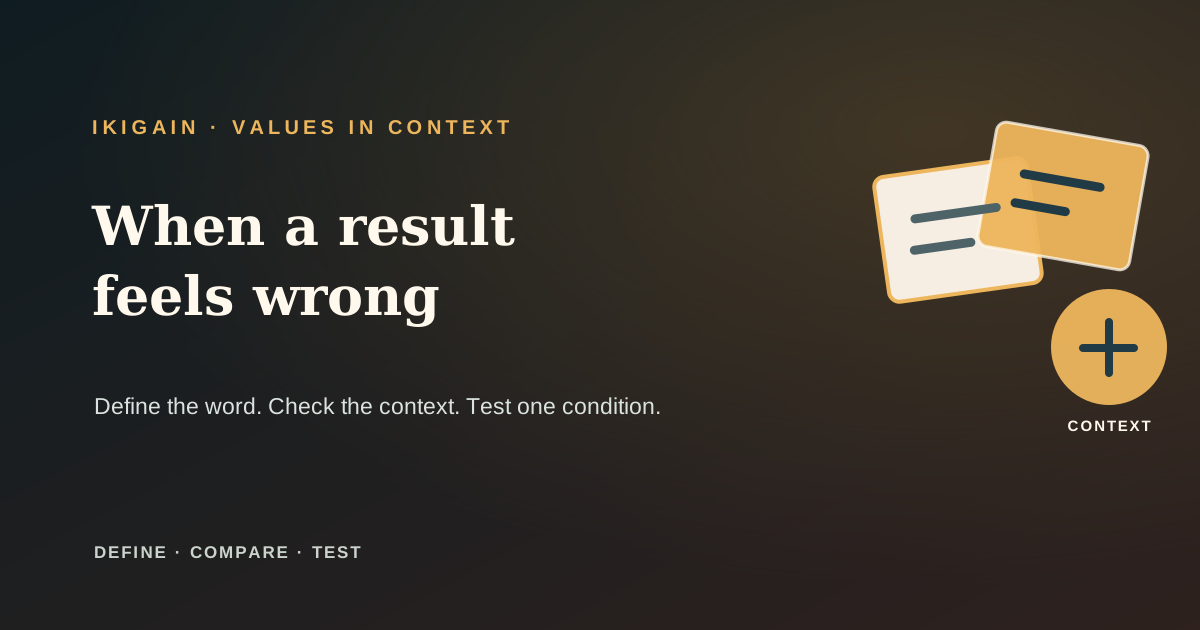
Check whether the word has a different meaning for you, whether you answered for a specific situation, and whether a recent event influenced your responses. Find one example that supports the result and one that complicates it before rejecting or accepting it.
Can personality scores change?
Scores can change when the test, wording, context, response strategy, or circumstances change. Some traits also develop over time. Compare the measurement conditions before making a claim about personal change.
How can I use a personality result at work?
Translate it into a condition or behaviour: preparation time, meeting format, decision ownership, feedback timing, or uninterrupted focus. Test one adjustment instead of telling yourself that a label determines your role.
Is a personality test a diagnosis?
Not by itself. A self-discovery test is not a clinical diagnosis and should not be used to make a high-stakes health or employment judgment without an appropriate professional process.