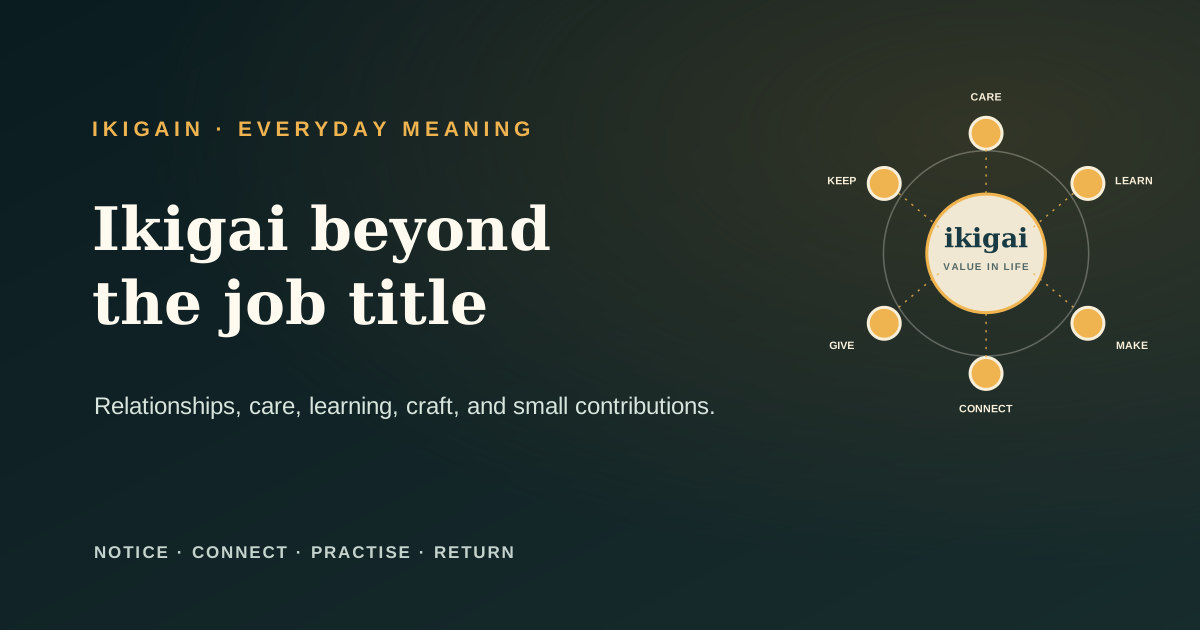
Ikigai does not have to be your job, your business, or a grand mission. It can be a relationship you care for, a practice you return to, a responsibility that matters, or a small contribution that gives shape to an ordinary day.
The four-circle diagram online often turns ikigai into a career exercise: what you love, what you are good at, what the world needs, and what you can be paid for. That can be a useful way to discuss work. It is too narrow as a description of every source of meaning in a life.
If your work is necessary but not deeply meaningful, that does not mean you have failed to find your ikigai. It may mean the question belongs somewhere else.
A wider question than “What should I do for work?”
Career is only one part of the week. Before treating ikigai as a professional decision, ask what you are actually trying to understand:
- What makes an ordinary morning worth getting up for?
- Which relationships do you want to keep tending?
- What activity helps you feel present rather than merely occupied?
- Where do your efforts make a difference to another person?
- What would you miss if it disappeared from your week?
These questions do not ask you to name a perfect identity. They ask you to notice value where it already appears. A nurse may find meaning in caring for patients and also in cooking with friends. A software developer may care about building useful tools and about being the person who looks after an elderly parent. Neither source cancels the other.
The question Sindy started with
In her account of creating Ikigain, our founder Sindija Vilmane asks, “What makes me truly happy? Am I happy now?” She describes spending years looking for things that interested her and wanting to make ikigai more interactive through a card game.
Those are questions about a life, not just a job title. In this article, we carry that starting point into ordinary scenes: a relationship you tend, something you enjoy learning, or a contribution you want to keep making.
What the word can include
There is no single checklist that every person must satisfy. Outside work, people often describe meaning through a combination of connection, activity, contribution, and continuity.
| Source of value | What it can look like | A question to explore |
|---|---|---|
| Relationship | Showing up for family, friends, neighbours, or a community | Who benefits when I keep this promise? |
| Care | Cooking, repairing, listening, tending, or protecting | What am I helping to remain possible? |
| Learning | Studying a language, practising music, or understanding a subject | What do I want to become more capable of noticing? |
| Craft | Making, growing, arranging, writing, or fixing something | Which part of the process keeps calling me back? |
| Contribution | Volunteering, mentoring, sharing knowledge, or improving a shared place | Where can a small effort make someone’s day easier? |
| Continuity | Keeping a family practice, story, skill, or place alive | What do I want to carry forward or adapt? |
The value is not always pleasure. Care can be tiring. Learning can be frustrating. A relationship can involve disagreement. Meaning is not the same as feeling happy at every moment; it is often the sense that an effort belongs to something you consider worth protecting.
Why the four-circle diagram can feel too small
The popular diagram is easy to draw and easy to remember. It is especially useful when you are comparing possible work directions. It can become unhelpful when it suggests that one answer must sit at the intersection of all four circles.
Many meaningful activities are not paid. Some are not obviously “what you are good at” when you begin. A friendship does not become less valuable because nobody pays you for it. A garden, a choir, a child’s bedtime routine, or a neighbourhood project may matter precisely because they are not products to optimise.
The diagram can still be used as a set of prompts. Add questions that reflect the rest of your life:
- Who do I want to be there for?
- What do I want to practise or preserve?
- What kind of attention do I want to give?
- Which ordinary task becomes worthwhile because of who it serves?
This turns the picture from a formula into a conversation. Our guide to writing an ikigai sentence you can actually use takes the same approach: start with scenes you can observe instead of an identity you have to prove.
Meaning can live in a repeated gesture
People often search for a dramatic answer because dramatic answers are easier to tell as stories. Everyday meaning is quieter. It may be the same walk with a neighbour, the lunch you prepare for your family, the instrument you practise after work, or the way you make a complicated process easier for a colleague.
Ask yourself what you continue doing when there is no audience. What do you repair before anyone asks? Which responsibility would you still choose if nobody described it as impressive?
The Japanese government’s Kizuna article on ikigai describes the concept through ordinary sources of value and connection rather than limiting it to a job title. That does not create one official definition for everyone, but it is a useful reminder to look at lived relationships and practices as well as ambition.
Elena’s three sources of meaning
Illustrative example: the person and situation are fictional.
Elena works in payroll. She does not describe the job as her calling, but she likes making a confusing process less stressful for people who are anxious about money. Outside work, she grows tomatoes on a balcony and sends a weekly voice message to her sister who lives abroad.
If she uses the four-circle diagram alone, she might conclude that her job is the only serious candidate because it is paid and uses her organisational skills. That would erase two important parts of her week.
She writes three observations instead:
- At work: I feel useful when a person leaves a difficult conversation knowing what to do next.
- At home: I feel grounded when I care for something slowly and see a change over time.
- In the relationship: I feel connected when I keep a small promise consistently.
These are not three competing careers. They are three forms of value: clarity for another person, patient care, and continuity in a relationship. They may influence her work, but they do not need to collapse into one job.
Try the seven-day meaning audit
For one week, do not ask “What is my purpose?” at the end of every day. Ask a smaller question: “Where did something matter today?”
Write down one scene each evening. Include enough detail to remember what happened:
- What did I do?
- Who or what did it affect?
- What part felt valuable: connection, care, learning, craft, contribution, or continuity?
- What part was difficult or costly?
- Would I want a little more of this, or simply a different condition around it?
After seven days, underline repeated verbs. You may find “listen,” “teach,” “make,” “protect,” “organise,” “notice,” “welcome,” or “understand.” Verbs are more useful than labels because they can travel between contexts. You might express “teach” through parenting, mentoring, writing, or work. You might express “protect” through care, law, engineering, or keeping a promise.
Do not turn the audit into a score. Its purpose is to give you a more honest set of observations than a single grand question can provide.
What to do when work and meaning do not align
You have more than one option. You can:
Improve one part of your current work
Look for a task that uses a meaningful activity, a person you want to serve, or a condition you need to protect. A small change in responsibility or rhythm may reveal that the issue is the shape of the role, not its entire field.
Give meaning a protected place outside work
Your job can support your life without carrying all of its meaning. Protect a recurring practice or relationship rather than waiting for free time to appear. Twenty minutes that actually happen may matter more than an ideal plan that never begins.
Explore a different work direction carefully
If your work consistently conflicts with important values or leaves no room for recovery, investigate alternatives. Start with a conversation, a small task, and the conditions that would make the change sustainable. The Ikigai vs. life purpose guide can help separate a broad direction from a single career promise.
These options can coexist. You do not have to decide that your job is meaningless before you make room for meaning elsewhere.
Do not use ikigai to romanticise exhaustion
Meaningful work can still be badly designed. A sense of contribution does not make chronic overwork, unsafe conditions, unpaid labour, or disrespect acceptable. If a responsibility matters to you, that is a reason to protect the conditions around it, not a reason to abandon every boundary.
Ask what helps you continue: time, rest, money, training, shared responsibility, accessibility, or a reliable person to talk to. A purpose that can only survive when you ignore your health or other commitments needs a different structure.
If you are dealing with persistent distress, loss of functioning, or a mental-health crisis, a purpose exercise is not a substitute for qualified support. Meaning can be part of recovery, but it should not be used to explain away suffering or tell you to endure it.
When a test can help
An Ikigai test can help you organise questions about enjoyment, contribution, strengths, and practical conditions. It cannot identify a single destiny, and it cannot see the relationships or responsibilities that make your life meaningful.
Use the free Ikigai test as a prompt, then bring one result into your seven-day audit. Complete the sentence: “This result makes me curious to observe whether…” If you cannot turn it into an observation or a conversation, you may be asking the test to make a decision it cannot make.
FAQ: ikigai beyond work
Does ikigai have to be a career?
No. Work can be one source of ikigai, but relationships, care, learning, craft, community, and repeated daily practices can also give life value. You do not need to force every meaningful activity into a job.
Can I have more than one ikigai?
It is more useful to think in terms of several sources of value than to search for one permanent answer. Different relationships and activities may matter in different seasons, and they can support one another.
What if my job pays the bills but does not feel meaningful?
Start by identifying what the job makes possible and whether any task or condition within it can change. Then protect meaningful relationships or practices outside work and explore alternatives with small, reversible experiments.
Is the four-circle ikigai diagram wrong?
It can be a useful career-reflection tool, but it should not be presented as the complete meaning of ikigai or as a formula that produces one profession. Add questions about relationships, care, practice, and ordinary contribution.
How do I know whether something truly matters to me?
Look for repeated evidence rather than a dramatic feeling. Notice what you return to, what you protect, who benefits, and what kind of effort you are willing to sustain with realistic support.