
TL;DR:
- Living with purpose reduces mortality risk and improves health outcomes.
- Purpose-driven living begins with honest self-reflection and iterative action.
- Regular evaluation and small, consistent habits sustain long-term fulfillment.
You've got the résumé. The paycheck. The calendar packed solid. Still something's off. That disconnect between doing well and feeling like it matters—it's not just in your head. People who live with purpose show a 40% lower mortality risk and better measurable health outcomes. This guide gives you a concrete, research-grounded process to sync your actual days and work with what counts for you—using the Japanese ikigai framework plus modern self-discovery tools. Not abstract platitudes. A real workflow.
Table of Contents
- Clarifying your purpose: Foundations and prerequisites
- Crafting your purpose-driven workflow: Step-by-step guide
- Troubleshooting and common mistakes in purpose-driven living
- Evaluating and evolving your workflow for lasting impact
- Our perspective: What most guides miss about purpose-driven living
- Discover your ikigai: Next steps with Ikigain
- Frequently asked questions
Key Takeaways
| Point | Details |
|---|---|
| Purpose boosts longevity | Living with purpose is empirically linked to longer life and better health. |
| Iteration matters more than perfection | Small, regular actions reveal purpose and keep your workflow effective. |
| Japanese philosophy inspires results | Applying ikigai and kaizen concepts helps align your life and work for lasting satisfaction. |
| Balance is crucial | Blending personal ambition with contribution to others drives resilience and fulfillment. |
| Regular evaluation sustains impact | Frequent reviews ensure your workflow evolves for continued purpose. |
Clarifying your purpose: Foundations and prerequisites
Before you build anything, you need to know what you’re building toward. Most people skip this step and jump straight into productivity systems. That’s why those systems collapse within weeks. Purpose-driven living requires a different starting point: honest self-reflection.
Start by asking three foundational questions. What do you genuinely enjoy doing, even when no one is watching? What do you believe the world needs more of? What are you naturally good at? These aren’t rhetorical. Write your answers down. Revisit them over several days. Your initial answers will shift, and that’s exactly the point.
Here’s what you’ll need before building your workflow:
- Time for reflection: At least 20 to 30 minutes of uninterrupted thinking per day during the setup phase
- Openness to discomfort: Some values you uncover may conflict with your current career or habits
- Willingness to revise: Purpose isn’t a destination. It’s a direction that evolves
- A journal or digital notes app: Capturing thoughts over time reveals patterns you’d otherwise miss
- Low perfectionism tolerance: Purpose emerges through action, not through waiting for the perfect answer
When it comes to approach, Japanese philosophy and Western productivity techniques differ significantly:
| Dimension | Japanese philosophy (ikigai) | Western productivity |
|---|---|---|
| Focus | Meaning and daily joy | Output and efficiency |
| Starting point | Values and passion | Goals and metrics |
| Pace | Gradual, iterative | Fast, structured |
| Success measure | Fulfillment and balance | Achievement and income |
| Community role | Central | Often secondary |
Research consistently shows that purpose lowers mortality even after adjusting for lifestyle and health confounders. This isn’t soft science. It’s measurable. And purpose longevity research reinforces that the mechanism works through behavior change, stress reduction, and social connection.
If you’re new to this process, start with finding your purpose as a structured starting point. You can also discover ikigai through guided reflection tools that map your passions, strengths, and values together.
Pro Tip: Don’t wait until you have total clarity to begin. Purpose reveals itself through doing, not through thinking alone. Start with what feels most alive right now, and let the picture sharpen over time.
Crafting your purpose-driven workflow: Step-by-step guide
With your motivations clarified and prerequisites in place, it’s time to build your personalized workflow. This isn’t about overhauling your life overnight. It’s about layering intentional habits onto your existing structure.
- Map your core values. Write down your top five values. Not what you think they should be. What they actually are based on how you spend your time and energy right now.
- Set weekly intentions. Each Sunday, write one sentence that captures what you want to prioritize that week, rooted in your values. Keep it simple.
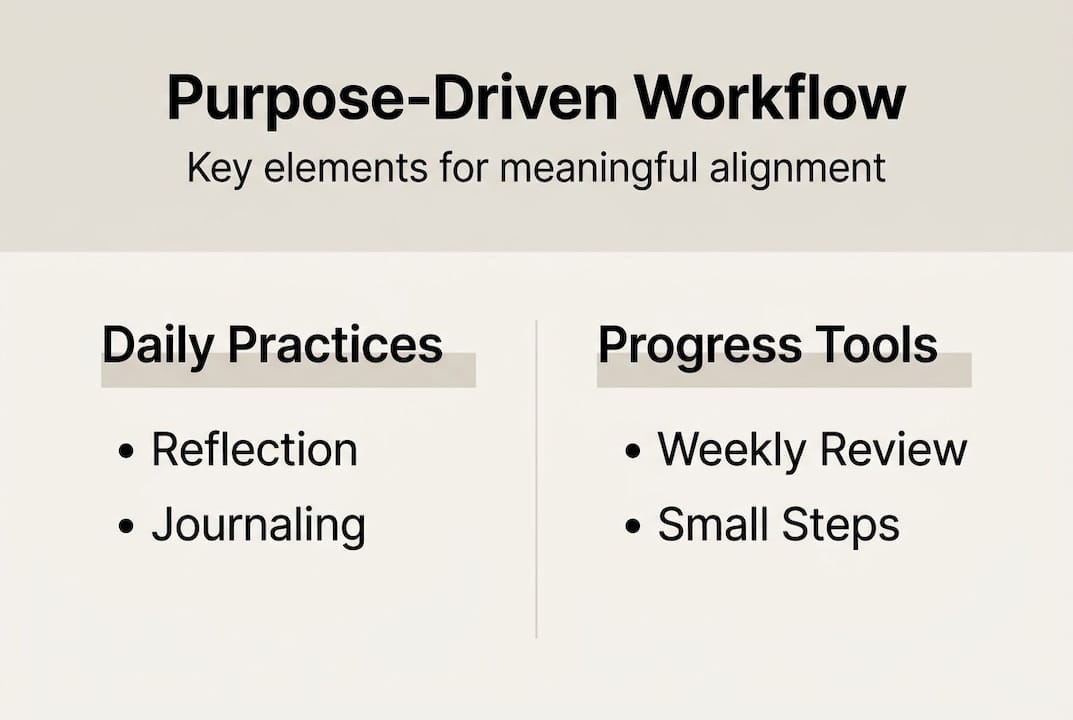
- Design your morning anchor. Choose one small act each morning that connects to your purpose. It could be journaling, a short walk, or reading something meaningful. Consistency matters more than duration.
- Block purpose-aligned work time. Identify two to three hours per week to work on something that aligns with your ikigai, whether that’s a side project, a skill, or a conversation.
- Review and refine weekly. Every Friday, spend ten minutes asking: Did this week feel aligned? What would I change?
Here’s how different workflow styles compare in practice:
| Workflow type | Daily anchor | Weekly review | Core tool |
|---|---|---|---|
| Japanese (ikigai-based) | Morning reflection | Values check-in | Journal + ikigai map |
| Western (goal-driven) | Task prioritization | KPI review | Planner + metrics |
| Hybrid | Intention + task list | Alignment + output | Digital notes + goals |
In Blue Zones like Okinawa, iterative action toward purpose fosters sustained well-being across a lifetime. It’s not a single breakthrough moment. It’s daily, small choices repeated over years. And prioritizing action over perfection is what separates people who sustain purpose-driven lives from those who stay stuck in planning mode.

For a deeper look at how purpose and progress work together, explore aligning purpose with progress through the lens of ikigai and kaizen. You can also reflect on discover life purpose through guided questions that sharpen your direction.
Pro Tip: Start with one change, not five. A single morning routine done consistently for 30 days will do more for your sense of purpose than a perfect 12-step system you abandon in week two.
Troubleshooting and common mistakes in purpose-driven living
As you begin implementing your workflow, challenges will inevitably arise. The most common one? Confusing income with purpose. Many people build a workflow around financial goals and wonder why it still feels empty. Money is a resource, not a reason.
Here are the most frequent pitfalls to watch for:
- Chasing external validation: Building a purpose-driven life to impress others defeats the point entirely
- Neglecting community: Ikigai isn’t purely self-focused. It includes what the world needs from you
- Burnout from over-optimization: Trying to make every hour purposeful creates pressure that kills joy
- Drifting back to old routines: Without regular check-ins, default habits reclaim your schedule quickly
- Treating purpose as fixed: What matters to you at 30 may shift significantly by 40. That’s healthy, not failure
Expert strategies for staying resilient include anchoring your daily actions to values rather than outcomes. When a day feels unproductive, ask whether your actions reflected your values. If yes, the day was purposeful regardless of output.
"If you build a life around only your own goals, you hit a ceiling. Add other people to the equation—whether that's family, work, or a community—and something shifts. That's where real resilience comes from. The research backs this up: people with purpose tied to others live longer, adapt better, recover faster. It's not about sacrifice. It's about what actually works."
Also track your stress and energy levels weekly. A purpose health study found that purposeful living improves physical health markers, including lung function and cardiovascular indicators. These are measurable signals that your workflow is working.
For a deeper grounding in the philosophy behind all of this, the ikigai philosophy guide offers a thorough look at the Japanese concepts that make this approach distinct from typical self-help frameworks.
Evaluating and evolving your workflow for lasting impact
Sustaining purpose-driven living requires more than initial commitment. It’s a continuous journey of honest evaluation and thoughtful adjustment. Most people set up a workflow and forget to revisit it. Then they wonder why it stopped working six months later.
Here’s a simple evaluation process to run monthly or quarterly:
- Review your intentions. Look back at what you set out to prioritize. Did your actions reflect those intentions at least 60 to 70% of the time?
- Assess your energy patterns. Are you ending most days feeling drained or reasonably satisfied? Energy is a reliable proxy for alignment.
- Adjust one habit. Don’t overhaul everything. Identify the single habit that feels most out of sync and change only that.
- Celebrate small wins. Acknowledge what worked. Purpose-driven living thrives on positive reinforcement, not just correction.
- Revisit your core values. Do they still feel true? If something has shifted, update your map.
Signs your workflow is functioning well:
- You wake up with a general sense of direction, even on difficult days
- Your work feels connected to something larger than a paycheck
- You have energy left for relationships and personal interests
- Stress feels manageable rather than constant
Signs it needs adjustment:
- You feel like you’re going through the motions
- Your most meaningful activities keep getting pushed to “later”
- You’ve stopped reflecting or journaling entirely
- Your sense of identity feels tied only to your job title
Purpose-driven behaviors and regular evaluation are linked to longevity across multiple population studies. This isn’t just philosophy. It’s measurable biology. Reflecting on discovering life purpose periodically keeps your workflow from becoming just another routine.
Our perspective: What most guides miss about purpose-driven living
Most purpose guides hand you a worksheet, ask you to list your passions, and call it done. That’s not how purpose actually works. In our experience working with the principles behind ikigai, the biggest mistake people make is treating purpose as something to find rather than something to build.
Japanese philosophy, particularly ikigai and kaizen (the practice of continuous improvement), teaches something counterintuitive: clarity comes after action, not before. You don’t figure out your purpose and then start living. You start living intentionally and your purpose becomes clearer with each step.
The guides that skip this truth leave people waiting for a revelation that never comes. Meanwhile, the people who discover purpose with ikigai through consistent, small actions are the ones who report the deepest sense of fulfillment.
Stop waiting for the perfect plan. Start with one honest action today. Purpose is not a destination you arrive at. It’s the quality of attention you bring to the journey.
Discover your ikigai: Next steps with Ikigain
You've got a framework. Now comes the harder part: actually knowing what you want. Most people skip this step and wonder why their work feels hollow.

Ikigain has actual tools for this. Start with the ikigai type test—it shows you where your interests, skills, and values actually overlap. Then look at the Japanese philosophy concepts that frame all of this. The life purpose questions section gives you specific prompts to break through circular thinking when you're lost on what direction to move in. Self-knowledge and clear execution depend on each other. You can't have one without the other.
Frequently asked questions
What is a purpose-driven living workflow?
It’s a structured process to align your daily routines and life decisions with your core values and passions, often drawing inspiration from Japanese philosophy like ikigai. Purpose-driven living is also associated with better health and longer life.
How do I avoid the income trap when following purpose-driven principles?
Focus on balancing self-oriented and community-oriented goals rather than prioritizing income alone. Balancing self and other focus builds resilience and sustains true purpose over time.
How often should I review and adjust my workflow?
Monthly reflection is ideal for catching drift early, while quarterly adjustments let you make bigger shifts as your purpose evolves. Regular evaluation is consistently linked to sustained purposeful living.
What are signs my workflow is working?
Increased energy, greater daily satisfaction, and positive health markers all signal alignment. A purpose health study found that purposeful living improves measurable physical health indicators.
Can purpose-driven living really impact longevity?
Yes. Studies from Blue Zones and multi-decade cohorts confirm that living with purpose is linked to lower mortality risk and a longer, healthier life.