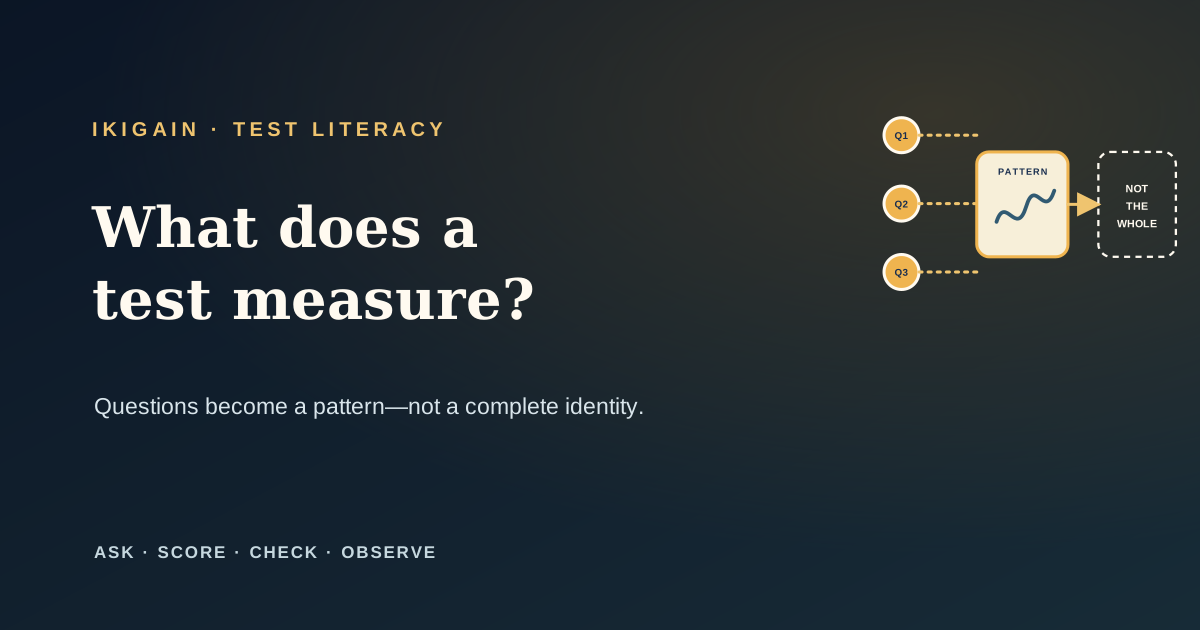
A self-report personality test summarizes your answers as scores or categories for selected patterns of behaviour and preference.
That sounds simple, but it changes how you should read the result. A score is not the same as a diagnosis, a fixed type, a measure of your worth, or a prediction of what you will do in every situation. It is information produced by a particular questionnaire, scoring method, context, and interpretation.
The useful question is not only “What did I get?” It is “What does this instrument claim to measure, and what evidence would make that interpretation useful for my question?”
Quick answer: a test measures a defined construct
Every personality test begins with a construct: an idea such as sociability, openness to experience, conscientiousness, emotional reactivity, or a preferred way of approaching decisions. The questionnaire uses items to represent that idea, and a scoring model combines your answers.
The result therefore depends on several layers:
- the construct the test chose;
- the wording of its questions;
- the response scale and instructions;
- the scoring and comparison rules; and
- the context in which you answered.
Change one of those layers and the meaning of the result can change. Two websites may both use the word “personality” while measuring different constructs or presenting the same construct in very different ways.
A test does not measure “the whole you”
People behave differently across settings. You may enjoy a lively discussion with close friends but dislike unplanned networking. You may be highly organized at work and disorganized during a period of exhaustion. You may prefer independent focus for some tasks and close collaboration for others.
A questionnaire samples your self-description. It cannot observe every role, relationship, skill, responsibility, habit, or pressure in your life. Even a thoughtful result is a partial view.
That partial view can still be valuable. A map is useful precisely because it selects some features. Problems start when we mistake the selected features for the entire landscape.
What the questions are doing
Personality items are not random conversation starters. They are written to represent a dimension or pattern. A question such as “I make plans and follow them” may contribute information about orderliness or self-regulation. A question such as “I enjoy being the centre of attention” may contribute information about one aspect of social engagement.
One item is rarely enough. A more careful measure uses several related items so that one misunderstood sentence has less influence on the overall score. The exact number and quality of items matter, but length alone does not prove quality.
Pay attention to the time frame and comparison implied by the question:
- Does it ask about how you usually behave, how you feel today, or what you prefer in an ideal situation?
- Are you comparing yourself with other people or describing yourself without comparison?
- Does “often” mean most weeks, most days, or simply more than sometimes?
- Are the items about behaviour, enjoyment, confidence, or ability?
Your answer can be honest and still reflect a particular interpretation of the wording.
What a score means
A score usually describes your position on the scale used by that test. It may be a continuous number, a percentile, a band such as low-to-high, or a category created by combining several answers.
The number does not have meaning by itself. A score of 65 could represent different things depending on the scale, the items, the comparison group, and the direction of scoring. A category boundary can also make a small difference look more dramatic than it is.
When a result gives you a percentage, ask:
- Percentage of what: item agreement, a trait scale, a comparison group, or a profile formula?
- What does a higher number mean in this instrument?
- Is the scale continuous or divided into categories?
- Does the site explain how uncertainty or borderline results are handled?
For example, a trait score displayed as 65% does not mean you score higher than 65% of other people. That interpretation requires an actual reference group and a percentile calculation. If the method is hidden, treat the score as a reflection prompt rather than a precise measurement.
Traits, preferences, and type labels are different
The word “personality test” covers several formats.
Trait measures
Trait measures place you along dimensions. A Big Five result, for example, may describe relative patterns across openness, conscientiousness, extraversion, agreeableness, and emotional stability or neuroticism, depending on the instrument’s terminology.
Traits leave room for degree and context. You can enjoy social interaction and still need quiet time. You can be organized in one part of life and flexible in another.
The Big Five Personality Test is most useful when you want to reflect on tendencies without treating them as fixed boxes.
Preference or style measures
Some tools ask about preferred ways of gathering information, making decisions, communicating, or approaching structure. Their result may offer a memorable language for a conversation, even when it does not claim to measure a stable trait in the same way as a dimensional inventory.
The 16-Type Personality Test is an Ikigain reflection tool, not an official clinical or employment classification. Its category can help you generate questions, but it should not be treated as a permanent identity or a hiring verdict.
Quizzes built around a story
Some online tests combine a small number of questions with a highly personalized narrative. The story may feel accurate because it uses broad, relatable themes. That experience can be useful for reflection, but emotional recognition is not the same as evidence that the test has measured a precise construct.
Before trusting a result, look for the boundary between what the test measured and what the written interpretation added.
Reliability: would the result be reasonably consistent?
Reliability concerns consistency or precision. If you answer the same instrument again under similar conditions, do scores tend to be reasonably similar? Do related items behave as if they belong to the same scale? How much noise could come from the particular questions or moment?
Reliability is not the same as truth. A bathroom scale that is always five kilograms too high can be consistent without being accurate. In personality testing, a result can be stable while still measuring the wrong construct for your question.
Short online quizzes often give little information about reliability. That does not make every short tool useless; it means you should avoid reading a small score difference as a major personal change. Our guide on why personality results can change when you retake a test explains the role of wording, context, scoring, and retest conditions.
Validity: does the interpretation fit the evidence?
Validity is not a magical label attached permanently to a test. It concerns whether evidence and theory support a particular interpretation of scores for a particular use.
A questionnaire might be useful for starting a self-reflection conversation but not for diagnosing a condition, selecting employees, or predicting career success. The proposed use matters.
The APA methodology guidance on psychological tests distinguishes validity from reliability and describes reliability as consistency across replications. The International Personality Item Pool also shows why transparency matters: it publishes items and scales intended for personality measurement and research rather than presenting one hidden online quiz as a universal answer.
For an everyday self-discovery tool, you do not need to conduct a full psychometric study before asking whether a result is interesting. You do need to keep the claim modest and match it to the evidence.
Context changes the answer
Your answers can reflect the situation you are in. A new manager, a caregiving responsibility, a period of stress, a new language, or a role that demands constant interaction can change which examples come to mind.
This is not necessarily bias or error. It may be a real description of how you are functioning in that context. The mistake is to treat a context-shaped answer as a permanent statement about every version of you.
Before taking a test, note what you are answering about:
- your usual behaviour over several months;
- your current behaviour in this particular season;
- an ideal preference; or
- the way you act in a named setting such as work, study, or relationships.
Keep that frame in mind when you interpret the result. A person can have a stable tendency and a changing expression of it at the same time.
What a personality test cannot measure by itself
A personality result cannot see your complete history, financial limits, health, access to training, local opportunities, skills, relationships, culture, or the behaviour of a specific employer. It cannot tell you whether you are a good person or whether you deserve a chance.
An informal online result cannot establish a mental-health diagnosis. A concerning result is not a clinical assessment, and a reassuring result does not rule out distress. If you are worried about persistent symptoms or loss of functioning, speak with an appropriately qualified professional.
Do not use a casual online score to make a high-impact decision about another person. Hiring, promotion, education, clinical care, and legal decisions require appropriate instruments, qualified interpretation, and evidence for the proposed use.
A practical way to read your result
Use the result in five passes:
1. Identify the claim
Write down the exact construct or preference the test says it measured. Do not start with the flattering paragraph. Start with the method and the scale name.
2. Find one matching example
Describe a recent situation where the result fits. Include what happened, what you did, and what conditions were present.
3. Find one complication
Write about a situation where the result does not fit or changes. This keeps the profile from becoming a box and may reveal an important context.
4. Translate the result into a question
“I am introverted” is broad. “How much planned interaction and uninterrupted focus help me do this task well?” is something you can investigate.
5. Choose an observation or experiment
Change one condition, ask someone for a concrete example, try a representative task, or record your response across two weeks. A small piece of real evidence is usually more useful than another label.
How this helps with work and purpose
Personality is one lens on work. Interests can help you identify activities you want to explore. Values can help you name conditions you want to protect. Skills and constraints help you judge what is possible now.
If you are exploring ikigai, do not ask a personality result to provide the entire answer. Ask what it helps you notice about contribution, attention, relationships, pace, or the kind of practice you want to develop. Then compare that idea with an ordinary week.
The aim is not to find a perfect match between a label and a job title. It is to make a better next decision with more honest information.
FAQ: what personality tests measure
Do personality tests measure who I really am?
They measure selected patterns in your answers using a particular instrument. A result can describe something real and still be incomplete, context-dependent, or uncertain. Read it as one source of information rather than a complete identity statement.
Is a high score always better?
No. A higher score usually means more of the measured direction on that scale, not more value as a person. Different situations reward different patterns, and every trait has possible strengths and costs depending on the context.
Why do two personality tests give different results?
They may measure different constructs, use different questions or scales, define categories differently, or ask you to answer about different time frames. Compare the methods before comparing the labels.
Can a personality test tell me what career to choose?
No. It can suggest work conditions or activities to investigate, but career decisions also require interests, skills, values, finances, responsibilities, training, and evidence from real tasks and workplaces.
How often should I retake a personality test?
Only when you have a clear reason and enough time for the comparison to teach you something. Retaking a test repeatedly to chase a preferred label usually adds noise. If you retest, keep the instrument, language, instructions, and time frame as similar as possible.