TL;DR:
- Cultural philosophy shapes values, goals, and fulfillment differently in individualistic and collectivistic societies.
- Participating in cultural traditions enhances resilience and psychological well-being through transcendent strengths.
- Effective well-being strategies must be adapted to fit an individual’s cultural background for genuine fulfillment.
Most people pursuing personal growth swallow advice without checking where it comes from. They grab frameworks from bestsellers, productivity apps, and wellness trends without noticing the cultural DNA baked into each one. What passes for "fulfillment" in one tradition might feel forced or meaningless in another. The philosophy of happiness you grew up with shapes your goals, your relationships, how you measure a life well-lived. If you don't know which cultural philosophy is running underneath your choices, you're assembling a puzzle using someone else's picture. This guide explores why understanding your cultural roots matters more than any productivity hack ever will.
Table of Contents
- What is cultural philosophy and why does it matter?
- How culture shapes your path to fulfillment
- The invisible power of cultural participation in well-being
- Does cultural fit unlock happiness? The science says yes
- Challenging one-size-fits-all: Why universal well-being models fall short
- Our perspective: Why embracing cultural philosophy is the missing key to fulfillment
- Explore your purpose through cultural philosophy
- Frequently asked questions
Key Takeaways
| Point | Details |
|---|---|
| Culture shapes meaning | Cultural philosophy determines how we define purpose, fulfillment, and happiness. |
| One size does not fit all | Personal growth and well-being strategies must be adapted to your cultural context for true effectiveness. |
| Value balance fosters resilience | Balancing diverse values supports happiness and adaptability across cultures. |
| Active participation matters | Engaging with your culture’s practices boosts psychological strengths like gratitude and hope. |
What is cultural philosophy and why does it matter?
Cultural philosophy refers to the shared beliefs, values, and worldviews a society uses to define meaning, purpose, and the good life. It’s not abstract theory. It shows up in whether you’re raised to stand out or blend in, to prioritize your own dreams or your family’s needs, to measure success by achievement or by harmony.
At its broadest, cultural philosophy divides into two major orientations. Individualistic cultures (common in the United States, Western Europe, and Australia) center personal freedom, self-expression, and authentic achievement. Collectivistic cultures (prevalent in Japan, China, much of Latin America, and the Middle East) center group harmony, relational duty, and community contribution. Neither is superior. But each creates a radically different blueprint for what a meaningful life looks like.
"Culture shapes what fulfillment looks like. In some places, it means standing out and being true to yourself. In others, it means fitting in and keeping things balanced. Your ikigai won't look like someone else's, partly because you're not raised the same way."
When people ignore these distinctions, they often experience what psychologists call internal conflict: a nagging sense that something is wrong even when life looks fine on paper. A collectivistic person following hyper-individualistic self-help advice may feel guilty for wanting community over ambition. An individualist in a high-pressure collective environment may feel suffocated trying to conform.
Here’s how cultural philosophy shapes everyday life:
- Goal setting: Whether you optimize for personal milestones or collective outcomes
- Career choices: Passion-first vs. family-duty-first decisions
- Relationship expectations: Independence vs. interdependence as the norm
- Emotional expression: Whether vulnerability is valued or viewed as weakness
- Measures of success: Internal satisfaction vs. social recognition
Recognizing your cultural philosophical baseline is not about limiting yourself. It’s about understanding the lens through which you view the world so you can make truly informed choices.
How culture shapes your path to fulfillment
Knowing the philosophical terrain matters, but the real insight comes from seeing how these differences play out in lived experience.
In individualistic cultures, personal development typically means discovering your authentic self, removing obstacles to self-actualization, and pursuing goals that resonate with your inner truth. Success is personal. Growth is self-directed. The self-help industry as most people know it is largely built on this model.
In collectivistic cultures, self-discovery for purpose looks different. Fulfillment often emerges through cultivating the self in service of relationships and community. Purpose is relational, not solitary. The highest expression of growth is contributing to something larger than yourself.
Research confirms these distinctions have real developmental consequences: culturally attuned pathways to fulfillment differ meaningfully between individualistic self-expression and collectivistic self-cultivation.
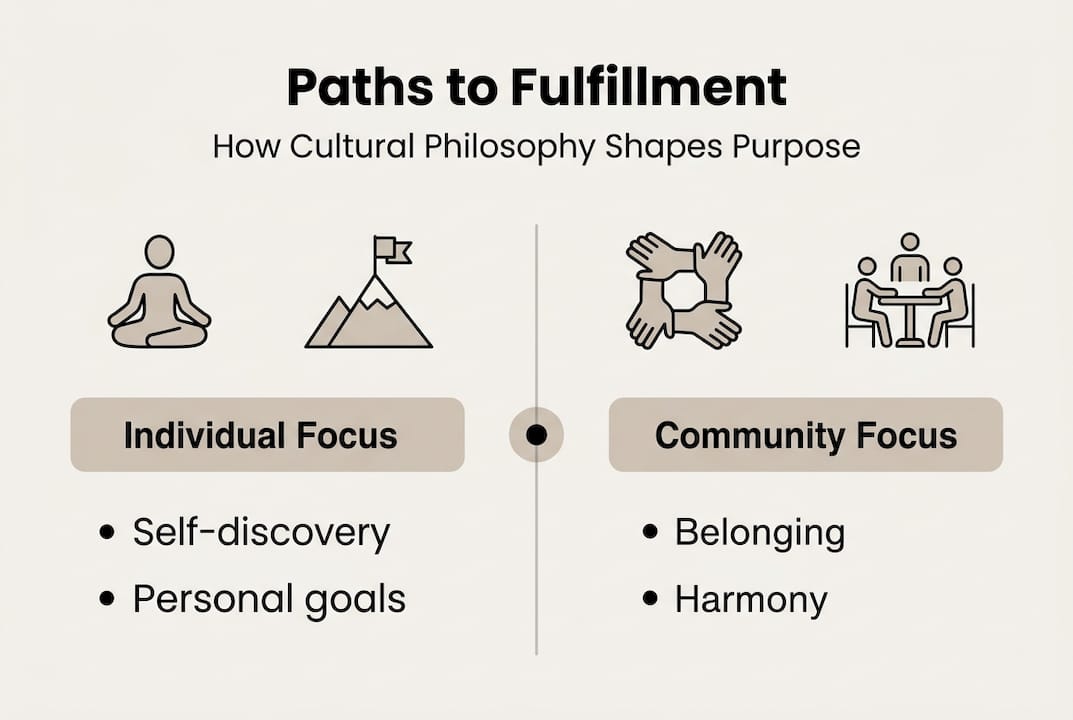
| Dimension | Individualistic cultures | Collectivistic cultures |
|---|---|---|
| Core purpose | Personal achievement | Group harmony |
| Self-concept | Independent, unique | Interdependent, relational |
| Success marker | Individual goals met | Family/community flourishing |
| Growth model | Self-actualization | Self-cultivation |
| Emotional priority | Authentic expression | Social attunement |
For many people, confusion about purpose comes not from lacking ambition but from following a framework that doesn’t match their intrinsic values. A person raised in a collectivistic tradition who chases purely individualistic goals may achieve them and still feel empty. The reverse is equally true.
Pro Tip: Spend 10 minutes writing down your top five life goals. Then ask yourself: are these goals driven by your own inner values, or by a cultural script you absorbed without questioning? The answer will tell you a lot.
The invisible power of cultural participation in well-being
There’s a quieter mechanism at work beyond philosophy and framing: simply participating in cultural life measurably improves psychological health.

A study of 1,516 Chinese youths found that cultural participation enhances psychological well-being through what researchers call transcendent strengths: qualities like gratitude, hope, and nonattachment. These aren’t passive benefits. Engaging in cultural rituals, community practices, arts, and traditions actively builds the psychological muscles needed for resilience and meaning.
| Cultural activity | Psychological strength strengthened |
|---|---|
| Traditional arts and crafts | Gratitude and aesthetic appreciation |
| Community ceremonies | Hope and sense of belonging |
| Contemplative practices | Nonattachment and emotional regulation |
| Storytelling and oral tradition | Meaning-making and identity clarity |
| Group music or performance | Social connectedness and joy |
This is enriching in the deepest sense: culture isn’t decoration on top of well-being. It’s a delivery system for it.
Here are practical ways to increase your cultural participation and reap these benefits:
- Join a community group tied to your cultural heritage or local tradition
- Attend cultural events, festivals, or performances regularly
- Practice a culturally rooted craft, meditation, or movement form
- Explore cultural development tips to find structured programs in your area
- Read philosophy, poetry, or storytelling from your own or adjacent traditions
For those on a mindfulness or personal growth journey, these aren’t extras. They are the soil in which sustainable well-being grows.
Does cultural fit unlock happiness? The science says yes
Beyond participation, alignment between your values and your cultural environment produces measurable gains in happiness, resilience, and life satisfaction.
A study analyzing person-culture religiosity match across 24 countries found that objective match supports social well-being and life satisfaction, while subjective match (feeling that you belong) boosts positive affect. In other words, both actual alignment and perceived alignment matter. You don’t need a perfect fit. You need enough resonance to feel at home in your own values.
Separately, research shows that value balance correlates with higher resilience universally, though the specific values involved differ between cultures like the United States and Japan. This is a key finding: resilience isn’t about having the “right” values in an absolute sense. It’s about holding your values in balance within your cultural context.
Here’s how to assess and improve your own cultural fit:
- Identify your core values. List what matters most to you in life: freedom, loyalty, creativity, duty, connection.
- Map them to your environment. Do your values align with those around you at work, at home, in your community?
- Notice friction points. Where do your values consistently clash with expectations? That friction is informative.
- Explore value diversity. Exposure to multiple cultural philosophies expands your options without requiring you to abandon your own.
- Adjust intentionally. You can’t change your culture overnight, but you can seek communities and practices that honor your values.
Pro Tip: A simple journaling practice asking “What felt meaningful today, and why?” builds self-knowledge about which cultural values actually drive your sense of fulfillment.
Challenging one-size-fits-all: Why universal well-being models fall short
Here’s an uncomfortable truth the self-help industry rarely admits: most popular well-being frameworks are culturally specific, not universal. They were developed primarily within Western, individualistic contexts and then marketed globally as if human psychology were culturally identical everywhere.
Research confirms individualistic vs. collectivistic cultures prioritize fundamentally different paths to self-actualization, meaning that applying the same model to both groups risks mismatch and disillusionment. And at the national level, lower collectivism and power distance correlate with higher national happiness, even after controlling for income. These structural differences shape what works.
"What rescues one person can sabotage another. If the advice contradicts someone's core beliefs—rooted in their culture, family, or history—it won't stick, no matter how sound it looks on paper."
Before adopting any self-help or personal development model, ask yourself:
- Was this framework developed within my cultural context or an entirely different one?
- Does this approach value individual achievement over community in ways that conflict with my worldview?
- Am I feeling worse after following this advice? That’s a signal, not a personal failure.
- Does this model treat emotion, vulnerability, or ambition the way my culture does?
- Can I adapt specific tools from this framework while keeping my cultural philosophy intact?
The goal isn’t to reject all outside wisdom. Exploring purpose and well-being across traditions is genuinely valuable. The goal is to become a critical, self-aware consumer of personal development rather than a passive follower of frameworks that may not fit your life.
Our perspective: Why embracing cultural philosophy is the missing key to fulfillment
After working at the intersection of cultural philosophy and personal development, one pattern stands out clearly: the people who experience real, lasting breakthroughs are not those who follow the most popular advice. They’re the ones who get honest about their cultural context and use it as a starting point rather than an obstacle.
Here’s the contrarian lesson we keep learning: you cannot “hack” fulfillment with imported tools alone. A Japanese philosophy applied to a Western life without adaptation, or a Silicon Valley productivity system imposed on a collectivistic household, will stall. Not because either is wrong, but because customization is the whole point.
The most effective path to purpose-driven living involves blending local wisdom traditions with the best of global insight. Seek out the practices and stories from your own cultural heritage. Then layer in what resonates from other traditions. Don’t replace. Integrate.
Pro Tip: Find one local or ancestral practice, whether a ritual, a philosophy, or a community gathering, and commit to it for 30 days. Notice what shifts in your sense of meaning.
The cultures that have maintained strong well-being across generations didn’t do it with apps or bestsellers. They did it by transmitting lived philosophy from person to person. That transmission is still available to you.
Explore your purpose through cultural philosophy
If this clicks with you, the work starts now. Understanding your ikigai is just the beginning—it's something you revisit and refine, especially when you factor in where you come from and what shaped you.

Ikigain.org exists because clarity doesn't arrive on its own. The Ikigai type test cuts through the noise and shows where your passions, strengths, and values actually collide. Want to understand why ikigai matters? Dig into the philosophy behind it. Stuck on a specific question about purpose? Search our answers. The work of finding direction is real, but the tools don't have to be complicated.
Frequently asked questions
How does cultural philosophy influence personal values?
Cultural philosophy shapes which values are emphasized, such as self-expression in individualistic societies or group harmony in collectivistic ones, directly impacting personal goals and fulfillment. The values you treat as non-negotiable often trace back to inherited cultural frameworks rather than purely individual choice.
Can engaging with cultural traditions improve well-being?
Yes. Cultural participation strengthens psychological health and resilience through transcendent qualities like gratitude and hope. Regular engagement with cultural practices is one of the most underrated tools for sustainable well-being.
What if my personal values don’t align with my culture?
Striving for value balance increases resilience, and even partial person-culture fit supports life satisfaction. Research also confirms that value balance universally correlates with higher resilience, so working toward alignment rather than perfection is both realistic and beneficial.
Are universal approaches to well-being effective for everyone?
No. Universal self-help models can backfire when they conflict with your cultural context. Research shows individualistic and collectivistic paths to fulfillment are fundamentally different, so tailoring well-being strategies to your own cultural philosophy consistently yields better results.