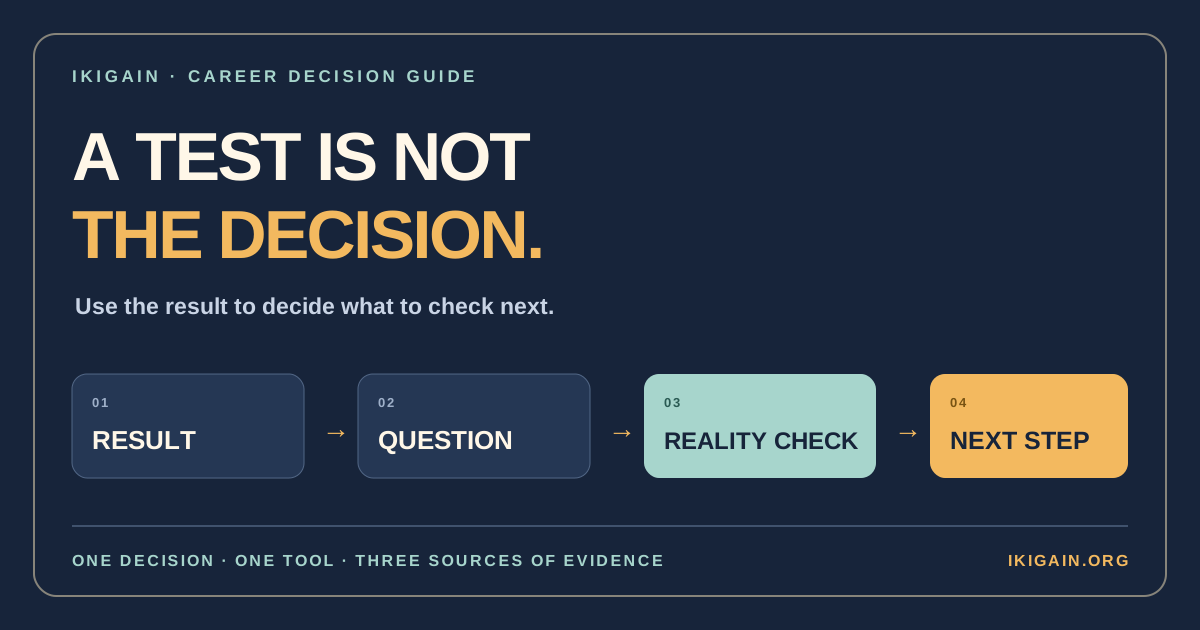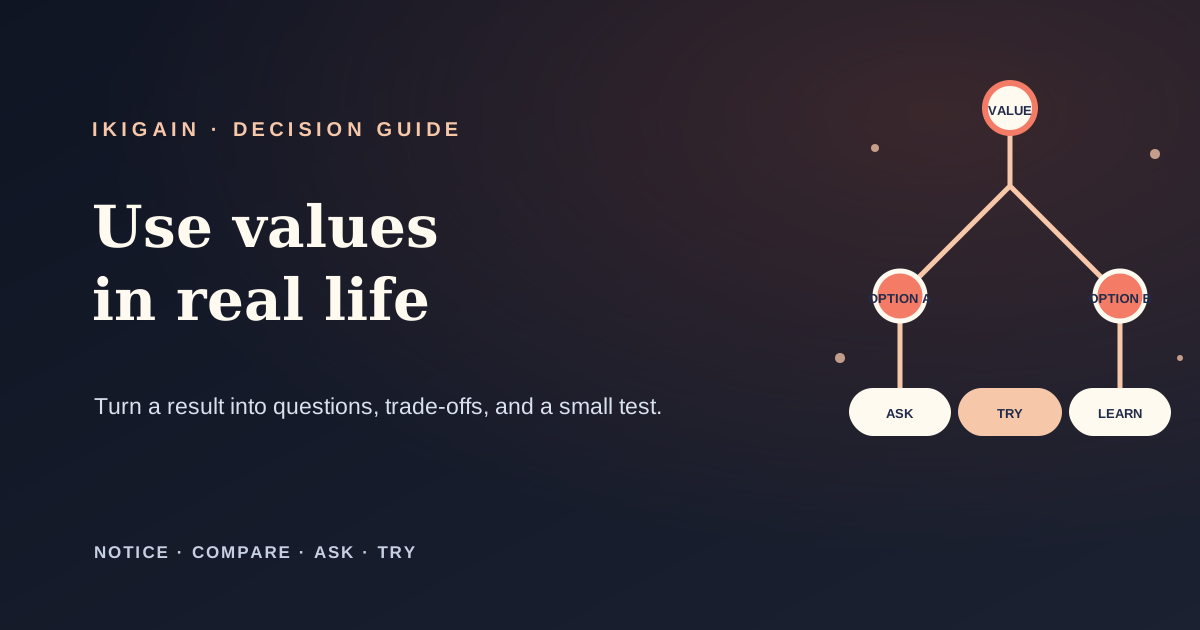
A values test is most useful when you have a decision in front of you and need better questions—not when you want a score to make the decision for you.
You might be comparing two jobs, deciding whether to accept a promotion, or trying to understand why a role that looks good on paper keeps draining you. A result can help you name what matters. The real work is checking whether each option gives those values a realistic place in your week.
This guide gives you a simple way to move from a values result to a decision you can actually test.
What a values test can and cannot tell you
A values test asks which parts of work or life feel important to you. Depending on the tool, it may ask about independence, relationships, achievement, stability, learning, recognition, working conditions, or contribution.
It does not measure your ability, guarantee that a workplace will honour its promises, or predict whether you will enjoy every task in a role. It also cannot remove the practical limits around money, location, health, family, immigration, timing, or the labour market.
That is not a weakness. It is a useful boundary. A values result gives you a language for the trade-off; it does not replace evidence about the option itself.
The archived U.S. O*NET 28.1 work-values data is a good example of the distinction. It describes values associated with occupational environments, including achievement, working conditions, recognition, relationships, support, and independence. An occupational profile is not a promise about one employer or a verdict about one person.
Start with the decision, not the test
Before taking a test, write the decision in one sentence. Make it specific enough that another person could understand what you are choosing between.
Weak question: What career is right for me?
Stronger questions:
- Should I accept this team-lead role or stay in my current position for another year?
- Should I move into a smaller company if it gives me more autonomy but less stability?
- Should I spend six months learning a new skill while keeping my current work?
- Does this opportunity solve the problem I actually have, or only sound impressive?
The clearer the decision, the easier it becomes to use a values result without turning it into a personality label.
Read the result as a priority, not a verdict
Suppose your highest results are independence, learning, and contribution. That does not mean you should become a freelancer, return to school, or leave your current job. It means those conditions deserve attention when you compare options.
Translate each value into a sentence you could observe in a real week:
| Value | More useful translation | Evidence to look for |
|---|---|---|
| Independence | I need room to choose how to complete important work | Decision rights, manager behaviour, and approval rules |
| Learning | I want regular chances to build or apply a skill | Training, feedback, stretch work, and time to practise |
| Contribution | I need to see who benefits from the work | Users, customers, colleagues, or a problem the role improves |
| Stability | I need a predictable base for my responsibilities | Contract, income, schedule, location, and organisational health |
| Relationships | I do better when trust and cooperation are part of the work | Team norms, collaboration, conflict handling, and support |
| Recognition | I need useful feedback and visible acknowledgement | Review process, credit, progression, and examples of fairness |
The translation is the important step. “Independence” can mean flexible hours to one person and authority over decisions to another. “Recognition” might mean public praise, a clear promotion path, or simply knowing that good work is noticed.
Separate a value from the form it takes
People often reject a value because the first version they imagine does not fit their life. You may value independence without wanting to work alone. You may value stability without wanting a repetitive job. You may value contribution without wanting a public-facing role.
Ask three questions for every high-priority value:
- What need sits underneath this word?
- What are two different ways that need could be met?
- What would be a clear sign that it is not being met?
For example:
- Independence may mean control over priorities, a flexible schedule, or freedom to design a solution.
- Learning may mean a mentor, difficult projects, formal study, or contact with a new field.
- Contribution may mean helping a customer, making a process fairer, supporting a team, or building something useful.
This prevents a test from narrowing your options too early. You are looking for conditions, not a single job title that supposedly owns the value.
Compare options with a small decision table
List two or three realistic options. Do not score every detail as if you have precise data. Use a simple scale such as clear evidence, uncertain, or conflict.
| Question | Current role | New role | Small experiment |
|---|---|---|---|
| Where would I have meaningful choice? | |||
| What would I learn in the next six months? | |||
| Who would benefit from my work? | |||
| What would make the option sustainable? | |||
| Which cost am I underestimating? |
Add a short note beside every answer. “The recruiter said there is autonomy” is not the same as “I spoke with two people who make decisions without three layers of approval.” Keep promises, assumptions, and observed behaviour separate.
Your goal is not to find the option with the highest total. It is to see which trade-offs you are making and whether you are making them knowingly.
Use the result to ask better questions
A values result can improve a conversation with a manager, recruiter, colleague, or someone already doing the work. Bring the value in as a question rather than a demand.
If you value independence, ask:
- Which decisions would I own during the first three months?
- When priorities conflict, who decides?
- Can you give me an example of a recent problem someone solved without waiting for permission?
If you value learning, ask:
- What would a strong person in this role learn in the first year?
- How is feedback given after a difficult project?
- Is learning part of the workload, or expected after hours?
If you value contribution, ask:
- Who uses the work, and how do you know it helps?
- What problem is this team responsible for improving?
- Can you describe a change that made someone’s experience better?
Pay attention to the specificity of the answer. A realistic example tells you more than a list of attractive words on a careers page.
Turn one uncertainty into an experiment
If your choice is reversible, test the most important unknown before making a large move. A good experiment is small, time-limited, and connected to one value.
If you are unsure about the work itself
Ask to shadow a meeting, complete a small project, volunteer for a related task, or interview someone who does the work every week. Notice the actual activities, not only the mission statement.
If you are unsure about the environment
Ask a future teammate how priorities change, how disagreement is handled, and what happens when someone is overloaded. Compare their answer with what you observe in the conversation.
If you are unsure about your ability to sustain it
Run a two-week version around your current responsibilities. Protect a small block of time, practise the central task, and record your energy, focus, frustration, and recovery. This is not a prediction of your whole future; it is better information than imagining from a distance.
Write the experiment as a sentence: “I will do X, with Y person or resource, for Z weeks, and look for these signs.”
Do not confuse a value conflict with a bad week
One difficult month does not prove that a role violates your values. A new role can feel uncomfortable while you are learning. A good job can contain tasks you dislike. Context matters.
Look for a pattern across time and situations:
- Does the problem happen only with one project or manager?
- Is the value missing, or is it present in a form you did not expect?
- Could a boundary, schedule change, or clearer responsibility improve the situation?
- What evidence would change your mind?
On the other hand, do not explain away a repeated mismatch forever. If the same important condition is absent, the cost is high, and reasonable changes are not possible, that is decision-relevant evidence.
When your values appear to contradict each other
Most real choices involve tension. You may want autonomy and stability, challenge and recovery time, recognition and privacy, contribution and a higher income. The answer is rarely to find an option that maximises everything.
Name the trade-off plainly:
I am willing to accept less short-term stability for more learning, but I need a financial floor and a review point after three months.
This turns a vague conflict into a condition. You can then ask whether the option meets the floor, whether the experiment is affordable, and when you will reassess.
If a decision affects housing, health, immigration status, debt, or other high-stakes responsibilities, use appropriate professional advice. A self-discovery test should help you prepare questions, not carry the entire decision.
Where the Ikigain Work Values Test fits
The Work Values Test can help you name the conditions you want to examine. Treat the result as a starting map. Write down the top values, translate them into observable conditions, and compare those conditions with a real option.
You can also combine it with an Ikigain personality and self-discovery test or read how to write an ikigai sentence you can actually use. Different tools ask different questions. Agreement can be useful, but disagreement is not a failure; it may show that one tool is describing preferences while another is highlighting conditions.
FAQ: using a values test for decisions
Should I take a values test before choosing a career?
You can, but start by naming the decision first. A result is easier to interpret when you have two real options or a practical question to investigate.
What if my result does not feel accurate?
Check the wording, the context in which you answered, and whether the value means something different to you than the test assumes. Compare it with recent behaviour and ask someone who knows your work well. You do not have to accept a result that does not match your experience.
How many values should I focus on?
Choose two or three for the decision in front of you. Trying to optimise every value at once usually hides the trade-off you actually need to make.
Can a values test tell me whether to quit my job?
No. It can help you identify what is missing and what you want to investigate. The decision also depends on finances, health, relationships, alternatives, timing, and the possibility of changing the current situation.
What should I do after I get my result?
Translate your highest values into observable conditions, ask someone for concrete evidence, and run one small experiment where possible. Revisit the result after you have learned something real.