An online IQ test can show how you performed on a particular set of reasoning questions, under particular conditions, on a particular day. That can be interesting and sometimes useful. It is not automatically a clinical IQ assessment, a diagnosis, a measure of your whole intelligence, or a prediction of your career.
The important question is not only “What score did I get?” It is also:
- What did this test actually measure?
- Was it standardized and normed for people like me?
- Were the time limit, language, device, and setting suitable?
- What decision am I hoping this number will help me make?
An online result is easiest to use when you treat it as a limited observation rather than a permanent identity.
Quick answer
A credible, well-explained online reasoning test may help you practise items involving patterns, logic, verbal relationships, working memory, or processing speed. It may give you a rough indication of how you performed on those tasks compared with the test’s reference group.
Many casual online tests do not provide enough information to support a precise IQ claim. They may use a small or undisclosed item pool, unclear scoring, outdated norms, no meaningful comparison group, or a marketing-oriented interpretation. A polished design is not evidence of measurement quality.
The APA definition of a standardized test highlights two requirements that are easy to miss online: scores need an appropriate comparison group, and the test should be administered, scored, and interpreted consistently. Without that information, a number may describe your performance on that website without meaningfully estimating an IQ score.
What an IQ test is trying to measure
Intelligence tests are designed around specific cognitive tasks. Depending on the instrument, they may sample reasoning, verbal understanding, visual-spatial processing, working memory, processing speed, or related abilities. They are not direct measurements of every useful human capacity.
An IQ score is usually a norm-referenced result. In simple terms, your performance is compared with the performance of a reference group that took the same or an equated test under defined conditions. The meaning of the score depends on how that comparison was built.
That is why the same-looking number can mean different things on two websites. One site may be using a carefully researched instrument with a clear age range and norm group. Another may convert the number of correct answers into a dramatic score using a formula that is not explained. The label “IQ” does not guarantee that the underlying measurement is comparable.
Online tests can still be useful for practice. They can introduce you to matrix puzzles, sequences, analogies, or timed reasoning tasks. They can also reveal which question types you enjoy or where you want to practise. But practice value and assessment value are not the same thing.
What a casual online result may tell you
If the test explains its limits honestly, an online result may help you notice:
- which types of reasoning questions feel familiar or unfamiliar;
- whether time pressure changes your performance;
- whether you prefer verbal, numerical, visual, or abstract problems;
- which strategies help you slow down and check an answer; and
- whether you want to explore a formal assessment or more structured practice.
Those are modest conclusions, but they are often more actionable than a dramatic label. You might learn that you enjoy visual patterns but rush through verbal questions. You might find that your score changes when you are tired or using a small phone screen. You might notice that the challenge is engaging even when the result is not what you expected.
Use observations like these to choose a next step. Do not use them to decide that you are naturally incapable of learning a subject or that one career is closed to you.
What it cannot establish
A casual online IQ test cannot, by itself, establish:
- a clinical diagnosis;
- a learning disability or giftedness determination;
- your complete intellectual profile;
- your future academic or job performance;
- your creativity, judgment, wisdom, motivation, or emotional skills;
- your suitability for a particular career; or
- your value as a person.
Even formal cognitive assessments are interpreted in context. A psychologist or other qualified professional may combine test scores with an interview, history, observations, records, and the specific question being asked. The American Psychological Association’s overview of psychological testing and assessment explains why a formal assessment is broader than a single test score.
This does not make an online result meaningless. It puts the result in its proper size.
Why online conditions affect the result
Reasoning performance is influenced by more than reasoning ability. Before interpreting a score, consider the conditions in which you took the test.
Time pressure
Timed tests measure performance under a time limit. That may be relevant to some tasks, but it also means that speed, pacing, familiarity with the format, and anxiety can affect the result. A person may reason well but lose points by spending too long on one item. Another person may work quickly but make avoidable errors.
Language and cultural context
Verbal instructions, vocabulary, examples, and cultural assumptions can change how easy a task feels. A test translated informally may not be equivalent to the original. A score should not be compared casually across languages or populations unless the test publisher explains how the comparison was established.
Device and interface
A visual puzzle may be easier on a large monitor than on a phone. A lagging connection, unfamiliar controls, glare, or an accessibility barrier can affect performance. If the conditions are not consistent, a difference between two scores may reflect the testing environment rather than a meaningful change in ability.
Practice and repeated exposure
Seeing similar item types can improve your strategy. That can be helpful if your goal is practice, but it complicates interpretation if you are comparing scores as though each attempt were independent. The Mensa IQ Challenge FAQ makes this distinction clearly: an online practice challenge is not the same as an official qualifying test.
Sleep, stress, and attention
Your performance on a particular day is affected by ordinary conditions. Fatigue, illness, stress, interruptions, hunger, medication effects, and attention can all matter. This does not mean that every result is random. It means that a single result should not carry more certainty than the test and the circumstances justify.
How to judge whether an online test is transparent
Before trusting a score, look for answers to these questions:
- What abilities and age ranges is the test intended to measure?
- Who created it, and what qualifications or research are provided?
- What is the norm group, and when was it collected?
- Are reliability, validity, and scoring methods explained?
- Is the score reported as an estimate or presented as absolute certainty?
- Does the site explain language, disability, accessibility, and practice effects?
- Does it distinguish entertainment, practice, screening, and formal assessment?
- Does it clearly explain what the result cannot be used for?
If the site hides the scoring method but promises an exact IQ, be cautious. If the result is locked behind a payment wall after emotionally loaded claims, be cautious. If the test says that one score proves you are destined for a career, be very cautious.
Transparency is not a guarantee of quality, but a lack of transparency is a meaningful limitation.
A founder note from Sindy’s search for ikigai
When I was looking for ikigai, I noticed how tempting it was to make a score responsible for a much larger question: “What does this say about my future?” I find a reasoning result more useful when it stays small—one clue about a task, not a verdict about my direction.
That is the same approach I use with other self-reflection tools. The result can open a question, but a real activity usually teaches you more about a possible path than another label does.
How to use your result without overinterpreting it
1. Save the conditions, not only the number
Record the date, test name, language, device, time limit, and whether you were rested or distracted. Save the report if it explains the scale and comparison group.
Without this context, a score becomes difficult to interpret later.
2. Identify the item types
Write down whether the test was mostly visual patterns, arithmetic, vocabulary, analogies, memory, or timed sequences. A result on one narrow format should not be described as a complete measure of intelligence.
3. Separate confidence from curiosity
Ask what you know and what you are merely curious about.
| If the result shows… | A careful interpretation is… |
|---|---|
| A strong performance on visual patterns | I performed well on these visual reasoning items under these conditions. |
| A lower result than expected | This format or situation was difficult; I should investigate why before making a broad conclusion. |
| A large change from a previous score | The tests or conditions may differ; compare their methods before interpreting the change. |
| A result that feels flattering | It may still be useful, but I should check the evidence and avoid turning it into an identity. |
4. Choose a grounded next action
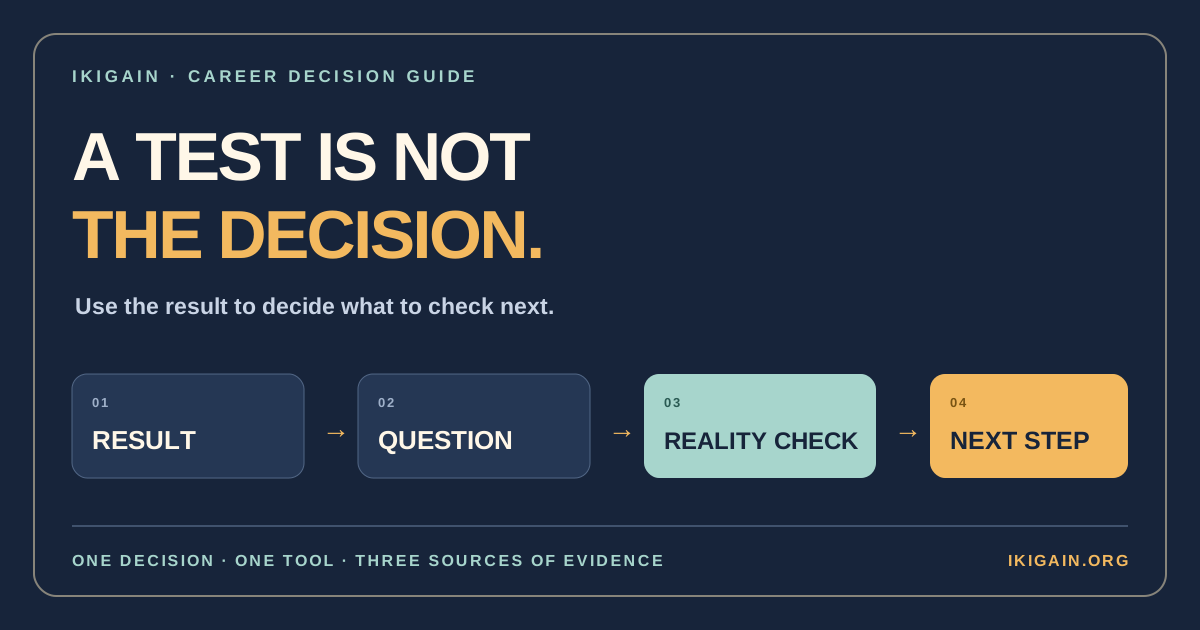
If you enjoyed the questions, practise a skill or explore a subject. If you are worried about learning or functioning, write down the concrete difficulty and seek an appropriate professional conversation. If you are making a career decision, compare the result with interests, values, skills, and real job conditions.
The Reasoning Skills Test can be a reflection starting point. The IQ Test offers another way to explore reasoning questions on Ikigain, but neither should be described as a clinical or official IQ assessment.
For background, compare the guides on how IQ tests work, whether online IQ tests are accurate, and how to read an IQ score chart. These pages are starting points for questions, not substitutes for a formal assessment.
What IQ has to do with career decisions
Reasoning ability can matter in education and work, but a career is not an IQ leaderboard. Jobs differ in the abilities they require, the training they provide, the amount of support available, and the outcomes used to judge performance. Motivation, interests, communication, persistence, health, teamwork, values, and opportunity also shape whether a path is workable.
If you are asking “Am I smart enough for this career?”, try breaking it into questions you can investigate:
- What tasks does this role actually involve every week?
- Which skills are required on day one, and which can be learned?
- What training or support is available?
- Which parts of the work interest me enough to practise?
- What conditions would make the role sustainable?
The first-test guide on the Ikigain blog explains why different assessments answer different questions. A reasoning test may be relevant to one question, while an interest, values, or personality tool may be more useful for another.
Do not let an online number disqualify you before you have examined the actual work. Do not use a high number as a reason to ignore your interests, support needs, or practical constraints.
When to seek a formal assessment
Consider a qualified assessment when you need an answer for a specific educational, clinical, workplace, or accommodation decision and the result will materially affect what happens next. Ask who is qualified to administer and interpret the assessment in your location, what instrument will be used, what it measures, and how the result will be explained.
An online quiz is not a substitute for that process. It may help you formulate the question you want to ask, but it should not be used to self-diagnose or to diagnose another person.
If a score causes intense worry, shame, or pressure, pause before taking more tests. Talk with someone you trust or a qualified professional who can help put the result in context. Your reaction is important information, but it is not evidence that the score defines you.
FAQ
Is an online IQ test accurate?
Some online tests may be carefully designed, but accuracy depends on the instrument, norms, administration, scoring, and intended use. Many casual tests do not provide enough evidence for a precise IQ interpretation. Check the methodology and treat an unexplained score as practice or entertainment rather than a formal assessment.
Can an online IQ test diagnose giftedness or a learning disability?
No. A casual online result cannot establish a diagnosis or an eligibility decision. Those questions require an appropriate, properly administered assessment and interpretation in context by a qualified professional.
Why did my IQ score change when I retook the test?
The tests may use different items, norms, time limits, or scoring rules. Your sleep, stress, attention, language, device, and familiarity with the format may also change. Compare the methods and conditions before treating the difference as a change in ability.
Does a high IQ score tell me which career to choose?
No. It may describe performance on some reasoning tasks, but career decisions also involve interests, values, skills, working conditions, opportunity, health, and training. Use the score to ask a narrower question, then investigate the actual work through conversations and small experiments.
Final takeaway
An online IQ test can be a puzzle, a practice exercise, or a limited clue about how you performed on a particular reasoning task. It becomes misleading when a website turns that clue into a promise about your identity, diagnosis, or future.
Keep the result in proportion. Check how the test was made, record the conditions, notice what the questions teach you, and connect the result with real-life evidence. A number can start a useful question. It cannot answer your whole life.