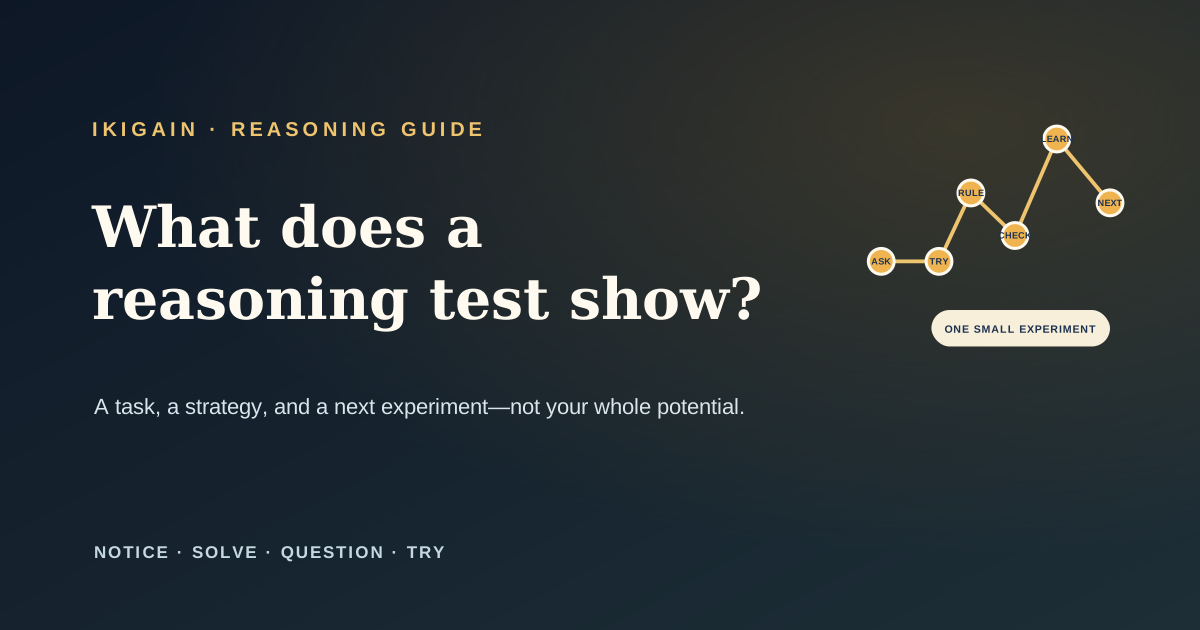
A reasoning test shows how you approached a particular set of problems under particular conditions. It may offer clues about patterns such as verbal, numerical, logical, or abstract reasoning. It does not measure your entire intelligence, your value, your future, or everything you could learn with time and support.
That distinction matters because online tests often present a single number as if it were a complete explanation. A result is more useful when you read it as evidence about a task: what kind of item did you solve, what strategy did you use, and what should you investigate next?
Quick answer: a reasoning test samples problem-solving
Reasoning tests typically ask you to identify relationships, continue a pattern, compare information, infer a rule, or choose the most defensible answer. Depending on the test, the items may use words, numbers, shapes, sequences, or short scenarios.
The result reflects the combination of:
- the abilities the test chose to sample;
- the difficulty and wording of its items;
- your familiarity with the format;
- your time, attention, language, device, and testing conditions; and
- the scoring and comparison method.
The APA overview of psychological assessment distinguishes a test from a wider assessment that can combine tests, interviews and observations. A short reasoning quiz provides only part of that picture.
Reasoning is not one single ability
People use the word “reasoning” to describe several kinds of mental work. A person may be comfortable detecting a visual pattern but need more time with dense verbal instructions. Someone else may explain a complex idea clearly and dislike timed numerical items.
Common reasoning formats include:
| Format | What the task may ask you to do | Useful follow-up question |
|---|---|---|
| Verbal | Compare meanings, infer a conclusion, or identify a relationship between words | Was the difficulty the reasoning or the vocabulary? |
| Numerical | Recognise a sequence, estimate a relationship, or apply a rule | Did arithmetic fluency affect the reasoning task? |
| Abstract or figural | Detect a transformation, pattern, or missing element in shapes | Which visual change did you notice first? |
| Logical | Combine conditions and determine what follows | Did you translate the wording into a clear structure? |
| Spatial | Imagine rotation, arrangement, or movement | Did the format feel familiar enough to show your strategy? |
These formats overlap, but they are not interchangeable. A score from one type of item should not be stretched into a claim about every kind of thinking.
What a score can tell you
Within the limits of the instrument, a result can help you notice:
- which item formats felt clear or confusing;
- whether you tend to rush, over-check, or change a correct answer;
- which strategies helped you find a rule;
- where practice with the format changed your performance; and
- which kind of problem you would like to learn more about.
If the test has transparent scoring and appropriate comparison information, it may also place your performance relative to a stated reference group. Read that comparison carefully. “Above average” only has meaning in relation to the items, the group, the conditions, and the purpose of the test.
An online result can be a useful starting point for self-observation. It is not automatically a standardized clinical assessment or an employment qualification.
What a score cannot tell you by itself
A reasoning score cannot establish:
- how intelligent you are in every setting;
- how creative, socially perceptive, motivated, wise, or practical you are;
- whether you will succeed in a particular career;
- whether you have a learning or mental-health condition;
- how much you could improve with instruction and practice; or
- what you should do with your life.
Reasoning is one part of human functioning. Learning opportunities, prior knowledge, language, sleep, stress, sensory conditions, disability access, motivation, and familiarity with the task can all affect performance. A lower result may tell you that the task was difficult in that setting. It does not explain the entire reason.
Why timing changes the interpretation
Timed tests mix reasoning with speed, attention, and the ability to work under a particular constraint. That may be appropriate if the test is designed to measure speeded performance. It becomes misleading when the result is presented as a pure measure of potential.
Before interpreting a timed score, note:
- how long you had for each item or the whole test;
- whether unanswered questions were penalized;
- whether you could revise an answer;
- whether the instructions were clear in your language; and
- whether the device or connection affected the experience.
A person who solves an item correctly with more time has demonstrated a different performance pattern from someone who solves it quickly. Neither pattern is a complete account of the person.
Why practice can raise a result
When you see a format more than once, you may learn the format itself. You may recognise common sequence structures, understand what the instructions expect, or become faster at ruling out weak answers. That improvement is real, but it is not necessarily the same as a broad change in reasoning ability.
If you retake a test, keep the first result and record what changed:
- Did you remember specific items or only the general strategy?
- Did you practise the underlying skill or the test format?
- Were the time, language, device, and instructions comparable?
- Did your sleep, stress, or motivation differ?
Use the difference as information about learning and conditions, not as proof that one score is the “real” you.
Read the item experience, not only the final number
After a test, write down three items or item types that taught you something. For each one, ask:
- What information did I notice first?
- What rule did I assume?
- At which step did I get stuck?
- Did I have the knowledge but run out of time?
- What would I try differently next time?
This turns a score into a small study of your process. If you are learning a new skill, that process information may be more actionable than the number at the top of the result page.
Reasoning test, IQ test, and intelligence assessment are not synonyms
Online services use these terms inconsistently. A short reasoning quiz may call itself an IQ test without providing the standardisation, reliability information, administration conditions, or professional interpretation expected of a formal assessment.
An IQ score usually refers to a standardised interpretation of performance across a defined test battery and reference population. The label alone does not prove that an online test has equivalent evidence. The APA’s information about testing and assessment is a useful reminder that tests measure particular attributes for particular purposes, and that appropriate use matters.
On Ikigain, the IQ Test and Reasoning Skills Test are self-discovery tools. The IQ Test methodology explains the intended scope and limits of that experience. These tools can give you a structured task and prompts for reflection; they are not clinical diagnoses, school placement decisions, employment screens, or proof of a fixed intellectual ceiling.
A result such as 14 of 20 correct — 70% describes accuracy on those questions. It is not an IQ of 70 or a population percentile. Converting correct answers into a standardized IQ score requires suitable norms and evidence; a percentage alone does not supply either.
How to use your result without overreading it
Keep the claim as small as the evidence
“I found visual sequences easier than verbal analogies in this test” is a defensible observation. “I am naturally intelligent but not creative” is a much larger claim that the result cannot support.
Connect the result to a real activity
If the result makes you curious about data, programming, design, writing, or research, try a small representative task. Look at your attention, persistence, questions, and learning—not just whether the first attempt felt easy.
Separate skill gaps from identity stories
A difficult item may reveal unfamiliar vocabulary, missing background knowledge, limited practice, or a strategy that you have not learned yet. Treat the gap as a place to investigate before treating it as a permanent label.
Use conditions as part of the evidence
Record the time of day, interruptions, language, accessibility needs, and emotional state. These details do not make the result meaningless; they tell you what the result actually describes.
Choose one next experiment
Practise one item format, ask someone to explain a strategy, try an untimed version, or compare the same skill in a real project. Then record what changed and what stayed difficult.
When a formal assessment is the right next step
An informal online test cannot answer every question. If the result relates to an educational accommodation, clinical concern, disability assessment, legal matter, or high-stakes placement decision, seek a qualified professional who can select and interpret an appropriate instrument.
This is especially important when a score may affect access to support. A casual result should not be used to deny help, make a diagnosis, or decide what someone is capable of learning.
If you are simply curious about how you approach certain problems, a self-discovery tool can be a reasonable first step. Keep the purpose modest and the follow-up practical.
A 15-minute reflection after the test
Use this short note after seeing your result:
- The task: Which item type did I complete most comfortably?
- The strategy: What did I try before choosing an answer?
- The friction: Was the obstacle reasoning, knowledge, language, speed, attention, or uncertainty?
- The transfer: Where might I use or develop this kind of thinking in real life?
- The experiment: What one small activity would give me better evidence?
Do not turn the reflection into a second score. Its purpose is to move from a broad label to an observable process.
FAQ: what reasoning tests show
Does a reasoning test measure IQ?
It may measure some reasoning tasks that appear in intelligence assessments, but the label depends on the instrument, its standardisation, and the intended use. A short online quiz should not automatically be treated as equivalent to a formal IQ assessment.
Can a low score mean I am not intelligent?
No. It means you performed in a certain way on that task under those conditions. Language, time pressure, stress, unfamiliar formats, knowledge, access needs, and many other factors can affect performance.
Can reasoning ability improve?
People can learn strategies, knowledge, and skills, and performance can improve with practice or better conditions. A change in score does not by itself show which factor changed, so look at the task and process as well as the number.
Should I use an online IQ result to choose a career?
No. A career decision needs interests, values, skills, responsibilities, opportunities, and direct experience of the work. A reasoning result can suggest a skill to explore, not select an occupation.
How should I compare two reasoning-test results?
Use the same instrument and instructions where possible, note the conditions, compare item patterns before labels, and avoid treating small differences as dramatic change. Ask what each result can actually support.