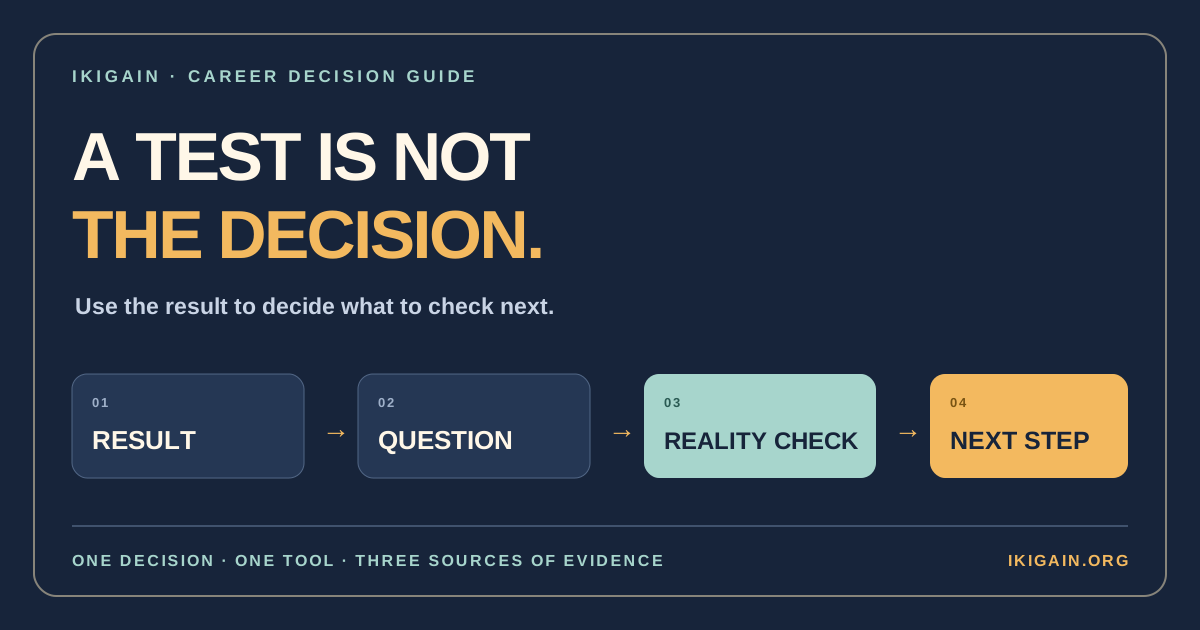
Self-discovery tests can help with a career decision when you use them to identify what to investigate next. They cannot choose a profession, employer, course, or resignation date for you. A useful sequence is simple: name the decision, take the test that addresses the missing information, rewrite the result as a testable question, and check it against a real task or work setting.
That boundary matters. “You are an Investigative type” sounds like an answer. “Do I enjoy gathering evidence when the question is messy and the work becomes repetitive?” is a question you can take into the world.
You do not need a battery of quizzes. You need one result that changes the next piece of research.
The short version: match the test to the blockage
| Where you are stuck | Tool that may help | Keep from the result | Check outside the test |
|---|---|---|---|
| “I cannot think of activities I want to explore.” | Career interests | Two or three activity families and their verbs | Tasks in real job descriptions |
| “Both options interest me, but they would shape my life differently.” | Work values | The condition or trade-off separating the options | Schedule, autonomy, support, pay, and workload |
| “I am unsure how I prefer to work with people or problems.” | Personality | A tentative work-style question | Behaviour across several settings |
| “I know the direction but cannot see what I bring.” | Strengths reflection | A repeated contribution with a recent example | Work samples, feedback, and the skill still missing |
| “The option is sensible, but I do not know whether it matters to me.” | Ikigai or purpose reflection | A question about enjoyment, contribution, growth, or support | A conversation or small commitment in that direction |
If you already know the missing fact—perhaps the role's hours, entry requirements, or daily amount of customer contact—research that fact first. Another questionnaire will not reveal an employer's calendar.
Start with a decision sentence
“What career is right for me?” contains too many hidden choices. It may mean choosing between two offers, finding a first field to explore, deciding whether to train, or trying to improve a role you already have. A test cannot help until you separate those decisions.
Write one sentence before you answer any questions:
By [date], I want to decide whether to [specific next move] by comparing [two or three real options].
Here are three usable versions:
- By 30 September, I want to decide whether to request an internal move or begin an external search.
- Before course enrolment closes, I want to compare user research and learning design through one real task from each.
- This month, I want to decide whether the problem is my occupation or the conditions at my current employer.
The sentence does not have to be elegant. It has to name a decision you can recognise when you reach it. “Find my purpose” is too broad for this job. “Choose two people to interview about community health roles” is not.
Choose the missing evidence, not your favourite quiz
Tests are often grouped together on websites, but their outputs are not interchangeable. Look at what each instrument was designed to elicit before you trust the report language.
Interests open activity options
An interest result helps when the page is blank. The Ikigain Career Interests Test uses the 30 activity items from the O*NET Mini-IP and returns six separate RIASEC scores. The official O*NET Interest Profiler documentation describes the instrument as a career-exploration tool for identifying broad work-related interests and connecting them with occupations.
The useful unit is not the occupation at the top of a list. It is the activity underneath it. Investigative work may involve diagnosing a fault, analysing a dataset, comparing sources, or testing a hypothesis. Social work may involve teaching, listening, facilitating, treating, or coordinating. Two people with a similar broad score can dislike each other's working day.
Keep two or three verbs. Then find where those verbs appear in actual roles.
Values separate attractive options
Values become useful after you have plausible choices. The Ikigain Work Values Test is an original exercise with 21 pairwise comparisons across seven work conditions. It asks you to make uncomfortable choices between desirable things such as stability, autonomy, development, contribution, connection, respectful support, and sustainable pace.
The result does not certify an employer. If “autonomy” ranks highly, it gives you a question: Which decisions would I own after the first three months? If “sustainable pace” matters, ask how many projects stay open at once and what happens during an urgent week. A careers page saying “flexible” is not evidence of either condition.
Personality suggests a work-style question
A broad trait result can help you notice patterns in stimulation, planning, communication, or reactions to uncertainty. The Ikigain Big Five Personality Test reports continuous trait scores rather than assigning a four-letter career identity.
Translate the score cautiously. Higher extraversion does not prove that sales will suit you. Lower extraversion does not rule it out. The better question is whether repeated client contact gives you usable energy, drains you, or depends on the format. A person may enjoy a prepared workshop and dislike an open networking event. The context is part of the evidence.
Strengths need episodes, not flattering nouns
The Strengths in Action Test asks about the previous eight weeks and looks for repeated contribution, energy, and self-reported signs of usefulness. It is an original reflection tool in validation, not an objective measure of talent and not a substitute for a work sample.
If a result says that you often create clarity, retrieve the messy document, decision, or conversation in which that happened. Who used the clearer version? What changed? Did the work energise you, or were you simply capable of enduring it? A strength claim becomes valuable when it produces an example and exposes the next skill to build.
Purpose reflection checks whether the direction is worth carrying
The Ikigai Test can prompt questions about enjoyment, contribution, development, and practical support. It is not a Japanese formula for one perfect job, and it cannot calculate meaning from four circles. Use it when an option looks rational on paper but you have not examined why you would keep showing up for it.
Purpose may live partly outside paid work. That is not a failed career decision. It may free you to choose a decent, sustainable job without demanding that one role provide identity, community, service, creativity, and income at once.
Turn the result into a claim you can disprove
Copy one part of the report—not the whole profile—into a five-column note.
| Result signal | Working hypothesis | A counterexample | External fact needed | Next check |
|---|---|---|---|---|
| “Investigative activities are high.” | I may enjoy finding evidence when the answer is uncertain. | I abandoned two long research tasks after the novelty wore off. | How much of role A is analysis versus reporting and administration? | Ask an analyst to describe last Tuesday; complete a two-hour sample task. |
| “Sustainable pace matters.” | I may prefer predictable workload over rapid promotion. | I handled a launch month well when the goal felt important. | How often does role B require evenings, and who controls deadlines? | Ask for a concrete example during the interview. |
| “Creating clarity appears repeatedly.” | I may contribute by turning confusion into usable structure. | I avoid explaining ideas live to large groups. | Does the role reward written clarification or mainly live facilitation? | Rewrite one real brief and request feedback. |
The counterexample is important. Without it, the worksheet becomes a sales pitch to yourself. You are not trying to defeat the result; you are finding its boundary.
The Standards for Educational and Psychological Testing make a useful distinction here: the precision required rises when a decision is consequential and difficult to reverse, while corroboration from other sources reduces reliance on a single score. A free reflection tool can reasonably guide a low-cost experiment. It should not carry a resignation, expensive degree, or employment decision by itself.
Compare ordinary Tuesdays, not career labels
Imagine Maya is considering customer success and learning design. Both seem “people-focused and creative.” That description is too polished to choose between them.
She opens six detailed job descriptions—three for each direction—and marks recurring tasks. Customer success includes live calls, account follow-up, product troubleshooting, renewal conversations, and switching between clients. Learning design includes interviewing subject experts, organising material, drafting activities, revising after feedback, and long periods in production tools.
Now the choice has texture. Maya's interest result gives her verbs: explain, organise, investigate. Her values result adds a condition: enough uninterrupted time to finish a piece of work. Neither result chooses learning design. Together they identify what she must verify.
She speaks with one person in each role. The learning designer explains that stakeholder revisions can be fragmented and political; the customer-success manager says some teams protect focus time and divide reactive support from strategic accounts. The tidy contrast disappears. Good. Reality has improved the question.
Maya then builds a short onboarding lesson from a complicated help article and asks two people to use it. She also shadows a client call and writes the follow-up. Afterward, she can compare attention, frustration, feedback, and the desire to try again. That evidence is still incomplete, but it is closer to work than a label.
The UK's National Careers Service places its assessment beside job profiles, courses, and access to an adviser. That layout captures the right relationship: self-assessment begins exploration; occupational information and conversation continue it.
Build a three-evidence decision packet
Before making a costly move, collect one item from each row.
1. Self-report evidence
Keep the result sentence and the date you took the test. Note anything unusual about the context: exhaustion, a recent conflict, unemployment, a promotion, or an intense project. Your answers are real, but they are answers from a particular moment.
2. Work evidence
Find a sample from your history or create a small one now. It might be a presentation, a spreadsheet, a repaired process, a difficult conversation, a workshop, a research note, or a prototype. Ask what you did, whether it was useful, what it cost in energy, and what you would willingly improve.
3. Market and setting evidence
Read several job descriptions, not one. Check entry routes, training time, location, pay range, tools, and work context. Speak with someone close enough to the role to describe routine inconveniences, not only the mission. If you are comparing employers, investigate the team and manager rather than treating an occupation as one universal environment.
This packet ends with an action plan. In the OECD's Survey of Career Guidance for Adults, only 51% of users reported receiving a personalised career-development roadmap. The report found that receiving one was associated with a 25% higher probability of employment outcomes and a 7% higher probability of entering education or training. Those are survey associations, not proof that the document caused the outcome. Still, they support a practical point: reflection should leave the page as a sequence of actions, not remain a profile.
The OECD report on adult career guidance also describes self-assessments alongside interviews, labour-market information, skills profiling, and personalised plans. A serious career process is a bundle of evidence.
Scale the evidence to the size of the decision
Not every career choice deserves the same research burden.
| Decision | Reasonable evidence before acting |
|---|---|
| Save three roles to investigate | One relevant assessment result and a task scan |
| Contact a professional or attend an event | A specific question you cannot answer online |
| Pay for a short course | Course outcomes, one sample lesson, and two independent reviews |
| Reduce paid hours for a trial | A written budget, time limit, learning goal, and exit condition |
| Resign, relocate, or fund a long qualification | Multiple conversations, real task exposure, financial scenarios, and advice suited to your situation |
Reversible steps are underrated. A conversation can overturn a stereotype in thirty minutes. A sample task can reveal that you love the problem and hate the tool. A weekend project may show that the work is satisfying but not at the pace you imagined. None of these experiences requires pretending that the first result was wrong.
Know when to stop taking tests
Take another assessment only if it answers a different unresolved question. An interests result followed by a values exercise may be sensible because one opens activities and the other compares conditions. Five personality quizzes with different labels usually do not add five kinds of evidence.
Stop and move to the world outside the screen when:
- you can already name two realistic options;
- the same themes keep returning in different language;
- you are retaking tests until one approves the option you prefer;
- a score has made the decision feel more urgent but not more specific;
- the next unknown belongs to an employer, course, occupation, or budget;
- you have not yet tried even ten minutes of the activity being discussed.
If results increase anxiety or begin to feel like a verdict on your worth, close the report. These tools are not clinical assessments, and career uncertainty is not a personal defect. A qualified careers adviser can help you organise information; suitable health support matters when distress extends beyond the decision itself.
A 20-minute result-to-action review
Set a timer and use one sheet of paper.
Minutes 0–3: write the decision. Name the deadline and no more than three options.
Minutes 3–7: choose one signal. Copy the exact result sentence or score that changes how you see the decision.
Minutes 7–11: write the opposite evidence. Record one situation that does not fit the result. This prevents the profile from becoming an identity.
Minutes 11–15: identify the owner of the missing fact. Is the answer in a job profile, with a practitioner, inside a course, at an employer, in your finances, or in a task you need to attempt?
Minutes 15–20: book the smallest check. Send the message, save the task, schedule the call, or put the trial in your calendar. Add a date for reviewing what you learned.
Your final sentence should be concrete: “Before Friday, I will compare the actual weekly tasks in three research-operations roles and ask one practitioner which task newcomers underestimate.” That is a modest sentence. It can move.
FAQ
Can a self-discovery test tell me which career to choose?
No. It can highlight interests, values, preferences, or repeated behaviours that deserve investigation. The career decision also requires evidence about tasks, entry routes, work conditions, resources, and the particular setting.
Which career test should I take first?
Take the test that matches the missing information. Use interests when you need activity ideas, values when you are comparing conditions, personality when a work-style pattern is unclear, and strengths reflection when you need recent examples of contribution. Research first if the unknown is already an external fact.
What if a suggested career does not appeal to me?
You do not need to accept it. Look underneath the title for the activity or interest theme that produced the suggestion. Keep the useful verb, discard the poor match, and search for another setting where that activity appears.
Should I retake a test before changing careers?
Retake it when the earlier result is old, your circumstances have changed materially, or the instrument answers a new decision question. Do not retake it merely to obtain a more reassuring label. Compare any change with recent behaviour and context.
How many tests are enough for one career decision?
Often one is enough to start. A second can help if it examines a genuinely different layer, such as values after interests. After that, a conversation, work sample, job-profile comparison, or small experiment usually adds more decision-relevant evidence.
Let the test improve the next question
A career test earns its place when it changes what you inspect, ask, or try. Keep one signal. Find its counterexample. Compare ordinary work. Then choose a reversible next step with a date.
The goal is not to discover a label strong enough to remove uncertainty. It is to reduce the uncertainty that matters, one piece of evidence at a time.