
TL;DR:
- Grit, combining passion and perseverance, predicts long-term success better than talent alone.
- True passion is a sustained, internal interest that persists despite setbacks, not just excitement.
- Integrating the Japanese concept of ikigai helps find purpose in small daily activities for lasting fulfillment.
Most people assume talent is destiny. You're either born with it or you're not—end of story. But that's not what the evidence shows. Grit, defined as perseverance and passion for long-term goals, actually predicts success better than IQ or natural ability. This matters because it means your career and life aren't locked in by what you happened to be good at age ten. In this article, we'll look at what passion actually is, why it moves the needle on fulfillment, what the Japanese concept of ikigai brings to the table, and how to start using this today.
Table of Contents
- Why passion matters more than talent
- Understanding the true nature of passion
- Integrating passion and Japanese philosophy for lasting success
- Turning passion into results: Practical frameworks and strategies
- The overlooked secret: Passion’s real role in success
- Ready to unlock the power of passion?
- Frequently asked questions
Key Takeaways
| Point | Details |
|---|---|
| Passion drives success | Grit and passion together outperform talent or IQ alone in predicting achievement. |
| Ikigai philosophy | Daily purpose and small passions can provide deep fulfillment and even promote longevity. |
| Actionable strategies | Blending passion with perseverance and practical frameworks helps turn dreams into real results. |
| Passion can be quiet | You don’t need bold or flashy ambitions—meaningful, steady passions matter most. |
Why passion matters more than talent
Talented people fail every day. Athletes with extraordinary physical gifts burn out in their twenties. Gifted students drop out before graduation. Brilliant professionals stagnate mid-career. The missing ingredient is rarely more talent. It’s passion paired with the persistence to keep going when things get hard.
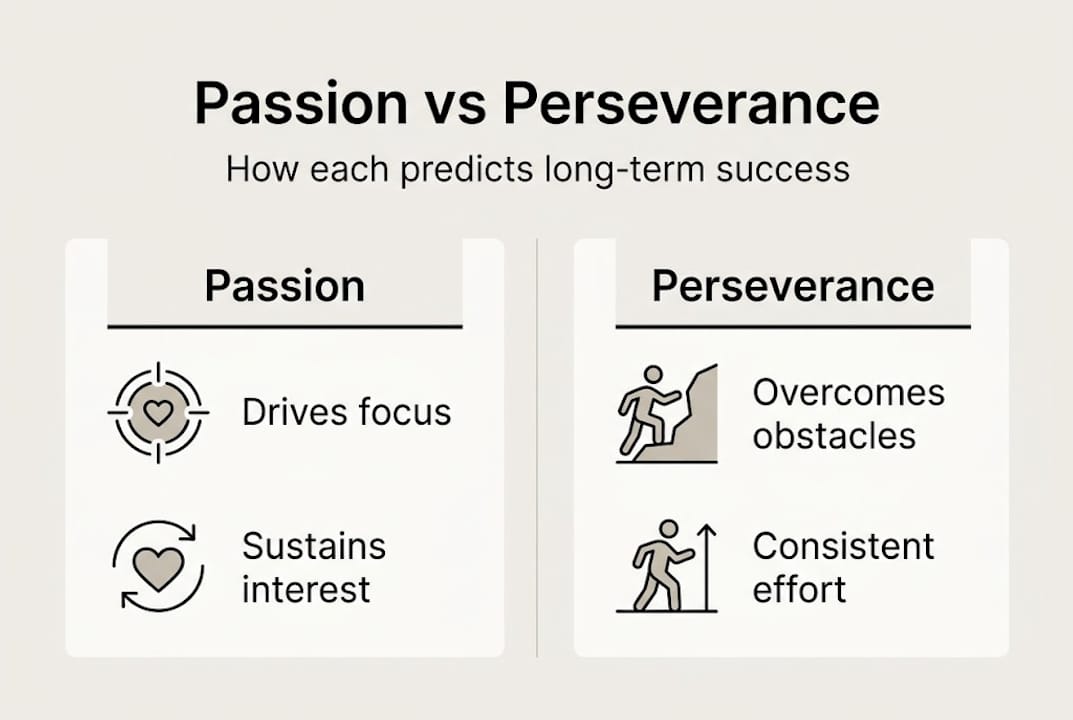
Psychologist Angela Duckworth popularized the concept of grit as the combination of sustained passion and perseverance toward long-term goals. Her research didn’t just confirm a hunch. A meta-analysis of 127 studies involving over 45,000 participants found that grit, especially when passion is present, predicts job performance, academic GPA, and competitive success at levels that raw talent simply cannot match.
Consider this comparison:
| Factor | Predicts short-term output | Predicts long-term success |
|---|---|---|
| Raw talent | High | Moderate |
| IQ | Moderate | Moderate |
| Grit (passion + perseverance) | Moderate | Very high |
| Passion alone | Low | Moderate |
| Perseverance alone | Moderate | High |
The data is striking. Grit consistently outperforms talent when the timeline extends. West Point cadets with higher grit scores were significantly more likely to complete the grueling first summer training than those with higher aptitude scores. That’s not a small detail. That’s passion literally carrying people through situations where talent hits its wall.
"Passion makes you want to keep going. Without it, you're just grinding. With it, the hard parts become something worth remembering."
Here’s what the research dispels about common myths:
- Myth: Talented people are naturally motivated. Reality: Talent without passion leads to underperformance and early burnout.
- Myth: Hard work alone is enough. Reality: Effort without passion is unsustainable over years and decades.
- Myth: Passion is a luxury. Reality: Grit and perseverance are practical predictors of outcomes, not just feel-good concepts.
- Myth: Success requires innate genius. Reality: Consistent, passion-driven effort compounds over time in ways genius rarely does.
Passion doesn’t make the hard days disappear. What it does is give those hard days meaning. That shift from pointless struggle to meaningful challenge is what keeps high achievers moving forward long after others have quit.
Understanding the true nature of passion
Here’s where many people get it wrong. Passion is not the electric buzz you feel when you first discover something exciting. That feeling is enthusiasm, and it fades. Real passion is something quieter, more durable, and far more useful.
True passion is a sustained, deep interest in something that keeps pulling you back even after the novelty wears off. It doesn’t always look dramatic. It often looks like a person who keeps returning to the same kind of work, hobby, or question year after year without being forced to.

Compare the two:
| Feature | Fleeting excitement | True passion |
|---|---|---|
| Duration | Days to weeks | Months to years |
| Motivation source | External novelty | Internal meaning |
| Response to setbacks | Abandon quickly | Persist and adapt |
| Energy pattern | Spikes and crashes | Steady and renewable |
| Outcome | Scattered effort | Compounding progress |
Japanese culture captures this distinction beautifully through the concept of ikigai explained as your reason for getting up in the morning. Ikigai doesn’t demand that your passion be grand or career-defining. A retired teacher who tends her garden every morning with care and attention has ikigai. A factory worker who takes quiet pride in precision has ikigai. Purpose lives in the small and the daily, not just the spectacular.
This is a critical insight that western productivity culture often misses. Life fulfillment with ikigai is not reserved for entrepreneurs and visionaries. It belongs to anyone who finds meaning in what they do, regardless of scale.
Pro Tip: Write down three activities you return to voluntarily, without being asked or paid. Look for the pattern in why you return. That pattern is a clue to your passion.
Here’s how to distinguish real passion from excitement:
- Ask yourself if you still care about it after a frustrating experience with it.
- Notice whether you think about it without prompting during unrelated moments.
- Check whether you’re drawn to learn more about it even when there’s no reward.
- Observe whether it connects to your values, not just your desires.
- See if it gives you energy rather than only taking it.
As grit meta-analysis insights confirm, passion without perseverance often leads to failure. But the flip side is equally true. Perseverance without passion becomes a grind that wears people down. The two are not separate virtues. They’re partners.
Integrating passion and Japanese philosophy for lasting success
When you combine the science of grit with the philosophy of ikigai, something powerful emerges. You get a framework for success that is both measurable and deeply human.
Ikigai is traditionally represented through four overlapping elements:
- What you love: The activities that bring you joy and draw your attention naturally.
- What the world needs: The contribution your work makes to others.
- What you can be paid for: The skills and value you can offer in exchange for resources.
- What you’re good at: Your strengths, developed over time through practice.
Your ikigai lives at the intersection of all four. Most people are operating within only one or two of these circles, which is why so many careers feel incomplete even when they’re outwardly successful.
The ikigai and well-being research is compelling. Japanese communities with high ikigai scores, particularly in Okinawa, show longer lifespans and stronger mental health outcomes. The reason isn’t genetic. It’s purpose-driven daily living. Meaning in small daily activities accumulates into a life that feels worth living, year after year.
Pro Tip: You don’t need to overhaul your career to find ikigai. Start by identifying one small daily activity that touches all four elements, even briefly. That’s your entry point.
Practical steps to integrate passion and ikigai:
- Map your four circles: Write down 5 things for each category. Look for overlaps.
- Start small: Identify one project or habit this week that connects to your ikigai intersection.
- Use mindfulness and ikigai practices to stay present to what actually energizes you versus what drains you.
- Apply this to your career: Explore how ikigai at work can reshape even routine tasks into purposeful contributions.
- Track your energy: Notice which tasks leave you feeling more alive and which leave you depleted. That data is more honest than any personality test alone.
Ordinary people use this approach every day. A nurse who understands that her passion for human connection intersects with her skill and the world’s need finds resilience even on exhausting shifts. A software developer who realizes his love of elegant problem-solving sits at the core of all four circles stops dreading Mondays.
Turning passion into results: Practical frameworks and strategies
Knowing what passion is and why it matters gets you halfway there. The other half is building the habits and structures that let passion do its work over time.
Here’s a step-by-step process for pinpointing and activating your passion:
- Self-reflection audit: Block 30 minutes to list every activity, topic, or cause that has ever excited you for more than a few months. Don’t filter yet.
- Seek honest feedback: Ask three people who know you well what they notice you naturally gravitate toward. External perspective often reveals blind spots.
- Run small experiments: Try passion-adjacent activities for 30 days before committing. Experimentation beats overthinking every time.
- Use the ikigai diagram: Map your findings onto the four-circle model. Where do multiple interests and strengths overlap with real-world value?
- Set a passion journal habit: Write for five minutes each evening about what engaged you most that day. Patterns emerge within weeks.
Building perseverance alongside passion requires structure:
- Set a daily or weekly ritual tied specifically to your passion pursuit.
- Define process goals, not just outcome goals. “I will write for 20 minutes each morning” beats “I will publish a book.”
- Build in recovery. Burnout is not passion’s fault. It’s the result of passion without rest.
- Use the ikigai vs kaizen framework to align continuous small improvements with your larger purpose.
As the grit plus passion research confirms, this combination predicts job performance and academic success better than either quality alone. You’re not looking for motivation. You’re building a system where passion makes perseverance feel natural.
When passions change, and they will, don’t panic. Finding your purpose is not a one-time event. It’s an ongoing practice of listening, experimenting, and adjusting. The goal is not to lock in a permanent passion. It’s to stay connected to what genuinely matters to you right now.
The overlooked secret: Passion’s real role in success
Here’s something most success content won’t tell you: the passion stories that make headlines are the exceptions, not the template. We celebrate the entrepreneur who turned obsession into a billion-dollar company. We overlook the schoolteacher who showed up with genuine care for 30 years and shaped hundreds of lives.
Quiet, consistent passion is far more common and, we’d argue, far more powerful than the dramatic version. It doesn’t trend on social media. It doesn’t get a documentary. But it builds identities, communities, and legacies that outlast any viral moment.
At Ikigain, we believe that ikigai’s meaning is fundamentally about this quiet version. Passion is not about hype. It’s about having a direction that makes daily life feel stable and worthwhile. Real growth almost always starts in small, personal moments, not big public declarations. The person who builds a life around genuine passion often looks unremarkable from the outside. On the inside, they’re running on something most people spend their whole lives looking for.
Ready to unlock the power of passion?
Knowing how passion and success actually connect—that's useful. But knowledge sits still unless you do something with it.

The Ikigai Test at Ikigain.org skips the generic stuff and identifies which of your passions, strengths, and values actually matter. The targeted questions surface patterns you wouldn't catch on your own. Want to understand why this approach works? The Japanese concepts behind it aren't just window dressing—they're what makes this different from other purpose frameworks. You already know what drives you. These tools help you see it clearly.
Frequently asked questions
Can you succeed without passion?
While talent and hard work contribute to results, grit and passion outperform talent alone in predicting long-term success and sustained fulfillment across careers and academic paths.
What’s the Japanese view on passion and success?
Japanese philosophy centers on ikigai, the idea that daily activities suffice for meaning and longevity. You don’t need a grand career mission. Small, purposeful passions practiced consistently are enough.
What if I haven’t found my passion yet?
Start by exploring interests through low-stakes experiments and reflection. Passion rarely arrives as a sudden revelation. It tends to emerge gradually through consistent engagement and honest self-observation.
Can passion change over time?
Absolutely. It’s entirely normal for your passions to evolve as you grow, gain experience, and encounter new challenges. Staying open to that evolution is itself a form of self-awareness and growth.