TL;DR:
- Understanding and evolving your core values is essential for meaningful daily life.
- Japanese ikigai emphasizes living your values through small, purposeful daily actions.
- Balancing self, relationships, and community values enhances resilience and life satisfaction.
Most people treat finding their values like a rainy-day project, something vague to revisit when life feels off. But in Japanese culture, understanding your values is not optional. It is the daily foundation of a life worth living. The Japanese concept of ikigai, which translates loosely as “reason for being,” treats value identification as a living practice tied directly to fulfillment, health, and even longevity. This guide gives you a clear, step-by-step roadmap for uncovering your core values, understanding why they shift over time, and using Japanese philosophy as a practical framework for purpose-driven living.
Table of Contents
- The essentials: What does it mean to identify your values?
- Japanese philosophy: Ikigai as a blueprint for values and fulfillment
- New evidence: Why balanced values boost resilience and satisfaction
- Practical steps: How to identify your core values (and keep them evolving)
- Why most guides on values miss the point: A deeper, living approach
- Discover your ikigai: Next steps for deeper purpose
- Frequently asked questions
Key Takeaways
| Point | Details |
|---|---|
| Values are foundational | Understanding your values is essential for authentic decision-making and purpose. |
| Japanese philosophy offers wisdom | Ikigai connects daily living to value alignment, emphasizing fulfillment in ordinary moments. |
| Balance increases well-being | Having diverse and community-oriented values is linked to greater resilience and satisfaction. |
| Reflection leads to fulfillment | Regularly reassessing your values and acting on them is key to ongoing personal growth. |
The essentials: What does it mean to identify your values?
Values are not the same as goals or beliefs. A goal is something you want to achieve. A belief is something you hold to be true. A value is something you feel compelled to live by, an internal standard that shapes how you make decisions, spend your time, and measure your own sense of success.
Think of values as your internal compass. When your actions align with your values, decisions feel easier and life feels more coherent. When they conflict, even small choices can create a nagging sense of dissatisfaction. That tension is not weakness. It is information.
Here are some common myths that keep people from doing this work seriously:
- Values are permanent. Many people assume their values are fixed from childhood. They are not.
- Values are obvious. Most people cannot name their top five values without prompting.
- Values are just preferences. In reality, values drive behavior in ways that preferences never could.
- Identifying values is a one-time task. It is an ongoing practice, not a checkbox.
One of the most important shifts in modern psychology is recognizing that values evolve across life stages. A value like adventure may be central in your twenties and gradually give way to stability or community as your circumstances change. This is not inconsistency. It is growth.
“The person who knows their values is never truly lost. They may be uncertain of the path, but they always know the direction.”
Japanese philosophy has long understood this fluidity. To learn more about the roots of this thinking, explore what is ikigai and how it frames the relationship between values and daily life. The key insight is this: your values are not a list you write once. They are a living map you update as you move through life.
Japanese philosophy: Ikigai as a blueprint for values and fulfillment
Most Westerners first encounter ikigai as a Venn diagram with four overlapping circles: what you love, what you are good at, what the world needs, and what you can be paid for. That diagram is useful, but it only scratches the surface of what ikigai actually means in Japan.
In everyday Japanese life, ikigai is less about finding one grand purpose and more about the small, daily feeling that life is worth living. It is the reason you get out of bed in the morning, whether that is tending a garden, connecting with a grandchild, or mastering a craft. Values sit at the very heart of this. They determine what fills the “what you love” and “what you are good at” circles with genuine meaning rather than socially acceptable answers.

The intersection of love, skill, need, and livelihood only becomes personally meaningful when it is filtered through your actual values, not the values you think you should have.
| Dimension | Western approach | Japanese ikigai approach |
|---|---|---|
| Purpose | Grand, singular mission | Small daily joys and meaning |
| Values | Fixed ideals to achieve | Fluid, lived daily |
| Success | External recognition | Internal alignment |
| Fulfillment | Destination to reach | Ongoing practice |
| Time horizon | Long-term goals | Present-moment engagement |
The contrast is striking. Western culture tends to treat purpose as a destination. Japanese philosophy treats it as a texture of daily life. Understanding the core principles of ikigai reveals why values must be lived, not just listed. You can also explore examples of Japanese values to see how concepts like harmony and personal growth play out in practice.
Pro Tip: When you feel stuck on “what you love,” try listing moments in the past month when time seemed to disappear. Those moments are often the clearest signal of your actual values, not your stated ones.
New evidence: Why balanced values boost resilience and satisfaction
This is not just philosophy. Research is catching up with what Japanese culture has practiced for centuries.
A 2025 study published in Frontiers in Psychology found that value diversity correlates with higher resilience in both Japan and the United States. People who held a diverse mix of intrapersonal values (relating to the self), interpersonal values (relating to relationships), and extra-personal values (relating to community and society) showed significantly greater ability to bounce back from adversity.
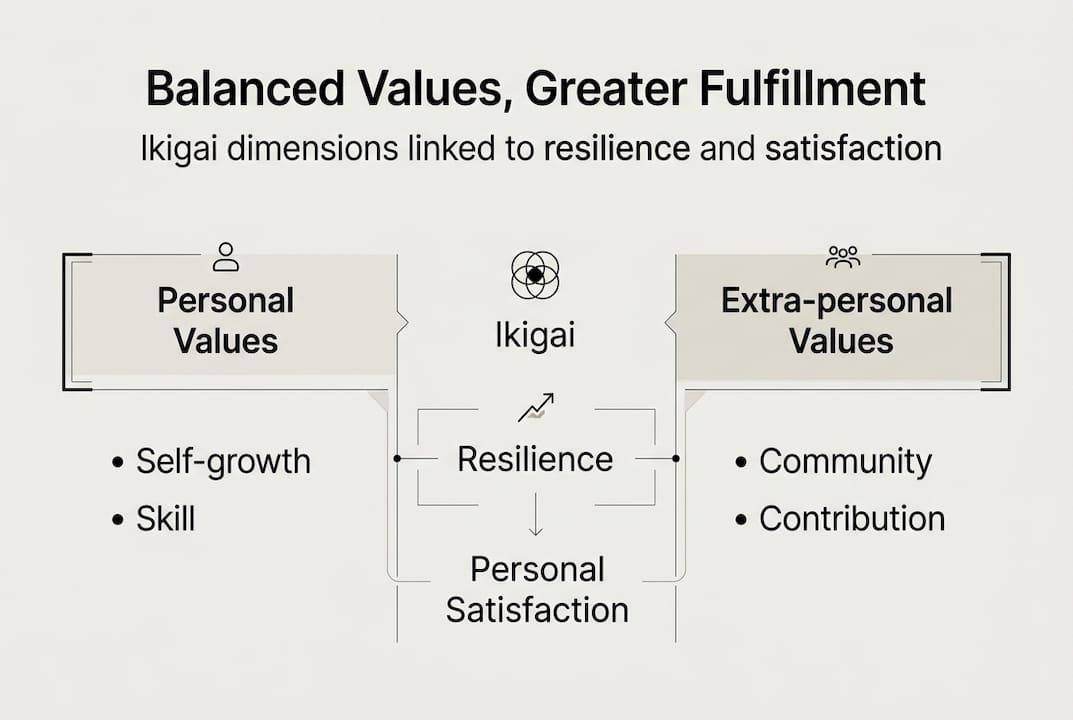
Even more striking: in Japan specifically, a stronger emphasis on extra-personal values was directly linked to higher life satisfaction. This reflects Japan’s deep communal traditions, where contribution to something larger than oneself is not a bonus but a core part of well-being.
| Value category | Focus area | Impact on resilience | Impact on satisfaction |
|---|---|---|---|
| Intrapersonal | Self-growth, health | Moderate positive | Moderate |
| Interpersonal | Relationships, family | Positive | High |
| Extra-personal | Community, society | High (Japan and US) | Very high (Japan) |
The implication for you is clear. If your value system is narrowly focused, say, entirely on personal achievement, you may be leaving resilience and satisfaction on the table. A balanced value portfolio, one that includes self, relationships, and community, creates a more stable foundation. Applying this insight to your career is especially powerful. See how ikigai at work can help you build a professional life grounded in all three value dimensions.
The takeaway is not that you need to abandon personal ambition. It is that weaving community-oriented values into your daily life appears to be one of the most evidence-backed paths to lasting satisfaction.
Practical steps: How to identify your core values (and keep them evolving)
Knowing that values matter is one thing. Actually uncovering yours is another. Here is a practical sequence you can follow today.
- Start with peak moments. Write down three to five experiences in your life when you felt most alive, proud, or deeply satisfied. Look for patterns. What was present in each one? Those patterns point directly to your values.
- Use contrast questions. Ask yourself: “What would make me feel like I had betrayed myself?” The answer reveals a value you hold deeply, often more clearly than positive prompts.
- Name and narrow. From your reflections, list ten candidate values. Then force yourself to cut the list to five. Ranking values creates clarity that a long list never can.
- Test against your calendar. Look at how you actually spent the last two weeks. Do your actions reflect your stated values? Gaps between the two are where alignment work begins.
- Schedule a quarterly review. Set a recurring reminder every three months to revisit your values list. Ask: have any shifted? Have new ones emerged? This keeps your values alive rather than archived.
Research confirms that values predict behavior only when you actively practice alignment, not simply when you identify them. A hierarchy of values on paper does not guarantee satisfaction. The daily practice of living them does.
The ikigai framework is a natural companion here. Use the four circles as a reflection tool, not just a career planning exercise. Ask yourself regularly which circle feels most neglected. That is usually where a value is being suppressed. True ikigai is about continual reflection and feeling daily purpose, not arriving at a final answer.
Pro Tip: Pair your values review with a simple journaling prompt: “What did I do today that felt genuinely like me?” Over time, the answers reveal which values are actually driving your life versus which ones are just aspirational.
For ongoing support, explore how to practice ikigai daily and why the ikigai method stands apart from generic self-help approaches.
Why most guides on values miss the point: A deeper, living approach
Here is what most values guides get wrong: they treat the exercise as a destination. You complete the worksheet, you have your list, and you file it away. Done. But that approach misses the entire point.
Western productivity culture tends to want values that are fixed, measurable, and optimizable. The problem is that a rigid values list can become just another form of self-imposed pressure, a standard you feel guilty for not meeting rather than a compass that actually guides you.
Japanese ikigai offers a fundamentally different model. The true Japanese ikigai is not a Venn diagram solved once. It is a daily felt sense, called ikigai-kan, that comes from small joys, not grand missions. Your values should work the same way. They should show up in how you greet the morning, what you choose to say yes to, and what you quietly let go.
The most fulfilled people we see engaging with this work are not those who found the perfect value list. They are the ones who stay curious about their values, who welcome the shifts, and who find meaning in the everyday moments of alignment. Explore what purpose of life really means when you stop chasing it and start living it.
Discover your ikigai: Next steps for deeper purpose
You now have a clear picture of what values are, why they evolve, and how Japanese philosophy turns them into a daily practice rather than a one-time exercise. The natural next step is to see where your own values and purpose intersect.

The ikigai type test at Ikigain.org is designed to help you do exactly that. It maps your core strengths, passions, and values onto a personalized ikigai profile, giving you concrete language for what drives you. You can also browse Japanese philosophy resources to deepen your understanding of the cultural roots behind these ideas, or explore the full range of ikigai personality types to see how your profile compares. This is where insight becomes direction.
Frequently asked questions
How do core values influence daily decision-making?
Core values act as internal guides, helping you choose actions and set priorities that feel truly meaningful. When you know your values, even difficult decisions become clearer because you have a reliable internal reference point.
Can your values change over time?
Yes, research and Japanese philosophy both confirm that values naturally evolve across life stages and experiences. Treating this evolution as normal rather than problematic is one of the most freeing shifts you can make.
Why does Japanese culture emphasize extra-personal values?
Community-focused values are directly tied to higher life satisfaction and resilience in Japan, reflecting a long tradition of finding meaning through contribution. The research on extra-personal value emphasis shows this is not just cultural preference but a measurable well-being advantage.
Is identifying values alone enough for fulfillment?
No. Fulfillment comes from actively aligning your daily actions with your values, not just naming them. Studies show that values predict behavior only through consistent practice, making alignment the real work.